In answer to this post, my brother-in-law points out three issues with Bridges. I don't think any of them make the setting unsuitable for a RPG.
First is that they ruin the First Law of Thermodynamics because energy can be created freely. My brother-in-law provides a somewhat complicated example. A simpler example I'll share here would be using a Bridge pair to make a continual waterfall and then powering a water wheel with this continual waterfall.
No big deal for RPG purposes. The Second Law of Thermodynamics is important, but many RPG settings ignore it. I can do the same.
Second, a wormhole allows time travel according to general relativity. The Wikipedia article refers to a way to escape the problems presented by this issue: potentially creating a "feedback loop of virtual particles". In other words, accelerating a Bridge to relativistic velocities simply means if you bring it back near its mate they both will break.
Third, any source of free energy makes it much easier to destroy planets. An asteroid or spaceship could be inexpensively accelerated to a high enough velocity to shatter a planet it impacts.
This should change the setting so life support systems are illegal. Anyone who has a spaceship with a life support system could fly it away from their planet, eventually turn around, and fly it back fast.
Also, it reinforces why BridgeCo needs to have hidden monitoring and "back doors" built into the Bridge network. Since Bridges can be used instead of life support systems, BridgeCo needs to know the location of all ships with Bridges on them. Similarly, if someone was to travel to an asteroid by Bridge, start accelerating the asteroid, and periodically return to adjust its course, BridgeCo needs to know.
It would also make sense that detection of asteroids has improved since real-life current capabilities, and that BridgeCo has a collection of previously-accelerated asteroids at the ready. If someone else does manage to try to "crack" an inhabited planet with an accelerated mass, there may be time for BridgeCo to pick one of its asteroids moving in an appropriate direction, transport it to the scene, and "crack" the aggressor first from a direction that sends the debris away from the threatened planet.
Monday, November 06, 2006
Sunday, November 05, 2006
Caffeine Table
Being a tea drinker, living among coffee drinkers, married to a biologist, I often get asked how much caffeine is in things. Since I only keep a rough ranking in my head, I'll blog the details here so in the future I can simply refer people to it.
Data comes from the Berkeley Wellness Letter, the Mayo Clinic Website, and the Stash Tea Catalog.
Except for the espresso, chocolate, and NoDoz, all values are typical for 12-ounce drink servings.
Data comes from the Berkeley Wellness Letter, the Mayo Clinic Website, and the Stash Tea Catalog.
Except for the espresso, chocolate, and NoDoz, all values are typical for 12-ounce drink servings.
- Herbal Tea: 0 mg
- Decaffeinated Tea: 1-8 mg
- Hot Cocoa: 8 mg
- Decaffeinated Coffee: 4-10 mg
- Milk Chocolate (4 oz.): 4-40 mg
- Dark Chocolate (4 oz.): 20-140 mg
- Soda: 22-55 mg
- White or Green Tea: 30-60 mg
- Oolong Tea: 50-100 mg
- Black Tea: 80-140 mg
- Energy Drinks: 75-160 mg
- Instant Coffee: 90-200 mg
- Espresso (4 oz.): 180-220 mg
- Drip Coffee: 160-300 mg
- NoDoz (2 pills): 200 mg

Saturday, November 04, 2006
Base Negative Ten
Apparently November 3rd was national cliché day.
Personally, I think there should be a day where we do all our arithmetic in base negative ten. That would be sweet.
(I don't know who first thought of base negative ten. I was introduced to it by Don. It works well with arithmetic once you get used to it.)
Personally, I think there should be a day where we do all our arithmetic in base negative ten. That would be sweet.
(I don't know who first thought of base negative ten. I was introduced to it by Don. It works well with arithmetic once you get used to it.)
Tao of Yeshua: Chapter 28
28
Knowing what is boastful but keeping to what is humble is being a watershed for all things.
As a watershed for all things, his experience makes virtue collect.
He is born again.
Knowing what is revealed but keeping to what is hidden is being a pattern for all things.
As a pattern for all things, his image makes virtue strong.
He returns to the infinite.
Knowing what is glorious but keeping to what does not shine is being a valley for all things.
As a valley for all things, his meekness makes virtue sufficient.
He returns to wholeness.
Vessels are carved from uncut wood by removing substance.
The Saint can use each vessel for its special purpose.
But great works do not require removing substance.
The humble accept the experiences that increase virtue.
The heavenly models how virtue is strong.
The meek can feel complete possessing only virtue.
Acquiring virtue from experiences is more valuable than acquiring skill.
The heavenly models how virtue is strong.
The meek can feel complete possessing only virtue.
Acquiring virtue from experiences is more valuable than acquiring skill.
Friday, November 03, 2006
The Sci-Fi Western
I only own two TV series on DVD: Kung Fu and Firefly. They are very different, but both fit the genre "Westerns".
The science-fiction setting I am planning for my role-playing game is also largely of the Western genre. So as I think about these two TV series I ponder what makes a Western a Western, but is still transferrable to a science-fiction setting.
Here is my list so far, presented somewhat in a cascading order of consequences:
This also sounds a lot like adventures in Edo-period Japan.
The science-fiction setting I am planning for my role-playing game is also largely of the Western genre. So as I think about these two TV series I ponder what makes a Western a Western, but is still transferrable to a science-fiction setting.
Here is my list so far, presented somewhat in a cascading order of consequences:
- The land around where people live is a "frontier" without governed settlements inhabited dangerous animals and people. Nevertheless, most settled locations have a few loners living on the outskirts due to temperment or profession.
- Most adults (or perhaps only adults of one gender/class) carry portable weapons, because of the frontier's dangers.
- Weapons technology is, at least temporarily, at a place where damage trumps armor (as opposed to knights clad in plate armor). Wounds from weapons are often fatal; a doctor near a conflict can only somtimes help the wounded.
- Society focuses on honor as much or more than law, because so many adults are armed with dangerous weapons.
- Big government exists, but does little, because it is annoying to big government to deal with an honor-focused, armed society. Most adults pay little in taxation and receive little in services. When big government is present it is often an interruption (installing a trade route, chasing a criminal, claiming a resource, etc.).
- Local government exists, mainly doing law enforcement. Without the power of big government to bring wealth redistributed from a non-frontier location there is not funding for local government to do much more that the basics. (Managing utilities, travel routes, and education may or may not be consider governmental basics.)
- Most adults belong to multi-family social groups to provide support in crisis situations (births and deaths, loss of home or livelihood, natural disasters, etc.). These social groups may be secular or religious; the various local groups may be peaceably cooperative or antagonistically competitive. Without government social services, people team up in other ways for protection from life's troubles.
- Corruption can control a settled location, because government is small and people are reliant upon social groups. If a social group grows into a dominating organization, it can often reign unchallenged.
- Heroes are often anti-heroes in that they remain personally troubled and/or unvirtuous but nonetheless able to save a settled location from local corruption or dangers invading from the frontier.
This also sounds a lot like adventures in Edo-period Japan.
Thursday, November 02, 2006
Portable Space-Time Wormholes and Their Applications
My last post mentioned that in my RPG's science-fiction setting there is a single impossible feature that makes the setting "science fiction" instead of "speculative futurism".
This feature is the existence of Bridges, which are portable "wormholes" in space-time.
In the game's setting, a company named BridgeCo invented these in 2020. The company kept their existence secret until 2070. During the intervening 50 years, BridgeCo has explored fairly thoroughly a sphere of radius 50 light-years, using unmanned factory ships that are self-replicating as well as creating a "bridge network" that links any notable planet or other resource. The gameplay happens during the following decade, as BridgeCo severs its ties with Earth, takes with it the Earth's bravest and brightest, and oversees the initial colonization of space.
Just because the game setting says so, Bridges work as follows:
UPDATE: The reason Bridges cannot rotate is to prevent them from being used within weapons. I don't want a small-looking gun magazine that holds a nearly inexhaustible supply of cartridges, a short-looking gun barrel that is actually a long rifle barrel, or a sword pommel from which springs a long blade.
This feature is the existence of Bridges, which are portable "wormholes" in space-time.
In the game's setting, a company named BridgeCo invented these in 2020. The company kept their existence secret until 2070. During the intervening 50 years, BridgeCo has explored fairly thoroughly a sphere of radius 50 light-years, using unmanned factory ships that are self-replicating as well as creating a "bridge network" that links any notable planet or other resource. The gameplay happens during the following decade, as BridgeCo severs its ties with Earth, takes with it the Earth's bravest and brightest, and oversees the initial colonization of space.
Just because the game setting says so, Bridges work as follows:
- They must be built as a "Bridge Pair": two closed, adjacent, matching loops of metal and circuity. Activating them requires a lot of energy, and destroys most of their internal parts.
- After activation the loops act as a portal with no space in between them. (The "back side" of each Bridge in the pair also is a portal, but usually this is covered over.)
- Activated Bridges are metal objects and fairly sturdy, but can be broken. If they break the portal closes. There is no release of energy when a Bridge is destroyed or its portal closed (big deal, you have filled in a hole of no depth).
- Activated Bridges can be translated in space-time, but not rotated. (For example, if a Bridge is facing down into a gravity well, such as face-down on a planet, you cannot pivot it upright.) Trying too hard to rotate a Bridge will break it.
- Bridges may be moved through Bridges. Some applications even involve "Bridge Stairs" in which a small Bridge is carried in a sphere that allows it to rotate, and out of this Bridge slides a very long, narrow, rectangular Bridge, and out of that slides a very long, square Bridge. (For example, a spherical locket can contain a system of three portals with the largest big enough to transport a spaceship.)
- Only BridgeCo knows how to build Bridges. The setting has alien races and alien technology, and all existing Bridges incorporate alien technology in ways that make reverse-engineering Bridges currently impossible to anyone outside of BridgeCo.
- Both BridgeCo and other people know how to make gravitational anomoly detectors, of which even portable models can accurately detect Bridges at a range of several miles.
- BridgeCo has access to more than enough physical resources, of any type, for everyone. Currency would be based on worker-hours, the only commodity of which BridgeCo has demand. Other companies and organizations would purchase vital resources from BridgeCo until they are part of self-sufficient colonies. Even after self-sufficiency has been achieved, except for specialty resources (i.e., a chemical derived from a plant or animal found only on a non-BridgeCo planet, pancake syrup made from the sap of your colony's special tree) there is no normal reason any resource would be sold for more or less than BridgeCo's price.
- For electrical power, build solar panels in orbit around a star, and run the output wires through a Bridge pair to where you need the electricity. The only disadvantages are that the star might act up, or a troublemaker with an electron telescope can detect your device from light years away.
- For mechanical power, activate a Bridge pair and then seal shut its portal in a manner that would destroy the Bridges to undo. Now it will conduct heat but not matter. Put one Bridge on an appropriately hot planet, or in an appropriately hot orbit. Put the other in the tank of a steam engine. As before, you have power until the distant Bridge is destroyed. This setup is only detectable by troublemakers at a range of several miles. (BridgeCo sells these in several standard sizes as "Eternal Engines".)
- If you want to travel planetside, use rotor-powered vehicles. Helicopters and fan-powered "cars" are both very practical if energy efficiency and fuel weight are not issues. Colonized planets in this setting would not have roads.
- To travel between a planet and its satellites, any fan-powered vehicle need simply be reasonably airtight, have multiple turbines, and use Bridges to at the entrance and exit of each turbine to direct airflow so there is a net push. (In space, a ship can move simply by being a paddle boat that carries its own river of air.) Bridges also mean that spaceships need not worry about life support systems or radiating heat.
- Few manned vehicles would be built capable of traveling between planets, let alone between solar systems. (Putting it another way, there would be many "shuttles" but very few "spaceships.)
- Bridge routes need monitoring and security. Planets would want all off-planet Bridge travel arriving at a hub before possible travel planetside. (Thus "ports" become way-stations on moons or space stations.) The concept of a "mega-store" is changed . (For example, except for security there is no longer a practical difference between a huge mega-store and a collection of smaller stores linked by a Bridge network. Thus large corporations have incentive to own and run a planet. Unless you live someplace that has local food for sale, why shop or work at a small, neighborhood market when MegaMarket is equally close and manages security for their own planet?)
- Unactivated Bridge pairs are potential weapons. Even by themselves they could be used to siphon away air or create a flood. Dropping a bomb (conventional or nuclear) through a Bridge pair would be a safe way to attack something, since the Bridges would be destroyed before too much of the explosion entered the attacker's side of the portal.
- Rumors that Bridges are physically thick because each Bridge is actually two Bridges (in other words, BridgeCo builds "back doors" into each Bridge) are, of course, completely false. (Wink, wink.)
UPDATE: The reason Bridges cannot rotate is to prevent them from being used within weapons. I don't want a small-looking gun magazine that holds a nearly inexhaustible supply of cartridges, a short-looking gun barrel that is actually a long rifle barrel, or a sword pommel from which springs a long blade.
Single-Fiction Science Fiction
I've decided to start blogging about the pen-and-paper role-playing game I'm designing. After all, one of the reasons I started blogging was to help process things I am thinking about.
To start out, I need to comment that we could measure how unrealistic any fictonal setting is by counting how many ways it is different from real life "just because". With this metric, only axioms are tallied, not their consequences.
For example, the Star Wars setting has, among other things, the force, lightsabers, faster-than-light travel and communication, and tractor beams. None of these are physically possible, and none are natural consequences of each other. In contrast, spaceships and aliens are futuristic but in a general sense physically possible.
Now, this is not a universally useful measure of how unrealistic a setting is. Fans of Firefly might ponder and/or appreciate how firearm technology has been almost stangnant for 500 years in that show's setting (in the year 2517 people are almost exclusively using today's guns). But my metric ignores this issue.
Nevertheless, for a role-playing game, this metric is very important.
The setting of a role-playing game needs to be intuitively understandable to the players, so they can estimate what are wise or foolish choices. This is different than settings for a novel or movie, in which some aspects of the setting can be left unexplained. In the Star Wars setting, those watching the movie do not need to understand how the force works because they do not need to make prudent decisions about when and how a character will use it.
One reason I am designing a role-playing game, as opposed to using a published one, is that the published games tend to be limiting in artificial ways that frustrate intelligent players.
Typically too many questions are unanswered, in one of two categories:
To keep the rulebook brief, the setting must be intuitive. To maximize this, I am designing a science-fiction setting with only one impossible feature (and its logical consequences).
To start out, I need to comment that we could measure how unrealistic any fictonal setting is by counting how many ways it is different from real life "just because". With this metric, only axioms are tallied, not their consequences.
For example, the Star Wars setting has, among other things, the force, lightsabers, faster-than-light travel and communication, and tractor beams. None of these are physically possible, and none are natural consequences of each other. In contrast, spaceships and aliens are futuristic but in a general sense physically possible.
Now, this is not a universally useful measure of how unrealistic a setting is. Fans of Firefly might ponder and/or appreciate how firearm technology has been almost stangnant for 500 years in that show's setting (in the year 2517 people are almost exclusively using today's guns). But my metric ignores this issue.
Nevertheless, for a role-playing game, this metric is very important.
The setting of a role-playing game needs to be intuitively understandable to the players, so they can estimate what are wise or foolish choices. This is different than settings for a novel or movie, in which some aspects of the setting can be left unexplained. In the Star Wars setting, those watching the movie do not need to understand how the force works because they do not need to make prudent decisions about when and how a character will use it.
One reason I am designing a role-playing game, as opposed to using a published one, is that the published games tend to be limiting in artificial ways that frustrate intelligent players.
Typically too many questions are unanswered, in one of two categories:
- The game setting does not allow characters to even attempt to use various skills or objects. Or the game setting is that flexible, but the game mechanics do not specify what happens when skills or objects are used in unexpected ways. (For example, there are poisonous plants but the game's setting or mechanics does not allow making poisons out of them.)
- Something (the force, laser weapons, magic, super-powers, etc.) works according to a rather haphazard collection of rules. It is impossible to modify these rules, even in ways the rules would find self-consistent. (For example, laser pistols must be getting a lot of energy from some sort of battery, but the game's setting or mechanics does not allow dismantling laser pistols to make use of their batteries, nor equipping the laser pistols with high-powered tactical spotlights.)
To keep the rulebook brief, the setting must be intuitive. To maximize this, I am designing a science-fiction setting with only one impossible feature (and its logical consequences).
The Skies are Bluer with a Stellated Icosahedron
Today I am very tired, because last night Eugene's weekly Wednesday night swing dancing was a special treat.
Normally there is no live music. Last night The Blue Skies Big Band, a local 20-piece swing band, played for two hours, and the dancing went on an extra hour after they stopped at 11pm. Also, a series of free lessons for "non-beginners" started up.
So I danced from 7pm until midnight. After arriving at home I had too much energy to fall asleep quickly, and wound up awake until 2am. I get up at 6am on Thursdays. So I'm tired today.
(Many of my math students were tired yesterday morning, because of partying the night before for Halloween. Today I started class by joking that now it was my turn to be tired, and my night-before party was more fun than theirs.)
Thus I postponed some grading this afternoon, and folded a stellated icosohedon. It was a relaxing and pleasant activity. Big and clear directions are here. I leave out "step 4" since this is how I learned to do this as a kid, it's faster, and it makes a sturdier construction.
Of course, some people are even fancier.
Normally there is no live music. Last night The Blue Skies Big Band, a local 20-piece swing band, played for two hours, and the dancing went on an extra hour after they stopped at 11pm. Also, a series of free lessons for "non-beginners" started up.
So I danced from 7pm until midnight. After arriving at home I had too much energy to fall asleep quickly, and wound up awake until 2am. I get up at 6am on Thursdays. So I'm tired today.
(Many of my math students were tired yesterday morning, because of partying the night before for Halloween. Today I started class by joking that now it was my turn to be tired, and my night-before party was more fun than theirs.)

Thus I postponed some grading this afternoon, and folded a stellated icosohedon. It was a relaxing and pleasant activity. Big and clear directions are here. I leave out "step 4" since this is how I learned to do this as a kid, it's faster, and it makes a sturdier construction.
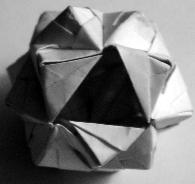
Of course, some people are even fancier.
Monday, October 30, 2006
Pressing and Blessing
An observation by Jonathan Cahn:
Yeshua gave blessings just before departing. He did this before dying (Luke 23:34), and later before ascending (Luke 24:50-51).
An an aside, he also said blessings at other typical times, such as before eating (many verses) or when greeting (Mark 10:16).
Saying blessings before departing can be hard to do, even if you are not being brutally killed. Yeshua got the strength and perspective to do so by praying at Gethsemane. In Hebrew this place is Got Shemen, "press of olive oils". In a place where olives were pressed and changed, Yeshua was pressed and changed.
Sometimes we have difficulty in departing from things. To move on from today, from a hurt, from a destructive friendship, etc., we must first, in prayer, experience pressing and blessing. Once we know how God wants us to pray about it and we intercede for it, then we can move on.
Sunday, October 29, 2006
Skype
My sister called today, and introduced me to the Skype webcam conversation software.
Very nice: free software, harmless EULA, easy to install, simple to use. I got to see my neice make faces. She got to see our lovebirds.
It does use more memory than Trillian when waiting in the background, but it loads much quicker, and I have more RAM than tolerance for slow-loading software.
Very nice: free software, harmless EULA, easy to install, simple to use. I got to see my neice make faces. She got to see our lovebirds.
It does use more memory than Trillian when waiting in the background, but it loads much quicker, and I have more RAM than tolerance for slow-loading software.
Dangerous Yard Work
Well, yard work is mostly done. I raked most of the back lawn, and the roof. I cleaned the back gutter while on the roof. Doing chores on the roof is fun.
A bunch of old "shooters" cut from our apple tree had worked well as a sukkah roof, but their usefulness was over. Using my cute little chainsaw I cut them into bits and put them in the yard waste bin.
To paraphrase Rita Rudner, it's amazing what a guy will happily do if danger is involved.
A bunch of old "shooters" cut from our apple tree had worked well as a sukkah roof, but their usefulness was over. Using my cute little chainsaw I cut them into bits and put them in the yard waste bin.
To paraphrase Rita Rudner, it's amazing what a guy will happily do if danger is involved.
Picture of the Day
Okay, time to go do yard work.
In parting silliness, I'll say that pictures of people holding cute pets are fun. But I think today's picture of the day is the kid-friendly Cthulhu license plate.
In parting silliness, I'll say that pictures of people holding cute pets are fun. But I think today's picture of the day is the kid-friendly Cthulhu license plate.


Fourfold Renewing the Mind
It's been a while since I wrote about anything related to ministry work. I actually have a pile of articles and notes with neat spiritual things to blog about. But none of these ideas are ones I need to process more. So they wait for when I have a better block of free time.
Yesterday's sermon and its subsequent discussion are worthy of more processing, however. Here is a summary.
First, our conscience is restored. The Apostles write a few times about how people are given pure consciences by God but can then distort their consciences until they find evil acceptable. God's Spirit within us renews our consciences to their intended purity. (The Biblical Greek work for "conscience" is suneidesis. There is no Biblical Hebrew equivalent.)
The author of Hebrews uses suneidesis to mean something else: our mental paradigms, our understandings of the world that guide how we think and act. In Biblical Hebrew these are collectively called yetzer and the sages write about the "good yetzer" and the "evil yetzer" that argue within us. The author of Hebrew also uses those phrases, and in verse 10:22 explains that faith in Yeshua's sacrifice that grants us forgiveness of sin will remove the "evil yetzer" from our minds.
So a second way our minds are renewed is when our evil paradigms are removed. (Ephesians 2:3 emphasizes that this is different from being enslaved to sin through "the flesh").
Other authors of the Apostolic Writings instead use the Greek word dianoia and its conjugations when referring to the yetzer. They even include this work in the Greatest Commandment, which is surprising to a modern Jewish reader: compare Deuteronomy 6:5 (ending in 'muchness') to Matthew 22:37 and its parallel verses (ending in 'paradigms/understandings').
(The author of Hebrews also uses dianoia when not contrasting the good and evil yetzer. Compare Jeremiah's prophecy of the New Covenant in Jeremiah 31:32(33) and its restatement in Hebrews 8:10 and 10:16: Besides our hearts, God's ways (his torah: teachings) are put on our 'inward parts' in Jeremiah, specified as our 'paradigms/understandings' in Hebrews.)
Third, the indwelling Spirit of God grants our minds strength and protection. In First Corinthians 10:13, Paul writes that God will arrange circumstances so that followers of Yeshua (while following God's plans) are never tempted by more than they can resist or avoid.
Fourth, God shares with us his some of his plans. Not only do we have better thoughts, but we can even know what God wants us to think about and do.
Yesterday's sermon and its subsequent discussion are worthy of more processing, however. Here is a summary.
Do not be conformed to This World, but be transformed by the renewing of your mind, so that you may discern what is the good and acceptable and complete will of God. - Romans 12:2How does the God's Spirit within us renew our minds? Let's consider four ways. We should be aware of each, to be grateful and cooperating with God in its progress.
First, our conscience is restored. The Apostles write a few times about how people are given pure consciences by God but can then distort their consciences until they find evil acceptable. God's Spirit within us renews our consciences to their intended purity. (The Biblical Greek work for "conscience" is suneidesis. There is no Biblical Hebrew equivalent.)
The author of Hebrews uses suneidesis to mean something else: our mental paradigms, our understandings of the world that guide how we think and act. In Biblical Hebrew these are collectively called yetzer and the sages write about the "good yetzer" and the "evil yetzer" that argue within us. The author of Hebrew also uses those phrases, and in verse 10:22 explains that faith in Yeshua's sacrifice that grants us forgiveness of sin will remove the "evil yetzer" from our minds.
So a second way our minds are renewed is when our evil paradigms are removed. (Ephesians 2:3 emphasizes that this is different from being enslaved to sin through "the flesh").
Other authors of the Apostolic Writings instead use the Greek word dianoia and its conjugations when referring to the yetzer. They even include this work in the Greatest Commandment, which is surprising to a modern Jewish reader: compare Deuteronomy 6:5 (ending in 'muchness') to Matthew 22:37 and its parallel verses (ending in 'paradigms/understandings').
(The author of Hebrews also uses dianoia when not contrasting the good and evil yetzer. Compare Jeremiah's prophecy of the New Covenant in Jeremiah 31:32(33) and its restatement in Hebrews 8:10 and 10:16: Besides our hearts, God's ways (his torah: teachings) are put on our 'inward parts' in Jeremiah, specified as our 'paradigms/understandings' in Hebrews.)
Third, the indwelling Spirit of God grants our minds strength and protection. In First Corinthians 10:13, Paul writes that God will arrange circumstances so that followers of Yeshua (while following God's plans) are never tempted by more than they can resist or avoid.
Fourth, God shares with us his some of his plans. Not only do we have better thoughts, but we can even know what God wants us to think about and do.
Tao of Yeshua: Chapter 27
27
A skillful traveler need not follow the wheel-ruts.
A skillful speaker need not offer blame or praise.
A skillful accountant needs no counting-tallies.
A skillful locksmith need not use bar or bolt to make a door impossible to open.
A skillful binder need not use twine or knot to make a bundle impossible to unwrap.
The Saint is thus considered always skilled at saving men, for he need not reject any man.
He is always skilled at saving things, for he need not reject any thing.
This is called a twofold understanding.
Thus this good man is the master of all men who are not good, and these not good men are the material for his goodness.
However wise one may be it is a great error to not value one's master, or to waste one's potential as material.
This is called the chief wonder.
The skilled are not constrained to only work with optimal materials.
Yeshua can bring salvation to anyone who truly repents,
no matter how evil their heart they can escape slavery to sinfulness.
Do not consider yourself too wicked for Yeshua to save!
This is an insult to Yeshua's ability to turn wickedness into goodness.
Do not consider yourself too weak for God to use!
This is an insult to God's ability to show his strength through your weakness.
Share with all people Yeshua's offers of salvation and strength.
An Expensive War
No real point to this, just a mathematician being distracted by numbers.
During his 23 years ruling Iraq, Saddam killed about a million people. That is about 44,000 people per year.
The highest estimates and countings of deaths since the March 2003 U.S. invasion total about 50,000 people. That is about 21,000 people per year.
So the U.S. invasion, compared to Saddam's reign, is "saving" about 23,000 lives per year. That is the good news.
The U.S. invasion has cost about 500 billion dollars. That means it costs about 9 million dollars for each life "saved".
Is that a worthwhile use of money? Saving lives is a noble endeavor, but that is not an efficient use of U.S. Taxpayer money to save lives in another country. Once we are looking beyond our own borders, there are plenty of health and policy issues that could save many more lives with such a vast sum of money.
For the other side of the argument, assume that if the U.S. had not done its invasion then terrorists would have nuked all of New York City by now. By this scenario the U.S. invasion has prevented an additional 8 million deaths, reducing the cost to $62,000 per person "saved".
Not even considering the extra "collective damage" of New York City vanishing, many Americans spend that much on their own health (especially over three or four years) to stay alive. We could still be saving more lives per billion dollars globally, but as a domestic issue this becomes defendable.
In reality, the war has prevented some domestic terrorism but probably not the total eradication of New York City. The actual efficiency of our war dollars per life saved is thus, of course, somewhere between the two above extremes.
And, of course, saving lives is not the only issue. But you were warned there was no real point to this post.
For another interesting analysis of numbers in Iraq, see Eye of the Beholder by Victor Davis Hanson.
Thursday, October 26, 2006
Three Completions
Today has been a rewarding day. I got a lot done, including making up math quizzes for the next few weeks and math PowerPoint slides for next week.
Especially nice was getting three things completed.
I have been busy working on an update of the congregation's prayerbook. Today I finished that project. (This Shabbat everyone will look at the draft and make comments, and then a final draft will be made.)
In my Tai Chi class, we finished learning the Chen 18-move short form. Of course I still must practice a lot to achieve any degree of proficiency, but I know how to do the entire form.
For a long time I was not able to make time to do Tao Te Ching translations at night. Tonight I got three more chapters done, up through chapter 36. This completes "Book One", the first half.
I am grateful to God for energy today! It surely was not from getting enough sleep. When I got home from LCC I thought I might need a nap, but I was able to get a lot more work done.
Now it's time to stop being on the computer and spend time my wife as she is processing garden basil in the kitchen.
Tao of Yeshua: Chapter 26
26
Heaviness is the root of lightness. Stillness is the master of restlessness.
Therefore the Saint travels all day with his wagon, quiet and at ease although there are magnificent views.
Why should a lord of ten thousand chariots react with lightness to all things?
If he conducts himself lightly he will lose his root. If he is restless he will lose his self-mastery.
Our eternal life is grounded in Yeshua.
We should act from this foundation, not react to circumstance.
If we are easily swayed or double-minded,
we will become less connected to Yeshua,
and lose our self-control.
We should act from this foundation, not react to circumstance.
If we are easily swayed or double-minded,
we will become less connected to Yeshua,
and lose our self-control.
Sayings to Ponder
I read a silly saying today, which I later found out was from the comic A Softer World (which I've never read, so I'm not sure if it is safe to link to):
Speaking of sayings that make you think about spirituality, how about Zen Koans as shared by a ninja? Chasidic Judaism also has a vast collection of short parables made from events in the lives of its famous practitioners, but unfortunately I don't have links to any. Nor do I know of any compilations shared by Jewish ninjas.
"I was so sure my search would end when I found God, but then I could not find my car keys and my cat ran away."One of my congregants is struggling to be at peace with God while having worries about her cats, so this was particularly timely.
Speaking of sayings that make you think about spirituality, how about Zen Koans as shared by a ninja? Chasidic Judaism also has a vast collection of short parables made from events in the lives of its famous practitioners, but unfortunately I don't have links to any. Nor do I know of any compilations shared by Jewish ninjas.


Skateboarding Progress
I mentioned earlier that my week is a little less hectic, now that the term has started and Fall's Jewish holidays are over.
One benefit is that I can schedule my time to do all my grading on campus. Since I do not need to bring papers home and back, I do not need to carry my satchel (a simple yet sturdy little Ikea bag).
I've found that the lack of a satchel means I can do skateboard wheelies (a "manual" in skater jargon) while commuting to and from the bus stop. Even if I'm new to this and my wheelies are very quick, this is fun and also allows me to get over a few uneven places in the sidewalk. Of course, I fall off more as I try the wheelies, but at my slow commuting speed those "falls" are actually "run forwards" and no big deal.
I still can't ollie.
Adobe Acrobat Annoyance
My math teaching now has me editing PDF files (post-lecture Starboard notes). I had forgotten how stupid Adobe Acrobat can be.
My latest problem was trying to break a large file (8.09 MB) into two smaller files so students using a phone line modem could download them more flexibly. But when I copy the file twice, and remove half the content from each copy, Acrobat saves the resulting files as bigger files!
Sigh. I've made a recommendation to the Math department that they get Foxit instead of Acrobat.
UPDATE: In January 2011 someone sent me an e-mail request to advertise Classic PDF Edtior as well as Foxit. It's probably from someone associated with that software, but it was politely worded to I have added the link. Know that I have not myself tried it, however.
Subscribe to:
Posts (Atom)