Sunday, April 02, 2006

John 11:4

So, building of two earlier posts, you may ask what is an example of how God currently treats us more as a disciple (to whom teaching is focal) than a spouse (to whom intimacy is primary)?

Consider John 11:4, a verse seldom discussed but deeply troubling.
But when Yeshua heard it, he said, "This sickness is not to death, but for the glory of God, that God's Son may be glorified by it."
First, a point of terminology: the verb "glorify" was adapted vocabulary which the apostles used differently, and different from its usual Greek meaning. When John uses the word it's always about public exaltation. (By Paul's use of the term you can glorify God while alone in a room, but not by John's.)

Second, realize the context: that El'azar (Lazarus ) had just died. In order for the death (and thus the resurrection) to be irrefutable, Yeshua purposefully delayed in traveling to that town. El'azar's relatives are in deep and grievous mourning, and his daughters are now unmarried and fatherless and thus also in financial trouble.

Yeshua says that all that family's pain and anguish is acceptable to God for the chance at publicly exalting the Father and Yeshua.

Note that Yeshua does not add, at that time, that he will raise El'azar and the family's pain and anguish will be replaced by joy and celebration. He could have said that, but he didn't. That was a secondary issue. Apparently the family's suffering would be worthwhile to God even if they were not about to have their suffering reversed, just because it created an opportunity to publicly exalt the Father and Yeshua.

More personally, if we are also followers of Yeshua in This World then our suffering is also not something Adonai minds if he can use it to be glorified.

More simply: suffering we learn from is valued by God.

That's how you treat a disciple, not how you treat your spouse.

Timeline

"1996 - Instant messaging created as a way for people all over the world to interrupt each other."
Beautiful!

(Spring term begins tomorrow. I'm trying something new: providing my instant messaging addresses to my math students. Hopefully I will not be put in the awkward situation of having to "ban" one of my own students for being rudely and unreasonably verbose.)

Personal Relationship

In February I wrote about being a disciple of Yeshua. A recent post at "Out of Ur", the blog associated with the Christian magazine Discipleship, asks whether having a personal relationship with Yeshua is scriptural.

Of course it is! But the personal relationship is currently that of master and disciple, more than that of groom and bride. The problems the other article mentions come from focusing on intimacy with Yeshua, which is currently quite possible but should not yet be the focus of the relationship.

Saturday, April 01, 2006

Carcassonne

Yesterday my wife and and I went downtown to visit a certain store, only to find that a lack of staff made it closed! Since we had already put some quarters in the parking meter, we decided to visit some other stores we had not ever been inside.

At one of them we bought a new board game, Carcassonne. We also got an expansion set. (Prices were much less expensive that at these links!)

We've now played the game four times, twice with friends and twice just the two of us. It's very fun and certainly recommendable.

We have not tried the expansion yet. It will change the game a lot.

The basic game is a "building" game where you are putting together a map and claiming which "features" on the map you are investing in making big. There is very little direct competition among players, since placed map pieces cannot be removed (or moved) and bids cannot be withdrawn. Also, it takes notable luck and skill to have a bidding war over a particular map "feature".

The expansion allows a player (again with some luck and skill) to remove their own or opponent's bids. Thus you can perhaps withdraw your bid on a "feature" that turned out to have low potential, or remove an opponent's bid on a high-potential "feature". Until we have tried it, we're not sure if this will make the game more fun or ruin it.

UPDATE: We've now tested the expansion in a four-player game, and it was helpful. The main effect relates to how the game starts with a the map divided into two halves by a road, and the first players to start farming on either half typically have an advantage. The expansion removes the likelihood that early farming will be worthwhile, thus making the game more fair to the players who do not move first or second.

UPDATE: The rules (or perhaps their translation into English) have a couple vague points. While searching for clarification online, I found out the game has a blog!

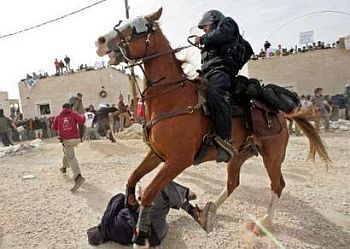
Habakuk and Amona

This one is for a friend. She does not have a computer, or know about blogging or searching online for images. But if she did, she would have created this after she noted how Habakuk 1:2-11 reminded her of recent events at Amona. So I will make it for her.
Adonai, how long will I cry, and you will not hear? I cry out to you "Violence!" and will you not save?

Why do you show me iniquity, and look at perversity? For destruction and violence are before me. There is strife, and contention rises up.

Therefore the law is paralyzed, and justice never goes forth; for the wicked surround the righteous; therefore justice goes forth perverted.

"Look among the nations, watch, and wonder marvelously; for I am working a work in your days, which you will not believe though it is told you.

For, behold, I raise up the Chaldeans, that bitter and hasty nation, that march through the breadth of the earth, to possess dwelling places that are not theirs.

They are feared and dreaded. Their judgment and their dignity proceed from themselves.

Their horses also are swifter than leopards, and are more fierce than the evening wolves. Their horsemen press proudly on. Yes, their horsemen come from afar. They fly as an eagle that hurries to devour.

All of them come for violence. Their hordes face the desert. He gathers prisoners like sand.

Yes, he scoffs at kings, and princes are a derision to him. He laughs at every stronghold, for he builds up an earthen ramp, and takes it.

Then he sweeps by like the wind, and goes on. He is indeed guilty, whose strength is his god."
My commentary:

What happened at Amona was about politics and age. Those Israelis who were forced from their homes in Gaza last August were promised much governmental help from the government which was not provided. The people of Amona knew they would not be receiving assistance in restarting their lives. The current (older) political leadership has been pursuing "unilateral disengagement" and the younger side of Israeli has been protesting that this policy is fruitless and hurting Israel. The polically active youth of Israel came to Amona to protest more than this one forced evacuation.

This generational divide was already heated and intense. It became so physically violent at Amona because here were protestors and police who were full of anger before the conflict began.

Last year, Israelis (and Jews worldwide) wondered if the Gaza pullout would provoke a civil war. The abundance of promises to those who lived in Gaza kept the nation from that, but at Amona the divide was again made visible.

Spring is Here

It's odd how different life is with Springtime.

Two weeks ago, seeing the thermostat read a current temperature of 62 would seem cold: time to put on a sweater or light the fire. Now that seems an okay temperature for just a long sleeve shirt.

I'm doing yard work and enjoying it.

I'm wanting to exercise more. My fondness for corny martial arts movies (which inspire me to get in shape) has returned.

I'm playing Go before bedtime on my Palm, after not playing for months. Yesterday night I even visited the Go Teaching Ladder to download two commented games to use as bedtime stories.

I'm less interested in political absurities, and even really annoying political things (see updates here) or societal issues that in colder times would instill quite an urge to discuss them with someone.

Computer Anonymity

Some of my friends think I'm a bit paranoid in my internet use because I avoid putting my e-mail address as a link that spambots would find. I don't spend time worrying or testing. I don't think I do any of these things except check for "https" on webpages with financial transactions and using free software to periodically check for adware.

But it's interesting what can be done, if I was actually paranoid.

UPDATE: Hm. Perhaps I should change some of my passwords. Eight letters takes a single modern computer only a short time to figure out!

Rhododendrons

Earlier this week, a friend taught me how to trim our rhododendrons. This turned out to be a lot of fun.

I'm not much of a gardener. I don't find most gardening enjoyable or relaxing, and the plants often don't find my efforts helpful.

But trimming rhododendrons is quite foolproof. The plants have potential branches all over, and many bifurcations. Thus I do not need to worry about finding a node to cut just beyond, nor the angle of the cut. I just cut off dead branches past the fork they originate at. And the dead branches are usually dried and come off readily, like a berry ripe for picking.

Also, in the back yard my nemeiss is sticks. We have a push mower, which can be clogged by even small twigs. I spend a lot of time picking up sticks from the lawn. Normally the last thing I want to do is produce more sticks for our yard waste bin. But rhododendrons like having their toes in a thick layer of leaves and pieces of twigs, so all I have to do while trimming them is use the pruners to cut the pruned branches into small pieces. That's quick and easy.

It's also true that the yard's spiders have not woken up from winter yet. We get lots of spiders in the summer. They are small and harmless, but their webs can be annoying. So it was nice to not have to swat webs out of the way before climbing into the rhododendrons. (The squirrels are back, but they're not a big deal. We have live traps.)

Finally and best, a rhododendron with its dead branches removed is more hollow inside. Since the rhododendrons are taller than I am, the result is large enough to stand in comfortably -- or for some of the rhododendrons, even climb around inside. As a child I used to love bushes that were "forts". Now I get to make lots of them! However, eating lunch inside one wasn't as innately entertaining as I remembered.

Spring Break

Last week was Spring Break. Apparently I did not do any blogging...

Actually, I noticed this on Wednesday, and it was part of a larger trend/mood. I am not sure why, but my psyche reacted to being on Spring Break by really not wanting to create anything.

I did gardening, cleaned up the house, and was productive but only in non-creative ways. I mostly read books, watched movies, went biking, went swing dancing, and spent time with friends. I did taxes without going into hiding.

I had expected to do many creative things: blogging, catch up on e-mails, work on the P'nei Adonai website, work more on preparing for my upcoming Math 20 classes, baking, finish making the new role-playing game to play with my wife. But those were the last things I was in the mood for.

Interesting... Well, apologies for being out of touch.

Sunday, March 19, 2006

OpenSource for Everything

Odd how many of these I am currently using...

(I differ for IM, using Trillian for Windows and Fire for Mac. The alternatives recommented by the above link may indeed by superior, but I can't imagine how. Trillian even has ultra-cool variable semi-transparency for its windows.)

UPDATE: I realized these websites do not list free Bible software. If you use Windows, e-sword is not Open Source, but it's free and as good as anything that costs money.

Countering Islamic Propaganda

As long as I'm discussing propaganda, there's this article that does de-bunking. Someone made a list of "Top 20 Musim Inventions", but only 10 really are...

UPDATE: The above link has gone bad; now its content is here. However, an even more thorough debunking of all 20 claims has been written by Jay.Mac here.

Countering Palestinian Propaganda

For a long time I've been looking for a thorough and well-written rebuttal of the Palestinian Authority's rewriting of history that has somehow become accepted as truth by so much of the media.

I finally found one! Big Lies, a 36-page PDF file written by David Meir-Levi and distributed by Front Page Magazine.

UPDATE: Today the Jerusalem Post had a related article about the URWA, which references this older article for context.

UPDATE: In yet another timely application, folks from the American Thinker and Martin Kramer debunk an essay from Harvard’s Kennedy School of Government (full version here).

Festivals of Fire and Ice

A quick comparison of Iran in March 2006, Harbin in January 2005, London in February 2006, and a cartoon about dalmations (to no overall point, they just fit the poem).

(With apologies to Robert Frost)

Some say the world will end in fire,
Some say in ice.
From what I've tasted of desire
I hold with those who favor fire.
But if it had to perish twice,
I think I know enough of hate
To know that for destruction ice
Is also great
And would suffice.

Whole Foods

In Eugene, a big local issue is the impending arrival of a Whole Foods store.

And the people who argue (quite reasonably) that we already have plenty of local and small "health food" grocery options are quite upset, even without having read the recent report on the Whole Foods chain by Slate!

Thursday, March 16, 2006

Imperial March with DJ Effects

This is for Mr. Clark, to finish up a conversation at the swing dance last night...

Behold, the mildly entertaining Star Wars Imperial March with DJ effects.

Pedometer Update

I wore the pedometer yesterday, as a test for a day when my wife and I go swing dancing in the evening and I bicycled to and from work. Well over 20,000 steps, by enough to excuse a large numer of false counts. Yay!

(Note that swing dancing, with its many quick triple-steps to fast music, is a somewhat unfair way of accumulating steps. Walking or bicycling up a steep hill is far more work per step than a small shift of weight on the dance floor. But it's still fun to find out that I might do 20,000 of anything during a day.)

UPDATE: Thursday was a stay-at-home day. I don't get nearly 10,000 steps when I am at the computer and doing a few household chores. Friday and Saturday were non-bicycling days but with (very different kinds of) real work happening, and those both coincidentally turned out to have near 10,000 steps.

Tuesday, March 14, 2006

What Money is Useful For

I've never heard a sermon on Luke 16:9, in which Yeshua advises his followers to use their money to "buy friends".
And I say to you, make friends for yourselves by means of the wealth of unrighteousness, so that when it fails, they will receive you into the eternal dwellings.
It seems a bit uncouth. Not devious, but base.

I realize that my paraphrase of "buying friends" puts a biased slant on the issue.  Yeshua is partly discussing a practical strategy for a society without insurance policies: when you have money be generous to your friends who do not have much, so that when your circumstances switch they might reciprocate.

One evening last week, my wife and I had a long conversation about people's spending habits. Towards the end of this conversation we wondered if people could be categorized as those who valued money for the security it can provide (the people who save unbudgeted money) and those who valued money for the comforts it can provide (the people who spend unbudgeted money).

This was a somewhat amusing dichotomy, for money really does not do either of those well. It can provide some security, but savings can quickly vanish and many kinds of troubles cannot be fixed with money. It can provide some comforts, but real lasting contentment cannot be purchased -- those who try always desire buying yet more things.

The two things that Yeshua suggests people do with money (give to charity and buy friends) are at least things that money does do well. Those who need food or clothing can be fed and clothed. And people to whom you have been generous often help you in your times of need.

UPDATE: Proverbs 17:8, 13, 23 add more practical advice. A gift (not a "bribe", as is sometimes translated) can be precious in the eyes of the giver if used to help him prosper. But do not use gifts to reward evil, or the evil will worsen. And do not give gifts in secret, for then it perverts justice (i.e., it becomes a bribe).

A Temporary King

In First Corinthians 10:24-25 we read that Yeshua is only temporarily the King of the Kingdom of God. In the World to Come, after Yeshua's enemies have been humbled, he will deliver that role of Kingship to God the Father.

Is there a name for someone who is temporarily a king in this manner?

I know of some similar ideas, such as regent: an heir of the king who is given the reign "early" before the old king dies, or a person who rules until a young king reaches adulthood. But the duration of a regent's reign is dependent upon the status of the otherwise proper king. Yeshua has a reign whose duration is dependent upon a mission's completion.

Sunday, March 12, 2006

Confused about Boasting (2nd Corinthians)

My sermon for last Shabbat focused on the difference between three types of sub-cultures. I put an overview chart online here. (I'm not quite sure how to make a good congregational web page out of this material.)

The sermon was about how we all participate in all of these types of subcultures, and the Good News applies to all of them but in different ways (although it always proclaims, "You need not work for what the culture primarily values, for God is freely giving this to you!").

For example, I grew up in a family that was very much an "individual responsibility" culture of innocence and guilt, am now living in a liberal city with the politics of a "greater good" culture of virtue, and work in an academic department that values my work based on an "esteem culture" of honor and shame.

(The last point might need some clarifying. In all academic departments I have known, including the math department at LCC, instructors receive very little peer review or oversight. I am valued by the department because of positive student feedback each term and because I participate intelligently in faculty discussion of pedagogy. In other words, people have heard I am good at what I do and yet I am still trying to improve. But how well I actually teach is not measured, either by virtue (do my students go on to be successful in more math?) or by guilt (do I actually cover 100% of the material I am responsible for teaching?). I trust I would measure well if I was measured in these ways, but it doesn't happen.)

As an example of a theological idea from the sermon that was new to most people, grace is actually technical term in the honor-shame suculture of the Roman Empire that included first-century Judaism. A ruler had "grace", which meant he was part of the family of the gods, and was thus above all normal human striving for honor; he should instead only focus on giving honor to others, and on helping the gods govern and care for people. There are clear parallels to all of these points in the Good News.

A point I did not make in the sermon was that boasting is also a technical thing in an honor-shame culture. It is the most gentle form of an honor challenge. People do not challenge someone who is socially inferior (that would be a shameful and bragging waste of time) or who is socially superior (that would be presumptuous and also shameful). So the smallest type of honor challenge -- the simplest way to try to gain honor -- is to boast to a peer.

As a contemporary example, if I said to another LCC math teacher, "All of my students who are failing are coming to my office hours," that could be an attempt to gain honor. (As an aside, it's not true, sadly. I have some math students who are failing but not seeking help!) My boast would be implying that I am so approachable and helpful that everyone who needs my help is seeking it out. The other teacher would then respond by either giving me honor ("That's great!") or by trying to match or exceed my boast ("Same here! And Bob's students come to my office hours too!").

Anyway, I just re-read Second Corinthians and that letter is full of stuff about boasting. Paul does not seem to be entirely self-consistent in his talk about how to boast properly and what he is boasting about. I'd like to understand it better in terms of the honor-shame dynamic, but need some help.

UPDATE: More here, including the idea that the Greek term is "glory", not "grace".

Anti-Semitic Cartoons

The furor over the Danish Cartoons has led to a new and Israeli contest to create anti-Semitic cartoons.

It is a healthy thing to be able to laugh at yourself. And it is a timely moment to affirm that other peoples' lies do not, in and of themselves, hurt you.

I found none of the Israeli cartoons as purely spiteful as some of the real thing, but many were funnier.

Dance-and-Juggle

Someone shared this video (from Google Video) of a very skilled juggler who times his routine with a piece music that has varied tempo and "hits". As someone who swing dances and also tries to do something interesting on the "hits" of the music I found it a remarkable show.

A Test of Habits

Some people are experimenting with using a mouse for web surfing but without using the mouse button. It's a fun site to play around with for a few minutes: Don't Click It!

Tuesday, March 07, 2006

Subdivision of GPA

Many math department faculty at LCC are into discussing pedagogy and other aspects of being effective as instructors and as a department. (This is part of what makes the job a nice one.) Yesterday there was a "colloquium on grading" whch involved spending an hour discussing grading philosphies and strategies while snacking.

This morning I had a related idea -- something big and odd enough to be worth posting here, rather than only on the online discussion forums used by the math department faculty to process ideas.

At the "colloquium on grading" it was of course mentioned that there are two basic ways to rank a student by assigning a grade. A normative rank compares the student to others in the class. An objective rank compares the student to an impersonal set of standards.

Instructors at LCC may pick which they do. I could create a syllabus that said, "Each test is designed to spread out student scores to compare you. This class will be graded on a curve," and that would work if I wrote appropriate tests. Or I could create a syllabus that said, "Each test is designed to measure what percentage of the topics you have mastered. Your score on the test will not be curved," and that would also work if I wrote appropriate tests.

Currently the college bookkeeping system blurs together how a student has received nromative and objective rankings. All grades are averaged into a GPA.

It would make more sense if a student is assigned two GPAs, with the grades from their normatively ranked classes and objectively ranked classes kept distinct throughout their community college career. (A weighted average could still be on the student's transcript for applications that ask for a single GPA.)

This would make an LCC student's transcript more valuable to local employers. Certain jobs require people who are unusually competent at a range of things: the people that consistently perform at the top of their class. Those employers would value having a student's normative GPA distinct. Other jobs require people who can be trained on-the-job: people that retain a high percentage of what is presented to them. Those employers would value having a student's objective GPA distinct.

The cost of such a change would primarily be a financial issue determined by the flexibility of the college's database software. (The small cost in time for professors, before entering grades, to check one box to select between "normative" and "objective" is trivial compared to any increased value of having an LCC degree.)

The timing of such a change would be a delayed effect. If grades were thus categorized starting in the 2006-2007 school year, this would be practically ignored until the Class of 2010 became the first class with dual-GPA transcripts.

UPDATE: My wife says the issue is math-centric, and ponders if any other departments do any objectively ranked grading. I respond by conjecturing that the popularity of objectively ranked grading will increase as government funding continues to increasingly favor having schools (of all kinds) demonstrate that they teach skill proficiency.

Monday, March 06, 2006

Something a blog linked to...

An interesting essay: "When Equality Matters".

As an aside, I noticed the themes of this article fit the Good News. God is not an "equalizer" in how he treats people. Individuals are often treated as being very different: personality which is acknowledged, strengths which are recognized, actions which are rewarded, and gifts which are received. Yet God does desire -- and provide -- that everyone have equal opportunity to have real liberty and equal opportunity to have eternal prosperity.

Ten Thousand Steps

I have no idea who first created the goal of taking 10,000 steps per day, and Google won't tell me. But that goal has become very popular.

Curious, I purchased an inexpensive pedometer after reading that these can be attached to your shoe while cycling.

Today I wore it all day for the first time. Bicycling to work logged 2,300 steps. Bicycling home logged 2,500. In both cases I rounded down since bumps in the road must have generated some false counts. I know there were not too many false counts since I checked a few times along the way while counting my pedaling, and because I average more than one pedal per second (and 60 sec/min * 30 min = 1,800 sec). So even being on the conservative side I can can use 2,100 steps for each direction of the commute.

While at work I took 5,300 steps. Here the pedometer was on my waist, and accurate.

So that's 9,500 steps and it's not even dinner time. Hooray!

Friday, March 03, 2006

Shark Spies

Who says that science is boring? Now scientists have remote controlled sharks, putting all other remote controlled toys to shame.

Now the Navy Sharks just need lasers. Or poisonous dart guns, like the missing military dolphins. Or even robot arms.

UPDATE: If you have remote controlled shark envy, there is an answer.

UPDATE: Toys with lasers! (Warning: link has sound)

Wednesday, March 01, 2006

Massively Multiplayer Online Pong

Well, perhaps I should not put this under the category of "enjoyments". But it's certainly amusing. I did enjoying seeing it once, and laughing at its existence.

The never-ending massively multiplayer pong game!

(Not to be confused with NET-Pong, for those who personally like to control the paddle and really must play with a friend far away.)

A Distinct Israel

Stuart Dauermann wrote yesterday in his blog an essay that included a list of scriptural verses about how Israel is a people God has made distinct from other peoples, and which God still wants to be a distinct people.

His essay's point is that some cultures can be presented with a "vanilla gospel" that as much as possible lacks cultural context and only speaks about issues such as love, being children of God, and being helped by God's Spirit being allowed to dwell within us -- but the Jewish people cannot be effectively addressed by any gospel that ignores their special scriptural status and role, and their special history of thousands of years of relationship with God.

Harold Kushner makes a related comment in his book To Life! While discussing the Sinai/Moav covenant, he links the concept of being distinct with the concept of being observant:
And what is in it for us, the Jewish people? Our reward will be the sense of God's presence...When the prophets want to threaten the Israelite people with the worst punishment they can imagine, they warn them that God will remove His presence from their midst and turn them back into an ordinary people again...


Not only the second half of Exodus, but the rest of the Bible and virtually everything that has been written about Judaism since biblical times [is] an attempt to answer the question: How do you hold on to the feeling of standing before God at Sinai?...Exodus's answer, Judaism's answer, is that you do it with special deeds and with sacred times and places. Three thousand years of scholarship and history are commentary on that notion.

This is the core of why being a distinct people in God's eyes is a cultural issue. Not only are the Jewish people set apart by God, but they are set apart by God in certain ways that have become a culture of "sacred times and places".

This is why a Messianic Jewish congregation is not -- and cannot be -- simply a church that does Shabbat instead of Sunday, and the Jewish holidays instead of Christmas and Easter. You cannot take a Christian culture and plug into it the Jewish "sacred times and places" and create the cultural dynamic of being "the descendants of Jacob whom God has set apart and been interacting with for thousands of years". (There are some groups that try this! But they tend to have no Jewish members, because the attempt fails so miserably at being anything like an actual Jewish culture.)

Tuesday, February 28, 2006

Ensoulment and Personhood

As long as I wrote about the Creation vs. Evolution debate yesterday, I might as well today write about when human life begins.

The short answer is "I don't have any idea." The longer answer adds, "And neither does anyone else."

First of all, I need to clarify two definitions, well-established by past doctinal dicussions. Personhood is when a life is first able to be treated as a human being -- a real person. Ensoulment is when a life gains a human soul.

Scripturally these are not the same. In Jeremiah 1:5 we read that personhood can begin before conception (Psalm 139:15-16 seems to agree). This is not a position people know how to deal with. What does it mean for issues of contraception, abortion, and infertility treatments if in God's eyes conception is (sometimes or always) the transition to Part II of our existence?

Among other things, it means that God places little value on prenatal life. Current research estimates that as many as 70% of fertilized eggs do not implant in the uterus, and as many as 40% of pregnancies end in miscarriage (about half of those pregnancies ending so early that they would never be noticed by the parents). It is nonsensical to assert that every conception is highly valued by God.

Either God does not see value fertilized or even newly-implanted eggs as he values human life, or he is content to let about two-thirds of humanity "skip" living in This World and go straight to the World to Come. I seldom see either alternative espoused by believers.

A different set of issues is presented when we ask when ensoulment begins. Until 14 days, an embryo lacks a "primitive streak" (what becomes the spinal column) and can split into twins. Anyone claiming ensoulment begins at conception must have an explanation for how a life with a human soul can go through twinning.

To add to the confusion, what counted as "standard belief" among believers has changed over they years.

Judaism has had more consistency. Since before the first century it taught that any fetus people know about is
a life made in the image of God. Any pregnancy is thus to be cherished! The one exception is a pregnancy that endangers the mother. In that case the fetus is classified as a rodayf, a hostile persuer (still a person), whose threat must be neutralized: by surgery if possible, or by abortion if necessary.

Too Cute!

Yesterday I was told about what must be the cutest webcomic ever. Don't click the link on the link unless you have half an hour free...

Count Your Sheep

For those without the time to read through them, some of my favorites: 1, 2, 3. And for those who also swing dance, this one too.

Monday, February 27, 2006

Creation and Evoultion

As a minister, I sometimes get questions about the "Creation vs. Evolution" debate. Here's a summary of my thoughts.

First, by my use of the word science none of it is science. As someone trained in the hard sciences, to me "science" is about measurable and repeatable experiments. So Creationism and Intelligent Design are not science, and neither is Macro-Evolution.

(For that matter, neither is Archaeology. There are volumes of Archeological reports claiming to either support or refute scriptural authenticity, and reading through them makes the lack of science quite evident. As perhaps the most blatant example, it is very reasonable but not currently provable to claim that carbon dating is as accurate for dates millions of years old as it is for recent dates which can be demonstrably verified.)

Micro-Evolution is science, as anyone who has bred goldfish or dogs knows well. But that's not what the debate is about. (Micro-Evolution describes how traits established but not always visible in a genetic code can be made visible in successive generations. The debate is about how traits not yet established in a genetic code first arrive there.)

I do agree with Michael Ruse that the debate is not a science-versus-religion fight but a religion-versus-religion intra-family feud. What the pro-Evolution people almost always discuss is not pure Macro-Evolution but what Ruse calls "Evolutionism": a worldview not based on science that has values and ethics as well as scientific theory, which deals with religious issues (a creation story, the purpose of humanity, a definition of human progress, ethical codes).

Ruse's book describes the rise of both Evolutionism and Creationism from a common base that originally lacked any fiery debate (even Huxley agreed Evolution had no implications for theism) and through common social factors (such as the Enlightenment's desire for views about human purpose and how to work towards a utopia). I could say more about the debate, but should probably just end with this book recommendation.

Shopping Help

Anyone know where to purchase (or download) a copy of the Talmudic tract whose name translates to "Pirque Mashiach" (i.e., also "Pirque Mashiah", "Pirkay Mashiah", etc...)?

Many thanks for any help!
And now let us speak in praise of King Messiah who will come in the future with the clouds of heaven and two Seraphim to his right and to his left, as it is written, Behold, with the clouds of heaven came one like the son of man...How beautiful is King Messiah bringing the gospel to Israel!
-Pirkay Mashiach 3:70,74

Friday, February 24, 2006

Where is Mr. Incredible Now?

Some days I am especially glad I moved from Southern California. (Link courtesy of Dave Barry.)

Another -ship

Another cute insight paraphrased from Jonathan Cahn's monthly publication...

In Ephesisans 5:1-2 we are told to imitate God while seeing ourselves as his "beloved children". And we are told that a help to considering ourselves as beloved is to be aware of and receiving of Yeshua's love.

Things we do tend to get made into -ship words. A congregation does worship, discipleship, fellowship, etc. We could also consider "belovedship" as the practice of receiving God's love and understanding ourselves as beloved children, so that we may better imitate God.

Luke 4

Luke 4 is a surprisingly pithy chapter.

Tempations and healings happen outside of the synagogues. Inside, Yeshua gets kicked out, and also a demon gets kicked out.

Yeshua stubbornly returns to visiting synagogues; the demon is never heard from again.

How much is it still true in general that temptations and healings (i.e., what shape people) happens outside synagogues, and inside is a focus on kicking things out (while Yeshua is trying to get in and get heard)?

Thursday, February 23, 2006

Average vs. Median

Okay, math fans, here's a quick questions.

According to the Federal Reserve, reported by AP: after adjusting for inflation, the year 2004 had median American income increase but average American income decrease.

So if the income value that half the families are above or below increased, more people are earning more. And if the average income also decreased, then in general which group has the decreasing income?

Median net worth also rose in 2004.

Poor AP writer. He could have said, "After adjusting for inflation, the poorer half of America is earning more and saving more. Income decrease is falling disproportionally on the richer half." That would have made him and his story popular! Instead he gave us a math problem.

If a Place was Gone

Yesterday the place in Samarra, Iraq, where the Shi'ite Muslims believe their messiah will return was partly destroyed.

This morning the situation appears to be extremely tense but not explosive.

About a year ago I read a fictional novel in which, towards the end, Jerusalem was utteryly destroyed. (In the story it was not a nuclear attack, but a different different kind of attack that turned everything within a few miles of the city center to powder.)

That chapter was shocking because previous chapters had all happened in America and presented no foreshadowing that the action would move to the Middle East or an entire city would be destroyed. And I was also left with an odd feeling because the "willing suspension of disbelief" I had as a reader was also demolished.

In retrospect there was no basis for this personal reaction. The prophetic events of Zechariah 12-14 and Revelation could be fulfilled years in the future, in a Jerusalem rebuilt from dust. Zechariah 14:2 makes it quite clear that the city does not have a shield of divine protection.

Yet I have a caring and love for that city, even though I have never been there. It seems inconceivable that after so much has survived so long that everything would vanish in moment.

This week I can sympathize with the Shi'ite shock and pain.

I am studying the books of Haggai and Zechariah. Both of these prophets apparently see the rebuilding of the Temple as an indication that the messianic era is imminent. Indeed, both even name Zerubbabel as the messiah (Haggai 2:22-23 and the combination of Zechariah 4:8-9 and Zechariah 6:10-13).

Zerubbabel quickly disappears from history. The Jewish people had been facing many enemies for 17 years after returning from exile, and perhaps being named messiah was fatal. Jewish kingship ends and there is a long delay until the next Israelite secular ruler rises (about 400 years, until the Maccabees).

Zerubabel is in Yeshua's lineage in Luke 3:27 and Matthew 1:12. He really was chosen, but only in lineage and not as himself being the messiah. This is consistent with scriptural language, in which a person's name often refers to a specific descendant of that person. Anyone told (as in Haggain 2:22-23) that "in that Day" he would be chosen should understand it probably means his descendant in the far future. But given the tone of Haggai and Zechariah, the fall of Zerubabel must have been a terrible shock to him as well as to Haggai and Zechariah. (Zerubbabel's partner, Joshua the high priest, apparently lives a little longer and does more in his lifetime.)

Scripture predicts that the Jewish people will be brought back to the land of Israel, that it be restored from desert to blossoming like a rose, and that God will never allow the Jewish people to be scattered again. It is tempting to be convinced that these prophecies are being fulfilled in our days. But it could still happen that Jerusalem is destroyed and the Jewish people of the Land are driven into Diaspora. Our generation would not be the first to have been disappointed after thinking that they were seeing fulfillment of these prophecies of everlasting return and restoration.

Capernaum

Jonathan Cahn and his congregation publish a monthly booklet with snippets from his sermons and news about their what their congregation has been doing. In the October 2005 issue he mentioned something nifty.

The name Capernaum in Hebrew is K'far Nachum. The word k'far simply means "village". The word nachum is a derivative of nacham which is not as easy to translate. It most literally means "to comfort" but when used reflexively it changes from any sort of comforting one's self to consoling one's self by feeling sorry, feeling regret, and doing repentance.

In Matthew's gospel, Yeshua specifically starts proclaiming the good news after he arrives in K'far Nachum (4:13-17). His message of restoration to God was proclaimed first from the Village of Comfort. The good news is comfort to us from God. And it is how we can console ourselves through repentance.

(The other gospel authors agree that K'far Nachum was the place Yeshua's ministry started, but do not link the village, and thus its name, with the good news as explicitly.)

Wednesday, February 22, 2006

No Eisner or Kirby?

The group Jews for Jesus is well known for being single-minded in their focus.

I normally do not complain much about their publications. Jews for Jesus is careful to speak of itself as different from Messianic Judaism. So I could make timely comments about how some of their theology is drastically different than that of Messianic Judaism when their publications make this evident, but that would be needless and impolite.

But now they publish an issue of Issues (volume 16, number 5) featuring the Jewish presence in comic book writers, and in single-mindedly pursuing their focus they do a terrible job of presenting that topic! They completely neglect mentioning the most influential Jewish comic book writers and how the entire field has been dominated by Jewish writers.

The main comic book awards are called the Eisners, for goodness's sake! Jack Kirby has a mountain named after him (in Astro City)! I even wonder which of my readers can name a famous non-Jewish comic book writer? (Anyone know Frank Miller's lineage?)

Really! To call such sloppiness journalism...

(I know. It's not supposed to be journalism. Sigh.)

Trees Without Veils Who Seek

Many people read Matthew 7:15-27 with a focus on the "fruit" rather than the "tree". The point is not to attempt to be a source of goodness. The point is that if you are good, you will naturally be a source of goodness. The parables are not meant to provide us with a goal, but with a standard to see ourselves more clearly.

This is related to Second Corinthians 3:18, in which the veil imagery has an unexpected context. Paul's point is that believers can see God and understand scripture more clearly than unbelievers, even though neither sees God directly.

A more obvious source of veil-is-now-gone imagery would be the veil in the Temple which had recently been torn in two at the time of Yeshua's death. Citing how Moses wore a veil after he descended from Sinai (because the Israelites could not bear to look at his radiant face) confuses the issue -- the analogy would would only fit well if the Israelites had been wearing veils, not Moses. Why would Paul use such a forced and awkward analogy?

Paul writes than only when a Jew "turns to God" is the veil removed so that God and scripture can be more clearly seen.

In other words, without turning to God it does not help to practice praying or practice studying scripture. Perhaps you know people that have expended much effort yet their praying never becomes more than meditation, and their scripture study never becomes more than vocabulary insights and pattern-matching.

To see God and to understand scripture are good things but they cannot be the focus and the goal. Rather, we must let Yeshua make our natures good, and then these good fruits will come naturally. Our focus and goal is being deep in the Kingdom of God (all of our lives are under God's rule) and thus deeply experiencing its righteousness.

We do not need to seek Yeshua -- he is knocking, waiting, and makes himself very available. We cannot effectively seek to produce good fruit. All we need do is turn to God and then follow him.

Yet we must do that. Until we turn to God and follow him the veil remains. One veil was removed when Yeshua died: the veil through which God looked out of the Temple at us. But that was not the only veil. The veil through which we look at God will remain until we turn to God.

Tuesday, February 21, 2006

Disciples and Converts

Last week I had an interesting conversation with a friend about the "Great Commission" -- that phrase is the common jargon for Yeshua's instruction in Matthew 28:18-20 to "make disciples of all the nations, baptizing them into the name of the Father and of the Son and of the Holy Spirit: teaching them to observe all things whatsoever I commanded you..."

The conversation focused on how this commandment is about making disciples. This was a very specific concept in first-century Judaism, which Yeshua modeled with his disciples.

A disciple is someone dedicated to changing his life by following someone and learning from them. A person can be Yeshua's disciple if he or she follows and learns from Yeshua's established teaching and Yeshua's active guidance.

Key to this dynamic is that Yeshua has risen, and communicates with us. Whether a believer receives words, images, dreams, or even scriptural verse references (or any combination of these) the fact remains that you cannot be the disciple of a dead person. In other words, you must be the disciple of a living person; there is no such thing as being the disciple of someone's teaching or legacy.

Messianic Judaism is quite focused on this disciple-making. Congregational life is built around helping people follow and learn from Yeshua.

In contrast, the Great Commission is usually interpreted by the Gentile Church to be about making converts. It is easier to make converts than disciples, because less commitment is requested and no interaction with God is required.

Yeshua routinely chased away potential converts who did not have the potential to become disciples. He thinned the crowd by saying difficult things (see John 8:30-59, Luke 14:25-35, and John 6:48-71) .

A person can be a convert to a system of ideas. It is possible to have many wrong ideas about the Messiah and make converts to that system of wrong ideas. But Yeshua has no false or heretical disciples: if people really meet Yeshua, and communicate with him, then they are following him and not a system of ideas; in time he will correct any wrong ideas they have.

Messianic Jewish congregations tend to reject the entire mindset of "convert". Instead they establishes two things: (1) Yeshua is Jewish and his disciples can be Jewish (2) we are those of his disciples who are living a Jewish lifestyle.

It is not that a Messianic Jewish congregation tries to "skip a step" -- there is no step! A person does not need to become a convert to a system of ideas to become the disciple of a person. Yeshua wants people to follow him and to start ASAP. An incredible diversity of thought and ideas exist in Messianic Jewish conregations because we are not groups of people who before coming together converted to similar systems of ideas about theology, morals, politics, etc.

Your God Reigns

A congregant asked me to read Showdown of the Gods by Victor Schlatter.

It was a bear to get through. The writing is of a style I shall dub "good-natured fanatic". Mr. Schlatter holds his beliefs very firmly and enjoys poking fun at opposing beliefs. This typically requires him to take twice as long to say anything, and often obscures what he is saying.

Add to the mix that I find many of the views he opposes to be straw men, and others are now obsolete four years after the fact, and that style gets slightly burdensome. Then add a lack of practical applications, and it gets wearisome.

He did make an interesting point in the ninth chapter. He notes that the hymn "Our God Reigns" (warning: link has sound) begins by citing Isaiah 52:7 but changes the text from "Your God reigns!" to "Our God Reigns!"

At a recent Shabbat service, there was a nice discussion about Romans 11 and the concept of "provoking unbelieving Jews to jealousy". The kind of jealousy mentioned there is not the jealousy of wanting what someone else has or has stolen from you. Instead, Paul is asking Gentile believers to give unbelieving Jews a cherished awareness of how much they have.

This is the kind of jealousy that in English uses the phrase "jealous over" instead of "jealous of". When my wife and I go swing dancing I not only like dancing with her but I also like watching her dance. It is nice to see her enjoying dancing while I can rest on the sideline. When I dance with her I look at her face a lot, and this is complimented by how when I watch her dance with someone else I can admire more of her figure. Watching her dance with another man is not threatening. I do not get jealous of the man she is dancing with. But I do feel jealous over her -- I am made aware how much I value and cherish her.

Similarly, in Romans 11, Paul asks Gentile believers to help unbelieving Jews realize how real their God is, how valuable God's promises are, and how much God seeks intimacy with people he has called his own.

In other words, in Romans 11 Paul is urging Gentile believers to tell unbelieving Jews, "Your God reigns!".

Isaiah returns to this in more detail in chapters 61-62. Gentile believers should be an encouragement and assistance to Israel. (Maybe not all of them, but enough of them to fulfill this calling.) In verses 6:1-9 "me" refers to Yeshua, "you" is Israel, and "they" are Gentile believers. In 61:10 through 62:5 the theme remains the same but the pronouns change as the passage shows a first-person perspective of the Gentile believers. Verses 62:5-12 conclude with Yeshua's first-person perspective.

Sadly, Gentile believers almost always fail in this role. It is especially sad because Romans 11 tells us that Yeshua will not return until Gentile believers reach "fullness" in this role!

Usually, unbelieving Jews see the message of the Gentile Church as even being about a totally different God! As with the hymn, the message has been changed from "Your God reigns!" to "Our God reigns!".

Back After a While

Hm. My blogging has been nonexistent for over a month. I guess I'm not addicted to it.

I have been busy, as well as dealing with illness. I'm not sure I have been sick in the past month but my wife caught a very bad cold. Between taking care of her and perhaps my body fighting off catching that cold I had been quite tired for about two weeks (Feb. 3rd through 15th).

My community college teaching did not happen on Monday, because it was President's day. It was nice to have some extra time to catch up on small chores. The whole month I have felt like I was just barely getting done what I needed to get done.

In retrospect, I should not have felt bad about that. My wife was getting a lot of my attention. My congregants have been receiving as much of my time as they want and need. Shabbats have been worshipful and nice. My math teaching is going well. I've had time to read the news and some interesting editorials. There must be many people for whom "barely getting done what I needed to get done" seems an unattainably high goal. But I had just felt very confined with no apparent cause.

I have been negligent in yard work, but the yard does not care. It also does not reward prompt lawnmowing. I've been diligent about keeping dandelions plucked. The grass can wait until it is about to go to seed.

I have not started taxes yet, but never do until March.

I have been praying regularly, but of course could always be praying even more.

I have not had a chance to watch the Lord of the Rings DVDs I received for a holiday present. (More LOTR humor here and here and here.) But my wife and I also received a box set of the Narnia books, and I've been reading them to her (we're in the middle of the third).

For my relaxing time that is totally unlike anything in real life I was playing an MMORPG, but now am reading e-books instead. I found the Cthulhu stories as e-books but they got old; the adjective "Herculean" has only limited robustness. Now I'm enjoying a lesser-known novel by Bram Stoker which is delightfully amusing as a product of its time.

More nice is that I upgraded my Palm's free Bible software and the new version has a built-in schedule for reading through scripture in a year (with links to tap and check-boxes). That's been a nice excuse to be reading parts of scripture I normally read only very seldom.

Well, now you know what I have been up to (and not up to). Besides collecting all those entertaining links during the past month I also have a pile of books and magazines with post-it notes marking interesting things to comment about. Most are ministry related but not fitting into any sermon or any Torah portion comments.

Let's see if I can get this act on the road. (Warning: last link has sound.)

Tuesday, January 03, 2006

Escape for the Ur-Qan

I am very glad that I already have a computer game I enjoy. It appears that Star Control 2 is now available as a free download. Fortunately, in my undergraduate years I already spent some time with this marvelous game. Had I only known about its greatness from watching friends play, I would be facing some severe time-management temptation now.

Metal Puzzles

My wife got me two metal puzzles (1, 2) as Chanukah presents. It took some work, but I was able to solve them both. I'll take them to my office at LCC. Hooray for not cheating and looking up the solutions!

Thursday, December 29, 2005

Politics

Although I do not normally blog about political issues, I recently came across two articles that seemed unusually important. The first is the most impartial evaluation I have seen published about our government's justifications for beginning the current Iraq war. The second shares some of the ways in which Radical Islam is able to be intimidating in America.

Snowmen and Snowmen

Someone collected a supposedly complete collection of Calvin and Hobbes snowmen cartoons.

Happily, there is no snow in my neighborhood this Chanukah. January might have a few days of snow at this rate; December had only a couple very icy days where we could not safely back the car down the steep driveway.

Watch Your Nose

This is cute.

Wednesday, December 21, 2005

An Article in Progress

P'nei Adonai has been invited to participate in a local newspaper project, in which different religious traditions contribute 100 words or less "about how you pray and think from your spiritual beliefs and teachings when you see someone holding up a cardboard sign asking for money".

That's a short enough composition that I thought I might as well share my work draft by draft here, as an insider's view of the project.

My challenge is threefold. First, I should keep this somewhat personal since I cannot speak for all of Messianic Judaism. Second, I mentioned this project on Shabbat at services and so I need to incorporate the feedback I have received from congregants. Third, I need to reply to not only the explicitly assigned statement but also the underlying issue of how to help the homeless.

Those of you not living in Eugene need some context: Eugene, OR, is a gathering-spot for transient beggars whose friends have told them of success amidst this liberal and caring community. So the easy answer of simply sharing wealth does not work, since the more free assistance is given the more homeless arrive in town. The local resuce mission strikes a balance by asking the people it shelters to help with cleaning, and eventually aims towards job placements for those who have a work ethic and are reliable. This is sensible, but the community needs other answers as well. For example, my essay hints at how the local utility company (EWEB) is gracious about working with charities to help people struggling with electric bills; I have worked with others to "sponsor" a disabled woman who is unable to work despite a strong desire to be more productive.

My blogging about my visit to the Eugene Rescue Mission is here.

[After the first draft, the allowed article length was increased to 150 words.]

[This project vanished until the end of February, when I was again contacted and told the article length was now limited to 100 words.]

Draft One (Morning of 12/21/05)

When time permits, I buy strangers food, chat, and offer to pray. I share that I have stayed at the Rescue Mission, and for meals and shelter my family or small congregation cannot better and safely provide. So our monetary giving is mostly to needy individuals (EWEB allows anonymous payments to a name and address) and programs we know use it well. Most strangers feel valued even if given little.

Rabbinic and Christian traditions use Mark 12:41-44 to debate if charity’s value is from help to the needy or as expressions of humility and gratitude. Messianic Judaism says, "Helpful caring".

Draft Two (Morning of 12/23/05)

When time permits, I buy strangers food, chat, and offer to pray. I share that I have stayed at the Rescue Mission, and for meals and shelter my family or small congregation cannot better and safely provide. So our monetary giving is mostly to needy individuals (EWEB allows anonymous payments to a name and address) and programs we know use it well. Most strangers feel valued even if given little.

Rabbinic and Christian traditions use Mark 12:41-44 to debate if charity’s value is from help to the needy or as expressions of humility and gratitude. Messianic Judaism says, "Caring helps everyone be more human".

When praying, I prefer if they pray aloud and I agree with what they say (more spiritual authority than me praying assumptions about what they need). Sometimes I share my spiritual weaknesses and we pray together as needy people and dependent on God. Sometimes friendships start.

Draft Three (Evening of 2/26/06)

When time permits, I buy strangers food, chat, and offer to pray. I share that I have stayed at the Rescue Mission incognito, and for meals and shelter my family or small congregation cannot better and safely provide. Most strangers feel valued even if given little.

If I pray with them, I prefer that they pray aloud and I agree with what they say. This has more spiritual authority than me praying assumptions about what they need.

Caring should help all people involved be and feel more human, significant, and valued.

Draft Four (Evening of 2/27/06)

When time permits, I buy strangers food, chat, and offer to pray. I share that I have stayed at the Rescue Mission incognito, so I know that for meals and shelter for others, my family or small congregation cannot better and safely provide.

If I pray with them, I prefer they pray aloud while I agree with what they say. This has more spiritual authority than me praying assumptions about what they need.

The sages wrote, "Charity done right involves looking each other in the eyes." Caring should help all people involved be and feel more human, significant, and valued.

Why Wookies Do Not Record Holiday Song Albums

My wife said this is "a little weird but fun". I'll simply let it speak (sing? growl?) for itself.

Wednesday, December 14, 2005

A=1, B-2, ...

Some codes are friendly. Some lack of codes are scary.

Penguins!

Penguins and penguins!

And another penguin!

December

Final Exam week at LCC is done, and with a break from my math teaching I will try and be better about blogging.

It's cold in Eugene this week. Not really cold, but quite cold. However, being Eugene, it is only getting below freezing at night because there is no cloud cover -- which means there is no snow, since if we had clouds it would be above freezing. So the roads safe, but gloves are suddenly popular.

Lately I've been reading H.P. Lovecraft's Cthulhu stories, which I find delightfully corny through a combination of the out-of-date science in which anything can be attributed to "vibrations", the notably frequent use of the adjective "Cyclopean", and his writing style of hinting at some amazing and surprising horror which is finally revealed to be no more than what you expected all along. As short stories they work well on my PDA.

Currently the P'nei Adonai website does not say anything about Chanukah on its holiday page. My job today is to fix that, and also use the essay to give a talk this evening, as a guest speaker at the local Masonic lodge. They had called last week asking about how to do a Chanukah display in their decorating, since they have a Jewish member. I tried to be helpful, and was invited to talk. They seem to prefer guest speakers who talk about world travel with a religious theme, but are willing to settle for me tonight. The essay's outline is ready, and now it's time to write.

My other chore today is to wrap Chanukah presents for family, and mail them. Except for the baked goods, which we'll keep in the freezer until Chanukah is nearer.

Happy December!

Sunday, November 20, 2005

Lots of Little Internet Games

Another friend recently pointed me to Lightforce Games. I have not played any of these, since I currently have a nice computer game to enjoy.

Those who have children might enjoy Orisinal more because they are so pretty, even if some are a bit simplistic.

Those looking for a specific little internet game will probably find it at Addicting Games.

Short Ads from the UK

A friend pointed out this webpage of funny ads. Enjoy!

Blitnz Wrappers

Well, my wife and I are still working on a gluten-free bread for small loaf pans. But we have made other progress! Now, besides the easy scones, pizza crusts, and apple/zucchini loaf breads, we have...

Gluten Free Blintz Wrappers

In a blender mix 4 eggs. Then add:
  • 1/2 cup rice flour
  • 2 tbsp potato starch
  • 1 tbsp tapioca flour
  • 1 cup nonfat milk
(The first three ingredients in the list can be replaced by 3/4 cup of any gluten-free flour mix. We also add some of red amaranth flour just for the neat colored speckles.)

Blend for about 30 seconds, then let the batter sit for a few minutes to thicken.

(This is a good time to put together your filling. A no-prep sweet filling is cranberry sauce and cottage cheese. For a quick and easy savory filling we currently use a little cream cheese with sauteed garlic, mushrooms, and spinach.)

Heat a small frying pan (six to eight inches diameter) on mediun heat. Use either butter or oil to coat the bottom of the pan -- half a tablespoon is usually plenty.

With a spatula, stir the batter and then pour some into the pan. For our eight-inch pan we use two tablespoons (measured as 2/3 of a quarter cup measure) but we're not experts and thinner blintz wrappers are quite possible.

Shake and swirl the batter in an attempt to evenly coat the bottom of the pan. Then return the pan to the stove.

When the edges of the blintz wrapper start separating from the pan the bottom will be browned -- flip it, and fry the other side for a few seconds before adding it to the pile of cooked blintz wrappers. Each cooked blintz wrapper will need a paper towel atop it to separate it from the next one.

If you cook more blintzes than you eat, the pile of cooked blintz wrappers, paper towels and all, can be put in a gallon size bag for refridgeration.

(For those who are curious, it seems that a Swedish Pancake is not cooked after the filling is added, a blintz is fried afterward, and a crepe is baked.)

How we are like Nazareth

Today I read a nice though from one of Jonathan Cahn's sermons. I'll paraphrase:
In John 1:46, Nathanael asks Phillip, "Can any good thing come out of Nazareth?"

But Yeshua came from heaven -- he only came through Nazareth. Nathanael asks the wrong question.

And each of us is similarly like Nazareth. It does not matter how small or unimportant we are, or what we are capable of by our own strengths and history. Yeshua acts through us. The Spirit of God acts through us.

What is from heaven comes through us.
The December/Kislev issue of Moment magazine has an opinion piece by Dennis Prager in which he explains his answers to the question of why so many American Jews are irreligious and/or anti-religious.

After describing two historical factors (incompatability with Orthodoxy's goal of separation from society, and a distrust of organized religion stemming from historical, organized, religious anti-Semitism) and one cultural factor (high attendance rates at anti-religious universities) he says:
Fourth, the only Jewish denomination consistently offering a real values alternative to the secular/Left vision is Orthodoxy...Most Jews therefore have few religious models with which to challenge secular/Left values.
Then his article continues...

His fourth point seems significant for Messianic Judaism. Its values are more conservative than Reform or Reconstructionist Judaism. This can make it simulatenously strange and helpful to American Jews who are searching for truth.

As an example, later in the magazine is an Ask The Rabbis piece with responses from different branches of Judaism to the question "Should Jewish children sing Christmas Carols?" The common Messianic Jewish response would match those of the Orthodox, Conservative, and Lubavitch answers: it wrongs Christianity to treat the clearly religious carols as if they are not religious, it wrongs America's pluralism to participate in a commercial effort to remove religion from Christmas, and it wrongs Judaism to claim that participating in an activity that is at its root Christian evangelism is an appropriate interfaith activity. Thus in any individual case it may be okay (because people and friendships matter, and caroling is not innately dangerous to an individual person) but in general it should not be encouraged.

Messianic Judaism would add that scripture already explains how Sukkot is the approrpiate time to celebrate Yeshua's birth. Doing so on December 25th is therefore not only a religious activity (it doesn't hurt to celebrate that someone, no matter what day is chosen) but an activity innately specific to Christian culture (the historical and cultural reasons for the choice of which day). Since Messianic Judaism hesitates to adopt Christian culture that is not scripturally based, it normally avoids Christmas.

As those values that Prager calls "secular/Left" are becoming more visibly unworkable (for example, just because an individual can participate in the activities of other faiths without harm to his or her religious identity does not mean entire religious cultures can cooperate in this way) perhaps Messianic Judaism will become both more "oddball" and more attractive for maintaining a distinctively Jewish yet non-Orthodox set of alternate values.

Friday, November 18, 2005

A Petition of Goodness or Spam?

Does anyone know if this petition (urgning the U.S. to take a strong stand against Iran's nuclear ambitions) is worthwhile or simply an invitation to e-mail spam?

I doubt the petition itself will actually do much. Petitions seldom do, and at this level of diplomacy too little is actually about what normal people know. But the number of people willing to sign petitions probably has domestic political consequences, so I am happy to take a moment to sign a worthy one.

Back to Blogging

Greetings again after a while! For a couple weeks I was in a not-blogging mood, and then my computer broke.

And I think I'll start this new round of blogging with a gripe, a disappointment: Eugene "lost" the Civil War Blood Drive.

Each year, during the week when the football teams from the University of Oregon and Oregon State University play (the "Civil War game"), the entire city is a bit fanatic. The county blood bank joins into the spirit of the occasion with their amusingly named Civil War Blood Drive. For those of us do not become emotionally consumed by the football event and its frenzy, the blood drive seems more significant.

The University of Oregon always "loses" the contest: 2152 to 2720 (in 2002), 2835 to 3705 (in 2003), 3095 to 4059 (in 2004), and this year 2220 to 2673. This could have been our year!

I called the county blood bank and confirmed that their number of regular donors is increasing each year. From this I'll conjecture that the overall drop in Civil War Blood Drive participants is not meaningful. Given that an individual cannot donate at whim but must wait 56 days between donations, if this annual event is actually successful in inspiring people to become regular donors then an increasing subset of the potentially donating population will be unavailable during the event itself!

Tuesday, October 11, 2005

Airport Status, NW USA

Another useful website.

How and Why

This is fun, about Escher stuff in real life. This is fun too, about why we say things.

A break from recipes

Those of you not so interested in the gluten-free recipes might enjoy sites I stumbled across: a review of ramen, and tips for fluffly waffles.

Wednesday, October 05, 2005

An Apology

Blogging has been non-existent for a while. Sorry!

My wife and I went on a vacation for the week of September 18th. Vacationing for a week with someone who is gluten intolerant requires a bit of preparation, so time was limited before we left, too.

The week of September 25th classes started at LCC, where I teach math.

And this week starts the High Holy Days, so my ministry work is extra busy.

Enjoy the links I've collected in the past three weeks (below). Sorry I don't have time for more blog content than that.

Various Links

I have no yearning to own most gadgets that are sold these days. But this would be quite cool to have, in a way I don't think I can explain.

A good joke is hard to find, even in a page supposedly having ten of them.

Remember that old "Powers of Ten" video? Now it is a website animation.

My wife and I have been working on more gluten-free recipes. We have macaroni and cheese almost ready, and are experimenting with power bars. But we don't play with our food nearly as much as some people.

Has anyone heard of HeyMath!?

If you want to print your own graph paper, this site has many varieties.

How many famous people you already know of were Jewish and believed in Yeshua?

And visit New York City with someone's Kermit the Frog doll.

Tuesday, September 06, 2005

Google Maps and Katrina

Google Maps now offers a comparison of New Orleans before and after Katrina's damage. Zoom in a little, and then you can scroll around and use the buttons labeled "Satellite" and "Katrina" to see the flooding in detail.

Thursday, September 01, 2005

Pizza Dough

Gluten-free pizza? No big deal.

This recipe makes one batch of dough for a typically-sized large home pizza pan, or two batches of a very thin crust for those with the patience to pat it out very flat. (Or sometimes we split a double batch into three parts, for an intermediate thickness.)

It refrigerates well for a few days, so you can prepare the dough before you want to actually make a pizza.

In a large mixing bowl combine:
  • 1 1/3 cup lukewarm water
  • 1 Tbsp yeast
  • 2 Tbsp olive oil
  • 4 cups gluten-free four mix
  • 1 tsp white sugar
  • 2 tsp salt
  • 2 tsp xanthan gum
  • 2 tsp vinegar
Mix well, first with a wooden spoon and then by kneading. Depending upon humidity and your flour mix, you may need to add a few teaspoons more warm water or flour mix: the dough should have a consistency that is "rubbery", not "dry" or "sticky".

This dough tastes better the more it rises. Let it rise for at least 4 hours. You can let some of the rising happen after you pat the dough flat onto the pizza pan (and you'll have to pat it, it can't be rolled).

Worshipping Grief

Last week's sermon was about the difference between forgiveness and pardon. It discussed why Yeshua had to suffer so much.

This discussion going around the blogosphere puts similar issues in a very different context. Do people who have suffered have higher moral authority? That sounds quite un-American and un-democratic. Rephrased: does suffering produce moral wisdom?

Sadly, it doesn't. Occasionally suffering prompts people to stop and think more. But just as often it prompts people to mindless vengeance.

God's plan is not that we need to suffer to grow wise, but that we can identify with him and his suffering, to avoid the need for our own suffering.

The novel The Bridge to Terabithia ends with a character inspired to live in the way a virtuous friend would have lived. He will put into the world what the friend would have, because the world needs it. The same plot is how we are supposed to think of suffering and Yeshua.

Bike Commute Challenge

If you live in Eugene and bike to work, try this.

Being Abled

I have some deaf friends in Rochester who will love this video.

Disaster

I have been a part of a few conversations in which someone Jewish wondered if the damage done by Hurricane Katrina was related to the U.S. supporting expelling Israelis from their coastal homes.

The best answer I have relates to a bumper sticker I saw last November: "If God wanted us to vote he would have given us candidates". (The saying has been attributed elsewhere to Jay Leno.)

Exactly how were those who lost there homes supposed to have done anything different politically? Most of the damaged counties voted for the more pro-Israel candidate. It wasn't the high-population counties that did otherwise that bore the brunt of a natural disaster.

For news about Katrina you might other miss, check Terry Teachout's page.

Truth in Advertising

Those of us not super refined might find this bit of truth in advertising amusing. But truth still does not mean "meaningful information".

The Problem with Miracles

This is a cool video about why God is not a D.J.

Wednesday, August 17, 2005

Orange Flags, Green Flags

Today I'm getting contacted by people wanting to know more about the Israeli withdrawals.

Here are some pictures. Here are others (click "next" by the picture to see more). Here are more and more.

Today also had more coverage of a two-day old report that U.N. money financed the new PA propoganda. The articles mention but do not include any actual picture of the banners that said "Today Gaza and Tomorrow the West Bank and Jerusalem" beside a U.N. logo. Another article states that Hamas has also received U.N. money.

If you want a map of Israel, this one is interactive.

Remember that Israel retains ownership of land it allows the PA to administer. People are speaking sloppily when they speak of Israel "giving land" to the PA now or in the past. There is still no Palestinian State. Perhaps the withdrawal is proceeding without being opposed by an expected miracle because legally this is about government, not land, and God's covenants are legal agreements that contain no assurance of good government.

Two very different kinds creativity

If you are bored with a traditional globe or bicycle, be bored no longer.

As for myself, I think I'll merely ride my three-speed around town. I'm happy enough knowing a nifty way to fold a t-shirt.

Thursday, August 11, 2005

A Sermon's Links

The sermon I am preparing for Saturday is about the tension between scripture's view that obedience to God allows us to best "get on with life" and the human need to do more to make life holy and complete, and thus to make obedience to God an end rather than a beginning.

The sermon will be added to the P'nei Adonai website FAQ page as "How does Messianic Judaism teach me to sanctify life?".

At one point I write a paragraph that could include two hyperlinks to give credit to sources that caused me to ponder. But such linking would be inappropriate from the P'nei website. Since I do not cite anything from those other webpages it is not necessary to cite them to avoid plagarism, and linking would be a distraction to the reader of the essay.
So here, in this more appropriate place, is the paragraph with the links.
We naturally prefer activity that allows us to feel in control. Today we can see political protesters who do activity that makes their cause less popular because it feels "good for their soul", and we see abused children who convince themselves that they are at fault since deserving the abuse means they can also stop the abuse. Similarly, we desire spiritual activity in which we do something that is good for our soul, so that we can do more when we want more improvement, and do what comes easily to allow easy improvement. It is uncomfortable when God's Spirit asks us to remove a firmly established bad habit we would rather not deal with and then rest as God's Spirit replaces it with virtue.
Update: During the sermon I also mentioned a link to an essay conjecturing that each of the Narnia books focuses on a different one of Gregory's "Seven Deadly Sins".

Better than Bubble Wrap

My brother and I used to like popping bubble wrap so much we would get each other sheets of it as birthday presents.

But we were clearly in the small league compared to these guys.

Tuesday, August 09, 2005

Preying on a Predator

I'm not a fan of RealOne player. It has unwanted options that lack obvious ways to turn off. But I needed to install it because of the ORT website with audio Torah reading, which some of my congregants use to help them prepare for reading from the Torah.

But now I'm glad it is on my computer, so I could watch this video from the Seattle Aquarium in which a giant octopus grabs and kills a large shark.

Monday, August 08, 2005

Telephone Game

What happens if you translate Star Wars: Revenge of the Sith into Chinese and then back into English?

Star War: The Backstroke of the West

(Some profanity, strangely enough. Very much silliness.)

Thursday, August 04, 2005

Penguins!

Ah, the joys of a photoshop contest.

Or, at least, the select picks from one.

A cube?

My Clie is all the MP3 player I need.

But I see this, and wonder why no company manufactures an MP3 player shaped like hearing aids? It seems so logical. At least the car stereo idea is finally realized.