Saturday, November 04, 2006

Tao of Yeshua: Chapter 28

28
Knowing what is boastful but keeping to what is humble is being a watershed for all things.
As a watershed for all things, his experience makes virtue collect.
He is born again.
Knowing what is revealed but keeping to what is hidden is being a pattern for all things.
As a pattern for all things, his image makes virtue strong.
He returns to the infinite.
Knowing what is glorious but keeping to what does not shine is being a valley for all things.
As a valley for all things, his meekness makes virtue sufficient.
He returns to wholeness.
Vessels are carved from uncut wood by removing substance.
The Saint can use each vessel for its special purpose.
But great works do not require removing substance.

The humble accept the experiences that increase virtue.
The heavenly models how virtue is strong.
The meek can feel complete possessing only virtue.
Acquiring virtue from experiences is more valuable than acquiring skill.

Friday, November 03, 2006

The Sci-Fi Western

I only own two TV series on DVD: Kung Fu and Firefly. They are very different, but both fit the genre "Westerns".

The science-fiction setting I am planning for my role-playing game is also largely of the Western genre. So as I think about these two TV series I ponder what makes a Western a Western, but is still transferrable to a science-fiction setting.

Here is my list so far, presented somewhat in a cascading order of consequences:
  • The land around where people live is a "frontier" without governed settlements inhabited dangerous animals and people. Nevertheless, most settled locations have a few loners living on the outskirts due to temperment or profession.
  • Most adults (or perhaps only adults of one gender/class) carry portable weapons, because of the frontier's dangers.
  • Weapons technology is, at least temporarily, at a place where damage trumps armor (as opposed to knights clad in plate armor). Wounds from weapons are often fatal; a doctor near a conflict can only somtimes help the wounded.
  • Society focuses on honor as much or more than law, because so many adults are armed with dangerous weapons.
  • Big government exists, but does little, because it is annoying to big government to deal with an honor-focused, armed society. Most adults pay little in taxation and receive little in services. When big government is present it is often an interruption (installing a trade route, chasing a criminal, claiming a resource, etc.).
  • Local government exists, mainly doing law enforcement. Without the power of big government to bring wealth redistributed from a non-frontier location there is not funding for local government to do much more that the basics. (Managing utilities, travel routes, and education may or may not be consider governmental basics.)
  • Most adults belong to multi-family social groups to provide support in crisis situations (births and deaths, loss of home or livelihood, natural disasters, etc.). These social groups may be secular or religious; the various local groups may be peaceably cooperative or antagonistically competitive. Without government social services, people team up in other ways for protection from life's troubles.
  • Corruption can control a settled location, because government is small and people are reliant upon social groups. If a social group grows into a dominating organization, it can often reign unchallenged.
  • Heroes are often anti-heroes in that they remain personally troubled and/or unvirtuous but nonetheless able to save a settled location from local corruption or dangers invading from the frontier.
What am I missing?

This also sounds a lot like adventures in Edo-period Japan.

Thursday, November 02, 2006

Portable Space-Time Wormholes and Their Applications

My last post mentioned that in my RPG's science-fiction setting there is a single impossible feature that makes the setting "science fiction" instead of "speculative futurism".

This feature is the existence of Bridges, which are portable "wormholes" in space-time.

In the game's setting, a company named BridgeCo invented these in 2020. The company kept their existence secret until 2070. During the intervening 50 years, BridgeCo has explored fairly thoroughly a sphere of radius 50 light-years, using unmanned factory ships that are self-replicating as well as creating a "bridge network" that links any notable planet or other resource. The gameplay happens during the following decade, as BridgeCo severs its ties with Earth, takes with it the Earth's bravest and brightest, and oversees the initial colonization of space.

Just because the game setting says so, Bridges work as follows:
  • They must be built as a "Bridge Pair": two closed, adjacent, matching loops of metal and circuity. Activating them requires a lot of energy, and destroys most of their internal parts.
  • After activation the loops act as a portal with no space in between them. (The "back side" of each Bridge in the pair also is a portal, but usually this is covered over.)
  • Activated Bridges are metal objects and fairly sturdy, but can be broken. If they break the portal closes. There is no release of energy when a Bridge is destroyed or its portal closed (big deal, you have filled in a hole of no depth).
  • Activated Bridges can be translated in space-time, but not rotated. (For example, if a Bridge is facing down into a gravity well, such as face-down on a planet, you cannot pivot it upright.) Trying too hard to rotate a Bridge will break it.
  • Bridges may be moved through Bridges. Some applications even involve "Bridge Stairs" in which a small Bridge is carried in a sphere that allows it to rotate, and out of this Bridge slides a very long, narrow, rectangular Bridge, and out of that slides a very long, square Bridge. (For example, a spherical locket can contain a system of three portals with the largest big enough to transport a spaceship.)
  • Only BridgeCo knows how to build Bridges. The setting has alien races and alien technology, and all existing Bridges incorporate alien technology in ways that make reverse-engineering Bridges currently impossible to anyone outside of BridgeCo.
  • Both BridgeCo and other people know how to make gravitational anomoly detectors, of which even portable models can accurately detect Bridges at a range of several miles.
The existence of Bridges, and BridgeCo having space explored and accessible in a 50-light-year radius, create several applications:
  • BridgeCo has access to more than enough physical resources, of any type, for everyone. Currency would be based on worker-hours, the only commodity of which BridgeCo has demand. Other companies and organizations would purchase vital resources from BridgeCo until they are part of self-sufficient colonies. Even after self-sufficiency has been achieved, except for specialty resources (i.e., a chemical derived from a plant or animal found only on a non-BridgeCo planet, pancake syrup made from the sap of your colony's special tree) there is no normal reason any resource would be sold for more or less than BridgeCo's price.
  • For electrical power, build solar panels in orbit around a star, and run the output wires through a Bridge pair to where you need the electricity. The only disadvantages are that the star might act up, or a troublemaker with an electron telescope can detect your device from light years away.
  • For mechanical power, activate a Bridge pair and then seal shut its portal in a manner that would destroy the Bridges to undo. Now it will conduct heat but not matter. Put one Bridge on an appropriately hot planet, or in an appropriately hot orbit. Put the other in the tank of a steam engine. As before, you have power until the distant Bridge is destroyed. This setup is only detectable by troublemakers at a range of several miles. (BridgeCo sells these in several standard sizes as "Eternal Engines".)
  • If you want to travel planetside, use rotor-powered vehicles. Helicopters and fan-powered "cars" are both very practical if energy efficiency and fuel weight are not issues. Colonized planets in this setting would not have roads.
  • To travel between a planet and its satellites, any fan-powered vehicle need simply be reasonably airtight, have multiple turbines, and use Bridges to at the entrance and exit of each turbine to direct airflow so there is a net push. (In space, a ship can move simply by being a paddle boat that carries its own river of air.) Bridges also mean that spaceships need not worry about life support systems or radiating heat.
  • Few manned vehicles would be built capable of traveling between planets, let alone between solar systems. (Putting it another way, there would be many "shuttles" but very few "spaceships.)
  • Bridge routes need monitoring and security. Planets would want all off-planet Bridge travel arriving at a hub before possible travel planetside. (Thus "ports" become way-stations on moons or space stations.) The concept of a "mega-store" is changed . (For example, except for security there is no longer a practical difference between a huge mega-store and a collection of smaller stores linked by a Bridge network. Thus large corporations have incentive to own and run a planet. Unless you live someplace that has local food for sale, why shop or work at a small, neighborhood market when MegaMarket is equally close and manages security for their own planet?)
  • Unactivated Bridge pairs are potential weapons. Even by themselves they could be used to siphon away air or create a flood. Dropping a bomb (conventional or nuclear) through a Bridge pair would be a safe way to attack something, since the Bridges would be destroyed before too much of the explosion entered the attacker's side of the portal.
  • Rumors that Bridges are physically thick because each Bridge is actually two Bridges (in other words, BridgeCo builds "back doors" into each Bridge) are, of course, completely false. (Wink, wink.)
What other applications am I neglecting to think of?

UPDATE: The reason Bridges cannot rotate is to prevent them from being used within weapons. I don't want a small-looking gun magazine that holds a nearly inexhaustible supply of cartridges, a short-looking gun barrel that is actually a long rifle barrel, or a sword pommel from which springs a long blade.

Single-Fiction Science Fiction

I've decided to start blogging about the pen-and-paper role-playing game I'm designing. After all, one of the reasons I started blogging was to help process things I am thinking about.

To start out, I need to comment that we could measure how unrealistic any fictonal setting is by counting how many ways it is different from real life "just because". With this metric, only axioms are tallied, not their consequences.

For example, the Star Wars setting has, among other things, the force, lightsabers, faster-than-light travel and communication, and tractor beams. None of these are physically possible, and none are natural consequences of each other. In contrast, spaceships and aliens are futuristic but in a general sense physically possible.

Now, this is not a universally useful measure of how unrealistic a setting is. Fans of Firefly might ponder and/or appreciate how firearm technology has been almost stangnant for 500 years in that show's setting (in the year 2517 people are almost exclusively using today's guns). But my metric ignores this issue.

Nevertheless, for a role-playing game, this metric is very important.

The setting of a role-playing game needs to be intuitively understandable to the players, so they can estimate what are wise or foolish choices. This is different than settings for a novel or movie, in which some aspects of the setting can be left unexplained. In the Star Wars setting, those watching the movie do not need to understand how the force works because they do not need to make prudent decisions about when and how a character will use it.

One reason I am designing a role-playing game, as opposed to using a published one, is that the published games tend to be limiting in artificial ways that frustrate intelligent players.

Typically too many questions are unanswered, in one of two categories:
  • The game setting does not allow characters to even attempt to use various skills or objects. Or the game setting is that flexible, but the game mechanics do not specify what happens when skills or objects are used in unexpected ways. (For example, there are poisonous plants but the game's setting or mechanics does not allow making poisons out of them.)
  • Something (the force, laser weapons, magic, super-powers, etc.) works according to a rather haphazard collection of rules. It is impossible to modify these rules, even in ways the rules would find self-consistent. (For example, laser pistols must be getting a lot of energy from some sort of battery, but the game's setting or mechanics does not allow dismantling laser pistols to make use of their batteries, nor equipping the laser pistols with high-powered tactical spotlights.)
In general, the longer the rulebook(s) for a role-playing game are, the more little rules it will have and thus the less appropriate it will be for player creativity. If a player's character is simply a very finite "toolbox" of options to apply to different events then intelligent adults might as well be playing a MMORPG instead of doing pen-and-paper role-playing.

To keep the rulebook brief, the setting must be intuitive. To maximize this, I am designing a science-fiction setting with only one impossible feature (and its logical consequences).

The Skies are Bluer with a Stellated Icosahedron

Today I am very tired, because last night Eugene's weekly Wednesday night swing dancing was a special treat.

Normally there is no live music. Last night The Blue Skies Big Band, a local 20-piece swing band, played for two hours, and the dancing went on an extra hour after they stopped at 11pm. Also, a series of free lessons for "non-beginners" started up.

So I danced from 7pm until midnight. After arriving at home I had too much energy to fall asleep quickly, and wound up awake until 2am. I get up at 6am on Thursdays. So I'm tired today.

(Many of my math students were tired yesterday morning, because of partying the night before for Halloween. Today I started class by joking that now it was my turn to be tired, and my night-before party was more fun than theirs.)

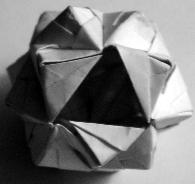
Thus I postponed some grading this afternoon, and folded a stellated icosohedon. It was a relaxing and pleasant activity. Big and clear directions are here. I leave out "step 4" since this is how I learned to do this as a kid, it's faster, and it makes a sturdier construction.

Of course, some people are even fancier.

Monday, October 30, 2006

Pressing and Blessing

An observation by Jonathan Cahn:

Yeshua gave blessings just before departing. He did this before dying (Luke 23:34), and later before ascending (Luke 24:50-51).

An an aside, he also said blessings at other typical times, such as before eating (many verses) or when greeting (Mark 10:16).

Saying blessings before departing can be hard to do, even if you are not being brutally killed. Yeshua got the strength and perspective to do so by praying at Gethsemane. In Hebrew this place is Got Shemen, "press of olive oils". In a place where olives were pressed and changed, Yeshua was pressed and changed.

Sometimes we have difficulty in departing from things. To move on from today, from a hurt, from a destructive friendship, etc., we must first, in prayer, experience pressing and blessing. Once we know how God wants us to pray about it and we intercede for it, then we can move on.

Sunday, October 29, 2006

Skype

My sister called today, and introduced me to the Skype webcam conversation software.

Very nice: free software, harmless EULA, easy to install, simple to use. I got to see my neice make faces. She got to see our lovebirds.

It does use more memory than Trillian when waiting in the background, but it loads much quicker, and I have more RAM than tolerance for slow-loading software.

Dangerous Yard Work

Well, yard work is mostly done. I raked most of the back lawn, and the roof. I cleaned the back gutter while on the roof. Doing chores on the roof is fun.

A bunch of old "shooters" cut from our apple tree had worked well as a sukkah roof, but their usefulness was over. Using my cute little chainsaw I cut them into bits and put them in the yard waste bin.

To paraphrase Rita Rudner, it's amazing what a guy will happily do if danger is involved.

Picture of the Day

Okay, time to go do yard work.

In parting silliness, I'll say that pictures of people holding cute pets are fun. But I think today's picture of the day is the kid-friendly Cthulhu license plate.

Fourfold Renewing the Mind

It's been a while since I wrote about anything related to ministry work. I actually have a pile of articles and notes with neat spiritual things to blog about. But none of these ideas are ones I need to process more. So they wait for when I have a better block of free time.

Yesterday's sermon and its subsequent discussion are worthy of more processing, however. Here is a summary.


Do not be conformed to This World, but be transformed by the renewing of your mind, so that you may discern what is the good and acceptable and complete will of God. - Romans 12:2
How does the God's Spirit within us renew our minds? Let's consider four ways. We should be aware of each, to be grateful and cooperating with God in its progress.

First, our conscience is restored. The Apostles write a few times about how people are given pure consciences by God but can then distort their consciences until they find evil acceptable. God's Spirit within us renews our consciences to their intended purity. (The Biblical Greek work for "conscience" is suneidesis. There is no Biblical Hebrew equivalent.)

The author of Hebrews uses suneidesis to mean something else: our mental paradigms, our understandings of the world that guide how we think and act. In Biblical Hebrew these are collectively called yetzer and the sages write about the "good yetzer" and the "evil yetzer" that argue within us. The author of Hebrew also uses those phrases, and in verse 10:22 explains that faith in Yeshua's sacrifice that grants us forgiveness of sin will remove the "evil yetzer" from our minds.

So a second way our minds are renewed is when our evil paradigms are removed. (Ephesians 2:3 emphasizes that this is different from being enslaved to sin through "the flesh").

Other authors of the Apostolic Writings instead use the Greek word dianoia and its conjugations when referring to the yetzer. They even include this work in the Greatest Commandment, which is surprising to a modern Jewish reader: compare Deuteronomy 6:5 (ending in 'muchness') to Matthew 22:37 and its parallel verses (ending in 'paradigms/understandings').

(The author of Hebrews also uses dianoia when not contrasting the good and evil yetzer. Compare Jeremiah's prophecy of the New Covenant in Jeremiah 31:32(33) and its restatement in Hebrews 8:10 and 10:16: Besides our hearts, God's ways (his torah: teachings) are put on our 'inward parts' in Jeremiah, specified as our 'paradigms/understandings' in Hebrews.)

Third, the indwelling Spirit of God grants our minds strength and protection. In First Corinthians 10:13, Paul writes that God will arrange circumstances so that followers of Yeshua (while following God's plans) are never tempted by more than they can resist or avoid.

Fourth, God shares with us his some of his plans. Not only do we have better thoughts, but we can even know what God wants us to think about and do.

Tao of Yeshua: Chapter 27

27
A skillful traveler need not follow the wheel-ruts.
A skillful speaker need not offer blame or praise.
A skillful accountant needs no counting-tallies.
A skillful locksmith need not use bar or bolt to make a door impossible to open.
A skillful binder need not use twine or knot to make a bundle impossible to unwrap.
The Saint is thus considered always skilled at saving men, for he need not reject any man.
He is always skilled at saving things, for he need not reject any thing.
This is called a twofold understanding.
Thus this good man is the master of all men who are not good, and these not good men are the material for his goodness.
However wise one may be it is a great error to not value one's master, or to waste one's potential as material.
This is called the chief wonder.

The skilled are not constrained to only work with optimal materials.
Yeshua can bring salvation to anyone who truly repents,
no matter how evil their heart they can escape slavery to sinfulness.
Do not consider yourself too wicked for Yeshua to save!
This is an insult to Yeshua's ability to turn wickedness into goodness.
Do not consider yourself too weak for God to use!
This is an insult to God's ability to show his strength through your weakness.
Share with all people Yeshua's offers of salvation and strength.

An Expensive War

No real point to this, just a mathematician being distracted by numbers.

During his 23 years ruling Iraq, Saddam killed about a million people. That is about 44,000 people per year.

The highest estimates and countings of deaths since the March 2003 U.S. invasion total about 50,000 people. That is about 21,000 people per year.

So the U.S. invasion, compared to Saddam's reign, is "saving" about 23,000 lives per year. That is the good news.

The U.S. invasion has cost about 500 billion dollars. That means it costs about 9 million dollars for each life "saved".

Is that a worthwhile use of money? Saving lives is a noble endeavor, but that is not an efficient use of U.S. Taxpayer money to save lives in another country. Once we are looking beyond our own borders, there are plenty of health and policy issues that could save many more lives with such a vast sum of money.

For the other side of the argument, assume that if the U.S. had not done its invasion then terrorists would have nuked all of New York City by now. By this scenario the U.S. invasion has prevented an additional 8 million deaths, reducing the cost to $62,000 per person "saved".

Not even considering the extra "collective damage" of New York City vanishing, many Americans spend that much on their own health (especially over three or four years) to stay alive. We could still be saving more lives per billion dollars globally, but as a domestic issue this becomes defendable.

In reality, the war has prevented some domestic terrorism but probably not the total eradication of New York City. The actual efficiency of our war dollars per life saved is thus, of course, somewhere between the two above extremes.

And, of course, saving lives is not the only issue. But you were warned there was no real point to this post.


For another interesting analysis of numbers in Iraq, see Eye of the Beholder by Victor Davis Hanson.

Thursday, October 26, 2006

Three Completions

Today has been a rewarding day. I got a lot done, including making up math quizzes for the next few weeks and math PowerPoint slides for next week.

Especially nice was getting three things completed.

I have been busy working on an update of the congregation's prayerbook. Today I finished that project. (This Shabbat everyone will look at the draft and make comments, and then a final draft will be made.)

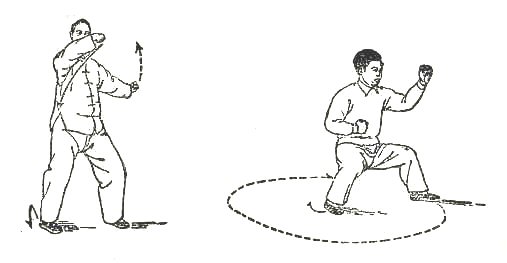
In my Tai Chi class, we finished learning the Chen 18-move short form. Of course I still must practice a lot to achieve any degree of proficiency, but I know how to do the entire form.

For a long time I was not able to make time to do Tao Te Ching translations at night. Tonight I got three more chapters done, up through chapter 36. This completes "Book One", the first half.

I am grateful to God for energy today! It surely was not from getting enough sleep. When I got home from LCC I thought I might need a nap, but I was able to get a lot more work done.

Now it's time to stop being on the computer and spend time my wife as she is processing garden basil in the kitchen.

Tao of Yeshua: Chapter 26

26
Heaviness is the root of lightness. Stillness is the master of restlessness.
Therefore the Saint travels all day with his wagon, quiet and at ease although there are magnificent views.
Why should a lord of ten thousand chariots react with lightness to all things?
If he conducts himself lightly he will lose his root. If he is restless he will lose his self-mastery.

Our eternal life is grounded in Yeshua.
We should act from this foundation, not react to circumstance.
If we are easily swayed or double-minded,
we will become less connected to Yeshua,
and lose our self-control.

Sayings to Ponder

I read a silly saying today, which I later found out was from the comic A Softer World (which I've never read, so I'm not sure if it is safe to link to):
"I was so sure my search would end when I found God, but then I could not find my car keys and my cat ran away."
One of my congregants is struggling to be at peace with God while having worries about her cats, so this was particularly timely.

Speaking of sayings that make you think about spirituality, how about Zen Koans as shared by a ninja? Chasidic Judaism also has a vast collection of short parables made from events in the lives of its famous practitioners, but unfortunately I don't have links to any. Nor do I know of any compilations shared by Jewish ninjas.

Skateboarding Progress

I mentioned earlier that my week is a little less hectic, now that the term has started and Fall's Jewish holidays are over.

One benefit is that I can schedule my time to do all my grading on campus. Since I do not need to bring papers home and back, I do not need to carry my satchel (a simple yet sturdy little Ikea bag).

I've found that the lack of a satchel means I can do skateboard wheelies (a "manual" in skater jargon) while commuting to and from the bus stop. Even if I'm new to this and my wheelies are very quick, this is fun and also allows me to get over a few uneven places in the sidewalk. Of course, I fall off more as I try the wheelies, but at my slow commuting speed those "falls" are actually "run forwards" and no big deal.

I still can't ollie.

Adobe Acrobat Annoyance

My math teaching now has me editing PDF files (post-lecture Starboard notes). I had forgotten how stupid Adobe Acrobat can be.

My latest problem was trying to break a large file (8.09 MB) into two smaller files so students using a phone line modem could download them more flexibly. But when I copy the file twice, and remove half the content from each copy, Acrobat saves the resulting files as bigger files!

Sigh. I've made a recommendation to the Math department that they get Foxit instead of Acrobat.

UPDATE: In January 2011 someone sent me an e-mail request to advertise Classic PDF Edtior as well as Foxit.  It's probably from someone associated with that software, but it was politely worded to I have added the link.  Know that I have not myself tried it, however.

Tao of Yeshua: Chapter 25

25
There were things in a form of unity before heaven and earth were formed.
Still, boundless, isolated, changeless, yet now it is in everything and never tires. It may be regarded as the mother of all things.
I do not know its personal name, so I call it the Way and can only describe it as Greatness. As Greatness it departs, goes far, and returns.
The Way is great, heaven is great, earth is great, and the king is great. In the world there are four great things and the king is one of them. Humanity patterns itself after the earth, the earth patterns itself after heaven, heaven patterns itself after the Way, and the Way follows itself.

Adonai was a unity before creation.
But before creation Adonai had nothing to sustain.
So Adonai decided to create and sustain the world.
Blessed are we to know the name Yeshua!
In greatness he departed heaven, came to earth, and returned to heaven.
He was great before creation, while first in heaven,
when on earth, and now when seated on the throne.
Humanity was created from the earth and is still earthly.
But Adonai has invited us to participate in his work
of transforming the earth to be like heaven.

Tuesday, October 24, 2006

October

Fall has turned cold. I mentioned the start of this event. Daylight is getting shorter just as raking and power-washing need to be done.

Fall has certain opportunities. Maybe I'll learn how to do Maple leaf origami. Mornings are misty and evenings have nifty clouds. There are fewer squirrels attacking the garden.

(If my readers will pardon some links with slightly risque humor or frightening images, I can mention that although I do not do anything for Halloween I'll get to see some of my math students in costume at school. I did have a "silly hat day" in one of my classes a little while ago so the students would have a chance to see me look foolish.)

Today I'm happy not because of Fall (although the trees and mists are quite nice) but because I have a three hour block of free time! This has not happened since before the start of the the term and all the recent Jewish holidays. I got more caught up on e-mail (now only 15 in my inbox) and can share silly links here. Hooray!

UPDATE: Can a crocodile costume make a pug dog cuter? Yes.

Sunday, October 15, 2006

A Nice Short Story

My father sent me a link to a nice short story: The Shabbos Goy by Joe Velarde.

It's amusing to me that the congregation has a "Shabbas Goy". Our nursery worker happens to not be Jewish, and so the congregation is spared any dilemma about someone working for us on Shabbat. (We just avoid giving her any paychecks on a Shabbat.) We did not plan it that way, but it works out nicely.

May she find hanging out with us as beneficial as Joe Velarde found his experiences!

Movie Review: Ushpizin

Last night I saw Ushpizin, a movie about Sukkot and how God acts in circumstances.

What a wonderful film! There's nothing to criticize, and I'm also afraid that if I praise any particulars I would spoil the film for people who have not seen it.

Now I'm wondering how many of the apparent times of rest between when God allows me to be tested are actually my failing to notice and/or pass the testing.

Fall's Politics

I have not been in a mood to discuss politics much lately. I'll do so here soon, in regards to the Oregon state and Lane county election measures (for which people might tell me additional important information).

Meanwhile, here is a brief selection of notable links about recent political events: the Pope's talk, North Korea, the 9/11 report cartoon version, U.S. border security, economic news, and support for Israel (warning: the last link has sound).

I apologize for the uncommented mix of fact and opinion. Hopefully these links contain worthy things to think about even if none are the final word on the represented issues. In some cases they are even entertaining.

Tao of Yeshua: Chapter 24

24
On tiptoe one stands unsteadily.
Straddle-legged one cannot go forward.
He who shows himself does not shine.
He who affirms himself is not acknowledged.
He who boasts is not given credit.
He who is flaunts his success is not invited to lead.
The Way calls these: "Leftover food and wasted action."
They are loathed by all. Therefore, a person of the Way does not behave like this.

How much of what we do is unnecessary striving?
Do what Yeshua values and he will make you whole.

Chocolate Cake and Gwyn's Frosting

Fall has really arrived in Eugene. Our big oak tree has lost half its leaves during the past two days. A fire again warms the house. Time to make brownies! Except that when I considered various brownie recipes and blended them into something that seemed optimal I wound up making a very nice chocolate cake.

Preheat oven to 350 degrees. Grease one or two 9 x 9 pans, depending upon if you want the cake to have two layers or not.

In a mixer, start (and keep it going) mixing:
  • 4 eggs
  • 1 cups white sugar
  • 1/2 cup brown sugar
  • 2 tsp vanilla
While the mixer is going, sift together into a bowl and set aside:
  • 1 cup gluten-free four mix
  • 1 tsp baking soda
  • 1/2 tsp salt
Then, while the mixer is still going, melt into a medium saucepan:
  • 1 stick (4 oz.) butter (we used a little of this stick to grease the pans earlier)
and when the butter melts add:
  • 1/4 cup nonfat milk
  • 1/4 cup evaporated milk (1/2 can)
  • 6 to 8 oz Dutch-processed cocoa (8 oz is one bag of Euphoria Chocolate brand)
Wait until the mixer has been going at least 10 minutes, if it has not been that long already. Then combine into the mixer:
  • the sifted-together dry ingredients
  • the chocolatey mixture
  • up to 2 cups of either chocolate chips and/or chopped and roasted nuts
Mix just enough so the ingredients are evenly combined.

Transfer batter to the greased pan and bake for about 45 minutes. When done baking the top will be firmly springy and a toothpick will come out clean.


There is no better frosting (or is this spreadable fudge? ) than that made by my mother-in-law, Gwyn.

Melt in a microwave and stir until blended:

  • 4 Tbs. butter
  • 4 blocks (oz.) baking chocolate
In a seperate bowl stir together and beat with an electric mixer until smooth.
  • 1/3 cup hot milk
  • 3 cups sifted powdered sugar
Combine the butter-chocolate mixutre and milk-sugar mixute, then stir in:
  • 1 tsp vanilla extract
  • 1/8 tsp salt

Beat until smooth and thickened: about 5 minutes. Use as frosting before it gets cool and too solid.

This makes enough to cover two 9 x 9 pans. (It's nice to use within one pan as both top and middle layers.)

Friday, October 13, 2006

Lego Star Wars

My wife and I have not bought a new cooperative computer game to play together in a long time. But today I splurged and bought a new one to try. (It was on sale.)

By the way, if you have not seen Revenge of the Brick, here it is (warning: link has sound).

UPDATE: A recent Windows XP update causes a conflict with the game installer. LucasArts had published a fix, but it does not work on all systems. A better fix is here.

UPDATE: The game does not support LAN multiplayer. "Cooperative mode" is when two players share the same computer and play cooperatively. Fortunately, my wife and I have a USB keyboard that make this more comfortable. (The game is a keyboard game, not a keyboard-and-mouse game. The camera position is adjusted automatically by the game as your character moves north/south/east/west, which may drive crazy people used to how a typical FPS functions with the mouse.)

UPDATE: Actually, the game is really a joystick/gamepad game. I remembered I had this in the garage, and it works much better than a keyboard (or keyboard-and-mouse).

Grocery Shopping and Hardware Shopping

In Eugene there is a local but very major hardware store named Jerry's. (There are actually two Jerry's stores now, one in the next town over.)

What makes Jerry's special is their outstanding customer service. (They are also as affordable as big chain hardware stores, but that alone is nothing unique.) Unlike other hardware stores, I can go there with a goal in mind confident that before I'll leave people who know what they are doing will have helped me turn my goal into an optimal plan and also helped me find the supplies I need.

It occurred to me that with the rising popularity of television shows and magazine articles about cooking, a similar revolution is set to occur in grocery stores. I know an increasing number of people that are trying to cook or bake something special at home now and then.

I do not know of anyone who goes to a grocery store expecting to ask a store employee for help by saying, "I'm having friends over for a dessert party tomorrow, and want to make something fancy and special but not too difficult. And one of the guests is on heart medication and cannot have sulfites, including corn syrup and brown sugar. What do you recommend?"

At Jerry's I can do the equivalent with a home repair or improvement project. So I wonder when grocery shopping (at least at certain stores) will potentially be similar?

Thursday, October 12, 2006

Tao of Yeshua: Chapter 23

23
It is natural to speak and act briefly.
A whirlwind does not blow all morning, nor does a rainstorm last all day. Who is it that makes these? Heaven and Earth. If even Heaven and Earth do not make outbursts last long, should people?
Therefore follow the Way in action. Open yourself to the Way to become one with it. Open yourself to virtue to become one with it. Open yourself to loss to become one with it.
Open yourself to the Way and rejoice in obtaining the Way. Open yourself to virtue and rejoice in obtaining virtue. Open yourself to loss and rejoice in obtaining loss.
Without trusting in this you are not trustworthy.

Seek Yeshua, virtue, and loss of selfishness.
If you have other priorities you are trying too much
and will have exhaustion and failure.

My Newest Invention

There should be cell phones that open and close like properly weighted butterfly knives.

UPDATE: And, when closed, it should be able to be used as a harmonica.

Apple Crisp and My Three Mistakes

My wife recently found a great apple crisp topping on a blog named Eggbeater. (It's actually a topping for any fruit crisp. But currently we have a lot of apples from the tree in our back yard.)

This week I was supposed to help make apple crisp for a Sukkot party last night. My role was supposedly simple. My wife prepared a mixture of cranberries, walnut pieces, and cinnamon to add to the apples in the main part of the crisp. She had prepared the topping the night before: it was waiting in the freezer on its jelly roll pan (and on a silpat) for me to crumble.

(Note: the topping recipe uses 3 cups of flour. To be gluten-free we use 1 cup each of quinoa, amaranth, and millet flours.)

My job was to prepare a lot of apples, put together the crisp, and bake it. We have an apple peeler/corer so the apple preparation goes quickly, even for our backyard apples which often have a bad spot or two that need removing (removing blemishes is quick once the apple has become one big spiral).

But three things went wrong...

First, I never caught on that the crisp topping was enough for four crisps. I used it all! My goodness that was a tasty dessert last night. But it had quite a bit more butter and sugar per serving than anything my wife and I normally bake.

Second, we are going to a final Sukkot and Simchat Torah camping party this weekend, and wanted to make more crisp. So I needed to bake more topping tonight.

Third, when I got home I locked myself out of the house. I had arrived by bicycle, and after parking in the garage went back outside to get the mail. By habit I closed and latched the garage door behind me. Oops. I got quite a bit of yard work done. Then I finally broke into the house as it was about to get dark: last night I had gotten in trouble for not leaving a light on for the lovebirds and I was not about to get scolded two nights in a row! I learn from my mistakes, yep...

(Breaking into the house was a bit tricky. But we have a ladder out in the back yard for apple picking, and I know our house. The trick I figured out will not work a second time, so I better find a good place for hiding a spare key.)

So now it's quarter past seven and I am still only at the stage of milling more grain. We happened to be out of milled quinoa and amaranth, so I need to refill our usual supply as well as make an additional cup of those for the topping recipe.

While typing this the mixer has cooled off. Quinoa's turn now...

Tuesday, October 10, 2006

Book Review: His Name is One

A pastor friend of mine asked me to review a book: His Name is One, supposedly about the meanings of the Tenach's various names for God.

The first chapter of the book is an example of good scholarship. A word root is studied by finding the words that are based on it, seeing how all these words are used in context, and then looking for patterns in denoation and connotation. This is easy to do with any good Bible software. That chapter also does a nice job explaining what Hebrew word roots are and how words are built off them.

The rest of the book is terrible. Sound scholarship is abandoned for a theory mocked by Hebrew scholars which hypothesizes that Hebrew word roots are actually pictogram sentences. This theory does not work, however. For an easy example (if you have the book) follow what the letter Dalet supposedly means according to the author. It means whatever he wants at the moment! Meanings only slightly related to the supposed pictogram-meaning are pulled out of the air, in a manner just as slippery as the meaning given to Tarot cards by a fortune teller.

Not surprisingly, the book is published by the creator of the pictogram-sentence-theory, Jeff Brenner, who has primarily popularized his theory through his website. I assume Brenner genuinely believes his theory. It is a shame pastors are being falsely told it is acceptable scholarship.

Tao of Yeshua: Chapter 22

22
What is bent becomes whole.
What is crooked becomes straight.
What is empty becomes filled.
What is worn becomes renewed.
He who has little will gain.
He who has much will be confused.
Therefore the Saint clings to the One and becomes a pattern for all things.
He does not show himself; therefore he shines.
He does not affirm himself; therefore he is acknowledged.
He does not boast; therefore he is given credit.
He does not flaunt his success; therefore he is invited to lead.
Indeed, because he does not compete with anyone, so no one can compete with him.
The old saying: "What is bent becomes whole" is not empty talk. Believe in what is truly whole and become like it.

Causing things to develop is Adonai's role.
Trust him to do it! Even for your own life!
He is complete, and will make you complete.

Sunday, October 08, 2006

Silly Quote

Something I found reading the comics this morning:
"We don’t just borrow words; on occasion, English has pursued other languages down alleyways to beat them unconscious and rifle their pockets for new vocabulary." - James D. Nicoll

Saturday, October 07, 2006

Tao of Yeshua: Chapter 21

21
Only the Way can act with pure virtue.
The Way taking a form is an idea mysterious and beyond comprehension.
Yet, despite being beyond comprehension and mysterious: there is its form!
Yet, despite being mysterious and beyond comprehension: it has become a thing!
This truth is confusing like darkness, yet gives life. This life is genuine, but requires belief.
From antiquity until now the Way has had the same name: Creator of all things.
This mysterious truth teaches about the Creator of all things.

How awe-inspiring that Yeshua took a form!
The Creator of the universe became a thing!
This is a strange truth that gives life if you believe,
and you can get to know Yeshua!

College, Algebra, Walmart, and the Middle Class

A recent article (warning: link to subscription site) by Anthony Carnevale in the Chronicle of Higher Education discussed how the American middle-middle class is disappearing. In other words, the American middle class is being split into two new classes.
...the middle class is sispersing into two equal and opposing streams: upwardly mobile college-educated haves and downwardly mobile non-college-educated have-nots.
Carnevale cites plenty of statistics to support this claim.

Between 1990 and 2004 average wages for people with college degrees have increased by more than $10,000 (in 2004 dollars), and the gap between average wages for people with only a high school education and people with a college degree has grown to $22,000 (or even $45,000 if the comparison is made to people with graduate degrees).

Moreover, the 2004 census showed that 95% of people with college degrees have employer-provided health-care coverage, compared to 77% of high-school graduates and 67% of high-school dropouts. (Jane Galt recently wrote about how providing health-care coverage is often a form of giving a raise, underappreciated by the employee.)

Finally, in 1967 50% of families headed by high-school dropouts and 70% of families headed by high-school graduates (without a college degree) were in the middle class. In 2004 those numbers dropped to 30% and 50%. Meanwhile, families headed by a college graduate rose from 22% to 36% of people in the top thirty percent of family incomes.

(As an aside: these statistics show why this graph is misleading. Inflation-adjusted middle class incomes have been declining because the constituency of the middle class is changing, and because middle-class workers are increasingly being given raises in the form of health-care coverage. Overall the economy has been doing well.)

Carnevale's article merely observes that according to the census statistics the middle class is bifurcating, and a college degree is the dominant factor for predicting which part someone is in. He does not explain why.

I'll post three related hypothesis, based purely on personal observations.
  1. As middle-class jobs increasingly are sales or service (rather than manufacturing), employers value a college degree since it shows the person is to some extent a team player. At the very least, they have proved they can do what "bosses" want for a few years. They are also probably used to group projects, knowing when to ask for help, and communicating in ways other people understand even if that communication style is not the most natural for themselves.
  2. Along with more teamwork, middle-class jobs are requiring more abstract thinking, so employers now have reason to value algebra experience as much as arithmetic skill. Percentages, ratios, and measurement conversions may be the most advanced math people use in daily life. But the ability to isolate x in the equation xy = xz + yz shows a level of abstract thinking not demonstrated by 5x = 3x + 15, which is considered relevant to many middle-class on-the-job decisions. (Thus the optional portfolios for my classes.)
  3. The rise of the "Big 3" retailers (Costco, Walmart/Sam's Club, and Target) has changed the niche of small retail stores. No longer able to compete with selling to the poor or lower-middle class, smaller stores have had to adjust by targeting the upper-middle class. Those that have succeeded have improved their own incomes (for example, small coffee shops are enjoying how Starbucks has somehow made it quite natural to pay more than $2 for a cup of coffee). Those that failed to adapt went out of business, pushing their workers down from middle-middle class to lower-middle class.

Thursday, October 05, 2006

Tao of Yeshua: Chapter 20

20
Abolish study of etiquette and customs and you will be free from care.
How vast is such study! What is the difference between "yes" and "yes please"? What is the difference between propriety and impropriety? Which things that others respect are actually worthy of respect?
What nonsense this is!
I am alone when all men are joyful in celebration, as with a holiday sacrifice or ascending the Spring Terrace. I am passive, like an infant which has yet to smile. I am weary, like an adult with no home.
When all men appear to have plenty, only I am left out. What a fool I appear to be!
When others appear intelligent and bright, I appear stupid and dim.
When others appear discerning and sharp, I appear confused and dull.
I rest like the sea although I appear to move aimlessly like the wind.
Let all men follow etiquette and custom. I alone appear ignorant and stubborn.
Yet what makes me most different from others is that I am sustained by the Creator.

Pleasing people is difficult.
So many rules make up polite and respectful behavior!
In comparison, Yeshua gives us few rules.
Seek his favor, not that of people.
This will create times when you do not fit in,
but you will not mind.
You will appear disturbed and lost,
but really your foundation is peaceful and secure.

Wednesday, October 04, 2006

Interesting Statistics

Heh. Brazil consumes 11% of the world's coffee.

One-third of a generation's Smoots find a career in measurement.

America's nuclear reactors, producing 20% of the nation's energy, are being upgraded.

American news agencies have only nine embedded reporters in Iraq.

A number of dictators employ(ed) doubles.

Tuesday, October 03, 2006

Fall

Fall is approaching. The trees are starting to turn colors: not all of them, but enough that waiting at the bus stop is not boring. Each morning there is about a 50% chance I need to light a fire in the fireplace.

So far this year's squirrel count is up to 15. As the weather cools off we are catching fewer squirrels: normally nothing any day, but when something enters the live trap it is more often an opossum or raccoon.

Tao of Yeshua: Chapter 19

19
Abolish legalism and minimize doctrine: the people will benefit a hundredfold.
Abolish charity and minimize justice: the people will return to caring for family members.
Abolish shrewdness and minimize wealth: thieves and robbers will disappear.
These three are merely words and not sufficient. There is something that includes them all.
Display the potential of undyed silk and the wholeness of uncarved wood: abolish selfishness and minimize desires.

Cultural virtues can be snares.
A religion with too much detail in rules and beliefs becomes dead.
A government with too many programs replaces family and neighborhood.
A society with too many material values creates crime.
Instead of focusing on so many things stay ready to be used by Adonai.
Then you will see great life, relationships, wholeness, and happiness.

A Biblical Business Model

A few years ago I spend some time asking "Christian businessmen" how their business models were determined by their faith.

In most cases there was no connection. These people were "Christian businessmen" in the same unrelated way they might also be guitarists or baseball card collectors who happen to run businesses.

But I did get a few interesting replies (mostly from one couple) All have application to running a congregation.
  • Make time and place to restfully enjoy being in alignment with God's plans. From an eternal perspective our primary job description is "worshipper". God values and rewards this. God never said he values or rewards maximizing efficiency.
  • When pushed, do not always pushing back. Sometimes submit and forgive.
  • Have rooms with purposes used by workers with a generic role. (When possible avoid having generic rooms used by workers with special, organized, or bureaucratic roles.)
  • Make sure a room (or person) is for prophecy, and another for intercession. The former helps the leadership listen in prayer to adjust the business's mission (goals) as needed. The latter listens and agrees in prayer to help the business's vision (strategies) be realized and adjusted.
  • Do not separate prayer and news, or prayer and announcements.
  • Ask for reports of joys and challenges.
  • The primary role of "elders" is teaching. So the best person at a role should not be in charge of doing that job. Let the second-best person at the role do the job so the person who is best at it has time to train others.
  • You are faithfully stewarding money if you (a) earn more than you spend, (b) avoid waste and know the difference between needs and wants, and (c) use money in a way that honors the person who gave it to you (whether a person or God). Aside from these principles avoid worrying about money; if you say it is all God's money then let him worry about it.
Who knows of others to add to this list?

Proverbs 14:4, Messes, and Pruning

A long time ago I wrote about how I find many Proverbs uninspiring.

But I recently read Proverbs 14:4 and love it.
Where there are no oxen the stall is clean,
But a multitude of production is in the strength of the ox.
Sometimes the only way to proceed is to let things get messy. With spiritual progress, that's often true.

After all, it's the productive vine-branches that get pruned. The last time God tried to prune you, did you take it as a compliment? Did you consider what change in habits or thoughts or mindsets should be a consequence of accepting the pruning? Were you grateful?

Laundry and Stains

These may be handy:
  • A guide to laundry care symbols
  • A guide to stain removal
Um, yes, I did do three loads of laundry yesterday. Why do you ask?

Benadryl and Allegra

For my allergy medicine when I have mild symptoms, I recently switched from loratadine (generic Claratin) to Bendaryl. I started allergy shots. The Benadryl is about the same price, helps my nose the same, and does more to reduce itchiness from the allergy shots.

I recently read that I was fortunate to not be using Allegra. I'm a big juice drinker, and Allegra is only absorbed 20% when taken with apple, orange, or grapefruit juice. (The report, from the Berkeley Wellness Letter, said no other common medications have this incompatibility with juice.)

TANGENT: The Wellness Letter also warned that a sleeping pill, Ambien, can cause sleepwalking in some people. So, how long until college students are slipping each other something that causes sleepwalking?

Monday, October 02, 2006

College Math in Redesign

So, how is the LCC math department participating in the college's redesign efforts?

First, classes are being modularized. One class is already modularized (Math 95) and is as "Flexible Sequence Algebra". The ten weeks of the term are divided into five sections. Students must pass each section to pass the class. The class is taught by five instructors (or more) with instructors starting the term with a different section. Thus one instructor teaches the sections in the normal order, A-B-C-D-E. Another instructor goes B-C-D-E-A. And so forth, allowing students who failed one module to sign up the following term for only the module they need, pay only for one credit instead of five, and be done in two weeks (which allows them to move along to Math 111 without being held back a term).

Other classes will be modularized but the details are tricky. Should all modularized classes have five sections, or as many sections as the class currently has credits, or as many sections as sensibly fits the material? What is the best way to pay instructors and charge students when some of the class is not planning on staying more than a few weeks? Will it always work that the next math class can postpone needing mastery of every topic in the previous class for a few weeks?

Second, new class schedules are being tried out. This term many math classes are being offered three days a week for 80 minutes instead of four days a week for 50 minutes. So far this is receiving predictably mixed reviews. A idea combining new scheduling attempts and modularization is to offer some "catch up modules" as a long weekend workshop, the way a CPR class is often taught all day long at a high school or college.

Third, the use of computers in math classes is being explored. Individual instructors already experiment with class projects that use computers. The department as a whole is now starting to plan "hybrid" variants of certain classes, and perhaps even 100% distance learning variants. Hybrid classes are easier, both because of the nature of math teaching and because the administration has put together sensible guidelines and policies about them (warning: links are to PDF and PowerPoint).

Tao of Yeshua: Chapter 18

19
Abolish legalism and minimize doctrine: the people will benefit a hundredfold.
Abolish charity and minimize justice: the people will return to caring for family members.
Abolish shrewdness and minimize wealth: thieves and robbers will disappear.
These three are merely words and not sufficient. There is something that includes them all.
Display the potential of undyed silk and the wholeness of uncarved wood: abolish selfishness and minimize desires.

Cultural virtues can be snares.
A religion with too much detail in rules and beliefs becomes dead.
A government with too many programs replaces family and neighborhood.
A society with too many material values creates crime.
Instead of focusing on so many things stay ready to be used by Adonai.
Then you will see great life, relationships, wholeness, and happiness.

Sunday, October 01, 2006

Happy High Holy Days!

Happy High Holy Days! L'shanah tovah tikatev(i) v'taihatem(i)!

("For a good year may you be inscribed as sealed." The alternate (i) endings are the grammatical form used when addressing women.)

This afternoon I am going canoing, before leading Erev Yom Kippur services.

Tomorrow I may or may not have time for more blogging. I have the day off from work, but will be babysitting two kids so some congregants who have not had the opportunity I have recently had to spend a day uninterrupted with God can have that opportunity.

McDonald's

Yesterday afternoon I ran a lot of errands. (Blogging is not the only thing I've been too busy to do for several weeks.)

Feeling snacky I stopped by a McDonald's for the first time in many months, if not years. That place sure has changed. (I know it is not as monolithic as we think.)

I ate a chicken snack wrap. For $1.29 it did what it advertised. I was a bit saddened to later learn it was not as healthy as I expected: the ranch sauce?.

Mostly I was surprised by the menu. There were six chicken choices, four burger choices, four salad choices, and a bunch of desserts. I don't think anyone would have predicted, when I was a teenager, that in a few years American McDonald's would have more chicken than burger options.

Parodies of Motivational Posters

Hm. I could waste a lot of time with this tool. (Thanks, Shamus.)

Fortunately, today is pretty busy. Too bad, since I know of some funny or cute or strange pictures.

Hm. "Propoganda: Tired of being a sheep? Be a parrot!" Or "Nerd Cred: My mech can beat up your mech."

Okay. Enough for now.

Hooray for Wierd Al!

Weird Al has a new video: White and Nerdy.

(Two different friends shared links with me. The YouTube version has a bunch of comments about the visual references. I had never heard of 43-Man Squamish before. But then, I'm only 30% White and Nerdy.)

UPDATE: An interview with Weird Al about his new album.

Sudoku

Help! One of my math colleagues beamed me a version of Sudoku for my PDA.

Faculty Inservice, Fall 2006: Redesign

As I mentioned earlier, the LCC the faculty start Fall term a week and a half before the students. Besides preparing for our classes, there are many meetings called "inservices". Some are to learn new skills, such as the Starboard training I mentioned before. Others are to discuss pedagogy.

This year's inservices were dominated by discussion about the future of community colleges in the U.S. The Secretary of Education has just completed a big report on this topic (warning: last link is a PDF).

Community Colleges are terribly effective economically. (A while ago I linked to this article that sings their praises.) One estimate cited at an inservice was that the education of LCC graduates increase the county's total wage income annually by four times the amount of LCC's annual cost. (Such estimates are admittedly subjective, and in part depend upon how much Oregon's natural beauty would attract other workers if Lane county natives were too unskilled. But at the very least LCC pays for itself, and helps locals acquire good jobs locally. It is difficult to find someone in Lane county that disagrees with either point.)

The problem is not that LCC is worth its cost to fund; the problem is that LCC has very little accountability and can clearly be run more efficiently.

For example, a history of badly planned computer system upgrades has produced a current mess where the computers for the Budgeting department and the Human Resources department cannot talk to each other. Since about 80% of LCC's costs are payroll this circumstance makes it nearly impossible for the Budgeting department to do its work.

(There are plenty of other examples of structures and systems that are broken. That one is simply the easiest to understand without any background explanation.)

Since a number of "big structure" items need to change, the administration's motto for this year is Instructional Redesign.

In practice, the challenge is twofold.
  • LCC needs to redesign its workings, especially its bureaucracy, quite broadly to make it as efficient as the Secretary of Education's report requires. Otherwise redesign will in the future be forced upon the college from outside.
  • At the same time, the administration wants to avoid firing anyone. This is less of a constraint that might first appear, for I have seen that employees at LCC are unusually willing to be transferred to other departments and/or do slightly different work when the college needs to better use its human capitol.
So the administration desires a process of redesign that identifies new, productive roles for people as often as it identifies wastefully unproductive roles. The solution is to focus on instruction, which can almost always be done better with a few new roles. Thus the new motto is "Instructional Redesign", not "Fundamental Redesign".

This is not how a competitive business would go about redesign. Efficiency will increase, but will not become nearly as optimized as through a redesign model constrained only by acknowledging the company's physical infrastructure.

But if done well this plan will improve LCC enough to satisfy everyone: the Secretary of Education's report whose criteria will be met, the LCC employees who retain jobs at the college they love, and the Lane county community which realizes LCC is a net gain by any measure even as things currently stand.

Chen Style Tai Chi

This term at LCC I am taking two P.E. classes. One is Tai Chi, taught by a friend of mine.

In the past he taught Yang style Tai Chi. This term, for the sake of variety, he is teaching the 18-move short form of Chen style, as well as its self-defense applications and a few types of Pushing Hands.

I am not sure how much skill I will acquire, but as with other exercise hobbies that is not the point.

UPDATE: Links adjusted in 2014.

Wednesday, September 20, 2006

Run, Rabbit Run

Sorry for disappearing for ten days. I have been extremely busy preparing for teaching a new term of math classes, and writing the liturgy for the congregation to use during High Holy Days.

I thought I would have more free time this week, but I have been attending many optional meetings at LCC. The college is in the middle of discussing and implimenting redesign issues, and as an adjunct instructor I am not required to participate but it is helpful to know what is going on. (Also, I dropped my PDA last week and broke it, and attending these meetings helps cover the cost of the replacement.)

By dinnertime tonight I should be done with all these preparations. Tomorrow there is a local pastors' prayer meeting to attend. Friday is one last important LCC meeting. I should finally have time to blog and garden and watch Firefly episodes.

UPDATE: The last meeting of the day was an introduction to the new Hitachi Starboard system that has been installed in most of the math classrooms. It's quite nifty!

Sunday, September 10, 2006

Tao of Yeshua: Chapter 18

18
When the great Way is abandoned people talk about "charity" and "justice".
When cleverness and knowledge appear, people talk about "hypocrisy".
When the six family relationships lack harmony, people talk about "devoted children".
When a kingdom falls into disorder, people talk about "loyal ministers".

If everyone followed Yeshua,
there would be no need to speak of virtues.
The more that virtues are discussed,
the more evil the world must be.

Firefly: Captain and Crew

Two days ago I mentioned the show Firefly in passing. As part of my relaxing before dinner I'll share one thing I found interesting about its first three episodes.

The captain, Malcolm, has lived through a lot and now a complex and many-faceted personality. Each of his crew members reflects one part of his own character.

As a former soldier he understands that endurance is paramount (Zoe) and sometimes aggression is necessary (Jayne). These are the crew members whom he empathizes with and and relies on the most, but does not always want to be around.

Now the war is over and he is trying to find a new identity. But he is held back by his wartime record. He has noble ideals but is as a societal outcast (Inara, in his view). He wants to be happy (Kaylee) but the only thing he really wants is to fly his ship (Wash). These are the crew members he is fond of but has trouble relating to.

As he recovers from wartime emotional baggage two issues frighten him. To counter his soldier's past he desires, in some sense, to be a healer (Simon). To deal with all the death he has seen and caused he vaguely desires more spirituality (Book). These crew members are new. Malcolm is forced to deal with and even need them. But he keeps emotionally distant and is uncharacteristically rude to them.

Since I have only seen three episodes I have no idea if Firefly continues this theme, in which the crew are not only individuals but also reflections of the captain's troubled personality. If so then the series will have much more rewatchability.

I cannot think of another story with this theme. I doubt Joss Whedon invented it, but he may be the first to introduce it to prime-time television. (Not being a big television watcher, I expect someone will correct me.)

It makes me wonder what characters would represent my own personality issues.

Friday, September 08, 2006

Love and Lust in First Corinthians 13:4-7

I was referred to a new blog today. In replying to one post I mentioned something about First Corinthians 13:4-7 that I was shown long ago by Aaron Jones.

First consider:
Love is patient. Love is kind
Love is not jealous, not bostful, not proud, rude, or selfish,
not easily angered and it keeps no record of wrongs.
Love does not gloat over other people's sins but rejoices in the truth.
Love bears all things, always trusts, always hopes, always endures.
We can replace "love" with "lust" and reverse the occurrences of "is" and "is not":
Lust is not patient. Lust is not kind
Lust is jealous, bostful, proud, rude, and selfish,
easily angered and keeps a record of wrongs.
Lust gloats over other people's sins and does not rejoice in the truth.
Lust bears little, never trusts, never hopes, never endures.
This works because in many ways love and lust are opposites.

One tricky thing is how secular society blurs together love and lust. Followers of Yeshua must understand and live out the difference.

A second, even trickier thing is that "lust" as embodied in the modifed verses above is part of our evil inclination, but physical attraction can be part of the good inclination. It is good to consider your spouse attractive.

When I am as close to God as I should be, Yeshua's work and God's Spirit within me allows me to be free of the evil inclination. In regard to lust, when I see an attractive woman I find I either pay attention to her face (or, rather, her temperment showing through her face) or I might briefly notice the rest of her and think something like, "She is attractive, may she make someone very happy."

I don't think that noticing someone is attractive ever stops (although when I am close to God I notice nature's beauty a lot more and thus spend less time looking at people). But the desire to possess or be possessed stops. The inclination to fantasize stops.

Actually, it's more than that. The desire to possibly interact stops. I stop caring what I think about that person or what they might think about me. That seems the true root of the earlier two things that stop.


As an example about love being different from lust, I'll share about Wednesday nights when my wife and I go swing dancing with friends.

My role as a lead is to make this space in front of me welcoming.
It does not matter if I do fancy moves or not. Neither does it matter if I have musicality or simply dance to generic eight-beat measures. Besides conversation (it is a social dance, after all) the important thing is for me to pay attention to the follow's center of gravity rather than my own. Then the dancing has balance and smoothness, and the follow looks good and has freedom to do styling.

In other words, through a kind of communication by touch I am letting someone know I value their comfort more than my showiness, and their company more than their talent. It works because people like simply being valued and supported and doing something cooperative--and knowing that's what is happening for about three minutes until the song ends.

That's what swing dancing is about (well, except in Portland). And it's something for which society does not provide many opportunities.

I'm not sure Yeshua's followers need to literally copy John 13 regularly and wash each other's feet. But on occasion I've given a (male) congregant a foot rub.

How It Should Have Ended

Weekend entertainment...

A long time ago a friend showed me the website "How it Should Have Ended" because their parody of the Lord of the Rings movie was silly. They just released a Superman movie parody that is truly classic.

Tao of Yeshua: Chapter 17

17
Optimally, people do not even know they are under authority.
Next best is to love and praise the rulers.
Next best is to fear them.
Worst is to despise them.
If those in authority do not trust the people to act correctly, then the people will not believe that those in authority are acting correctly.
Thus wise rulers think more than they speak, and value their words. And the work went smoothly, was completed, and the people all thought: "We have done it ourselves!"

When in a position of authority,
when possible act as Adonai does.
He rules all, but may be ignored.
He is worthy of love and praise,
but willing to let people take credit for his work.
He gives people too much freedom,
knowing the only other option is being a tyrant.
Make few rules,
and let people decide how to do the work you want done.

Conspiracies

During the last few days I have had to politely deal with someone who calls the congregation to talk about conspiracy theories, especially ones regarding him personally. People are bugging his phones, poised to come into his room through the attic access panel, and making him tired with low doses of poison in the air or food.

Sadly, such folks cause me to have no patience in dealing with even mostly-true conspiracy stories. Reform Judaism magazine recently featured an article about the oil industry's history which I have not read. I've long put off reading about gun control's Nazi roots. I should know more about the Nazi roots of Islamofascism than I do. (If the last topic is new to you, start with this video.)

My lack of interest could potentially lead to problems.

For example, I recently skipped over Barry Chamish's websites when someone recommended I read them. Does Chamish know what he is talking about? Would investigating his theories help me be better supportive of Israel? Is there any hope that Porkbusters can get more U.S. elected representatives to care about representing their people?

I probably will never know, since I'm so turned off by the whole genre and thus far have not seen any practical applications. My devotion to love God and love my neighbor seems unaffected by who is manipulating big policies or big money.

Yeshua had no interest reforming human governments. He dealt with them. He will return to overwhelm them. Until then his focus and his disciple's focus is the health of local communities and individuals.

UPDATE: Over the weekend I was introduced to two more conspiracy theories. One of them, from what I can find, seems quite established as true and is nicely written up by Ben Hecht in his book Perfidy. The other, The Book of J, seems nonsense, since Umberto Cassuto debunked the Documentary Hypothesis years ago.

UPDATE: A rebuttal to the link between gun control and the rise of Nazi power is here.

Community Confirmation of Divine Guidance

Heh. Stuart Dauermann can be cute when fed up.

As the saying goes, "Why don't ministers work out? They already get exhaustion, colleagues complaining about how little they can do, and possible injury."

Of course, that saying was from the same rack of greeting cards that also had "There is too much blood in my caffine system", "Having kids is like being pecked to death by a duck", and "The problem with Italian food is 3 or 4 days later you're hungry again."

Free Software That's New to Me

I've come across three pieces of free software.

Since I probably won't have time to try them out for quite a while, I'll ask if anyone has had good or bad experiences with them...
Supposedly Audacity is the best free MP3 editor; my only use would be trimming the beginnings or ends off song files. Avast! received high marks from Consumer Reports, and might replace my current antivirus software when its annual subscription runs out. Foxit reportedly loads much, much faster than Acrobat or Acrobat Reader.

The Shofar and Shabbat

There is a rabbinic rule that the shofar is not blown on Shabbat. From what I can find, this is based solely on the Talmudic passage Rosh Hashanah 29b. The concern is that using the shofar on Shabbat would involve carrying it a long enough distance to be considered work.

Many Messianic Jewish congregations use the shofar regularly. There are scriptural reasons to do so: God's people are assembling, and announcing the imminent arrival of their Lord.

Does anyone have more information about why Rabbinic Jews do not use the shofar more regularly?

This Week, Matrix Movies

This week I returned from a cousin's wedding and got ready for a special congregational event this weekend.

Next week I plan for my Fall term math teaching. Teaching math at a community college is a wonderful side job for which I am very thankful.

This week I have time to start a very interesting but rather long book about the early development of Judaism and Christianity. Last week I read a shorter book: Paul by E.P. Sanders. Both books are useful for prompting me to think about worthwhile issues, in particular how much Protestant theology has watered down Paul's expectation that followers of Yeshua would stop sinning.


My wife is away in Seattle, on a business trip until late Sunday night. She does not like watching movies much, so I took advantage of her absence by finally renting the second and third Matrix movies. Sadly, this turned out to be a waste of time. The DVD of the third movie was broken and only would show the first half of that film--and I found I did not mind. I later found commentary on the movies that was more intriguing than either movie.

I liked the first Matrix movie. It focused on real human religious issues: unnoticed enslavement, escape to freedom, receiving gifts that are confusing to use, and how the power to resist evil is an inferior substitute to the authority to judge evil. I had neat conversations with friends after that movie, in which we figured out why the heroes could have fancy guns but not superpowers (they had FTP access but no "write" file privilege).

The latter two movies just seemed a convoluted science fiction story that unraveled a puzzle about powerful AI "fake people" who were all manipulating the protagonist to advance their own agendas. This could have been done well, but except for the special effects it was nothing special.

While on vacation I was introduced to Firefly by relatives. That was something special. I spent some birthday gift money at Amazon. The DVDs should arrive soon.

Mundane, Potent, and Holy

The blog Out of Ur recently had an interesting article about a generation gap. I'll reply to one particular bit:
Boomer Christians tend to divide the world into three categories: the holy, the secular, and the downright sinful...The new generation of Christians, however, tends to see only two categories: the holy and the sinful. This means things that previously fell into the "secular" category are now open for consumption and experimentation without judgment. Take, for example, tattoos.
If Christians studied Hebrew a little more then this argument would disappear. In Biblical Hebrew words for "ritually potent" and "ritually impotent" are tahor and tamay. Something tahor may be set apart for God. Something tamay may not.

In other words, God created some things with the intention that they were simply mundane. Other things could be devoted to him, but might not be until the Messiah's reign (Zechariah 14:20-21).

The word for "set apart" is kadosh. Most English translations have "holy" or "sanctified", which sounds overly abstract. If I own a pair of candlesticks and decide that from now on I will only use them for Shabbat, I have set them apart. It's not complicated.

Most English translations render the words tahor and tamay "clean" and "unclean", which totally misses the point and sounds like God is talking about cooties.

In Greek the parallel words are akatharton and ekathaizen. This clears up Acts 10:14-15,28 and Mark 7. People cannot be ritually impotent. Vices, not dirt, make us distanced from God. (So all food is ritually potent, as Leviticus 11 taught. This is totally different from a common Christian misunderstanding of Mark 7 that claims Yeshua was trying to teach Jews that for them "all things are food".)


I know some readers will not let me end this without commenting on tattoos. I'll simply cite what I've written to two young Christians who had e-mailed the congregation wanting to know about Hebrew words for a tattoo they wanted. After providing them with the Hebrew they requested, I said:
If you Google "Leviticus 19:28 tattoo" you can get some information about a big debate. That verse literally says, "And cuttings for the dead do not make in your flesh, and letters of incision not put on you; I am the Lord." The problem is that the word translated "incision" (see Strong's H7085) only appears that once in the Old Testament -- it is thus somewhat guesswork about what that word really means, and whether this verse only prohibits cutting the flesh, or if any marking of the flesh (including tattoos) is contrary to God's intentions. Doing a search on the internet will show you a plethora of different opinions, many with conflicting scholarly support. I'll recommend prayer above scholarly consensus on this ambiguous issue.