Saturday, November 24, 2018

Island Map

I made a map for a new Nine Powers campaign with my family.


Creating the image involved only a few steps.

Red Blob Games has an island maker.  My settings were these.  (Uncheck the box for "icons".)

GIMP is the free version of PhotoShop.  I made three adjustments.

1. Filters -> Blur -> Gaussian Blur -> Radius 2
2. Filters -> Artistic -> Clothify -> Blur 9, Azimuth 100, Elevation 45
3. Colors -> Levels -> Upper Input Level from 1 to 1.6


Inkscape is the free version of Illustrator.  I used it to add the rectangles and text.

UPDATE: The settings for my Arlinac Island map are these.

Monday, November 05, 2018

Elementary School Spooky Posters

Want to decorate your elementary school for a haunted house fundraiser, or Halloween?

Here is a simple creative writing activity.

Make one list with all the types of places in your school.  For example, there is the main office, principal's office, gym, cafeteria, a hallway, etc.

Make a second list with all the kinds of traditional spooky monsters.  For example, a zombie, mummy, werewolf, ghost, etc.

Then match up items from the two lists to make silly and spooky posters.  Ideally the sentences you make are very short (to fit on the poster) and not too gory (to not scare the kindergartners).

Here are my examples, which should not be provided to a classroom of kids actually doing the activity.


Zombified? See school nurse for a cure.

Please report haunted toilets to the school secretary.

Please do not dig up skeletons in the playground.

Ghosts also must keep right in breezeways.

This quad is peanut and garlic free.

Be safe. Be kind. Be responsible. Be plump and juicy.

Is it the real Principal Moore?

Do not take candy from the witch.

The teachers lounge fridge needs a new jar of eyeballs.

Today at 3pm is werewolf howling choir practice.

Tired? Energize with new Van der Graaf gym routine.

Fifth grade embalming class postponed to Monday.

Can't find your phylactery? Check the new Lost and Found.

Respect our rodents! Only bullies command rat hordes.

Monday, October 08, 2018

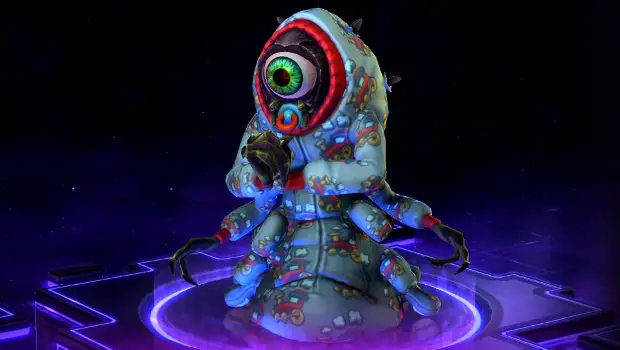
Abathur for Heroes of the Storm QM

 
This is a summary of my longer Abathur Guide appropriate for players using Quick Match to get used to the hero.

Macro Goals

Playing Abathur in Quick Match is a great way to improve your macro skills.  Everyone knows you are mostly enjoying the pajamas and little toy trains, but you can also learn macro.


Use the mini-map to monitor hero positions, lane pressure, and minion soaking.  Learn to intuit where the opposing team is likely to be.

Learn the maps, especially which bushes/smoke players use to hide.

Use the top panel to monitor ally health bars.

If you play Abathur well, opponents will be slowed, while your allies get shielding, experience, and healing.

Talents

Here is a set of generally useful talents appropriate for the chaos of Quick Match.

Start with Regenerative Microbes for healing.  The spike burst talent would helps a dive team more, but at the start of a Quick Match game you cannot know if your team dives well.  The locust talent would help more if the enemies lack waveclear, but in Quick Match players may not rotate lanes normally anyway.

At level 4 get Sustained Carapace.  In Quick Match your team always needs more healing.

At level 7 get Vile Nests for slowing the opposing heroes.  Your team can benefit from slowed opponents without careful teamwork.

At level 10 get Ultimate Evolution and have fun with it.

None of the level 13 or 20 talents are especially appropriate for Quick Match.  Pick appropriately for structure damage, sniping, or healing.

At level 16 the normal choice is Envenomed Spikes, again because your team can benefit from slowed opponents without careful teamwork.  However, if no ally is taking mercenary camps getting Locust Brood will allow you to claim camps by yourself.  See my longer guide for details.

Abathur's Positioning

The locusts you emit only pressure lanes without opposing heroes.  Use Deep Tunnel accordingly.  Ask allies to destroy walls since this lowers opponents' vision of locusts.

In early game only body soak when opponents clump for objectives, by positioning yourself safely in farthest lane.  In late game both teams clump for team fighting, so you can body soak more safely.

Also use Deep Tunnel to travel to unguarded objectives, including Pirate Coin Camps and dropped Spider Queen gems.

Symbiote

Minions should never die to your towers unsoaked: use Symbiote on those towers.  Similarly, use Symbiote to soak minions fighting in the middle of a lane without heroes.

Make cooldowns efficient by using Symbiote+E+W+Q then leave Symbiote.

Toxic Nests


Place toxic nests to provide vision in bushes near the next team fight (objectives, boss, etc).  Also place toxic nests on opponents' side of map in vertical paths along their rotation routes.

If you hover the mouse cursor over the toxic nest button, its range is faintly visible on the mini-map.

You can also place toxic nests in center of clumped enemy minions in lanes without heroes.  (If the toxic nest deals the final damage to an enemy minion, your team soaks the experience.  Try placing two, one at a time.)

If you have time, you can use place toxic nests to distract fort/keep shots away from allies.

Ultimate Evolution

Use Ultimate Evolution as team fights start, or the fight will end before Symbiote becomes available.  Pick the ally for Ultimate Evolution based on position and mobility (often a global hero ally is best).

You can also use Ultimate Evolution to zone opponents away from objective without a full team fight.

Thursday, June 21, 2018

Wrinkles, Pins, and Locations

I have always wanted to run urban adventures, but always had trouble doing so until I recently developed a system for organizing my preparatory work.

The first step was to brainstorm factions. I knew that each faction needed both public and secret goals, and that the goals of different factions should sometimes cause strife and other times encourage alliances. Because of the Nine Powers setting I made sure the factions represented a variety of races and Powers.

After much experimentation I realized each faction only needed four descriptors: key person, summary overview, typical encounter, and connections.

As an example, within Industry District the Builders Guild is led by a Dweorg names Lachary the Solid. The guild espouses that Frosty Kostkey has indeed mended his ways and promotes selling utilitarian machinery to improve the district's reputation. Typical encounters could be testing or protecting new machinery for the city, or dealing with an over-zealous machinist who is creating dangerous machinery. The guild opposes people who harm the district's reputation by remaining loyal to Frosty Kostkey's historic plans of conquest and Winter bleakness.

The second step was to brainstorm a half-dozen wrinkles. This is my terminology for a new issue affecting Arlinac Town. The issue provokes responses by most factions. These responses need the same four descriptors.

As an example, poor people have been disappearing from the slums. A kobalt named Railey the Sweet wants to help, and bring public gratitude to the Builders Guild and the Industry District. She is a local expert at constructing sentry cameras, and has teamed up with a Bergtroll named Viczoria who crafts magical lenses to construct several cameras that will make time-stamps when they see Ogres or Undead. Railey needs clueless adventurers to discreetly hide a camera on a rooftop, stay somewhat nearby for several hours to guard it, and then bring it back to her so she can analyze the time-stamps it produced. But what else might the magical lenses be able to see or record? Unrelated to the missing poor people, the cameras might notice that a vampire pirate has started shipping ghouls into town. Also, Viczoria is a prominent member of a troublesome faction based in the Illuminated District that believes beautifully made things only count as "artistic" if they are magical and popular: her politics might cause trouble for adventurers working with her. 

A wrinkle could be a policy change, holiday, notable visitor, or crisis that affects the city broadly. Because not all wrinkles are tied to a specific location in the city, the useful physical "map" if the city is the vague layout of wrinkles. But a worthy wrinkle does (eventually, if not initially) involve something tangible: a person, item, or location that is causing all the fuss. So I visually imagine this tangible layer as pins on a wall map. Each pin denotes the person, item, or location creating a center of gravity that pulls factions to action. Yet pins might need to be relocated on the wall map as events unfold.

In the above example, the PCs eventually discover a secret sect of Ogre Toxophilites has been having new recruits hunting poor people as part of their initiation tests. The wrinkle's "pin" is an Ogre named Phloe who is the current recruiter for that sect. The GM has no need to determine her initial location in Arlinac Town. Let the PCs can investigate however they want. Various wrinkles will all be unfolding simultaneously. When the PCs make appropriate decisions, the GM can improvise clues about Ogres and Phloe. The eventual encounter with the Ogre Toxophilites will be most meaningful if it develops organically. 

The "true map" of the city is abstract and three-dimensional. Each faction has its own layer: a network of nodes floating above the more tangible pins. In the above examples I described the wrinkle "poor people have been disappearing" with the pin "Phloe the recruiter for the Ogre Toxophilites" and one of many nodes above it in the Builders Guild layer.

Not every faction will have a node above every layer. That is okay. The followers of Frosty Kostkey who still want to conquer in his name might not care about missing poor people or a small group of murderous Ogres. Plenty of connections are made as the different wrinkles interact, and the factions clash in the ways they are interested in the wrinkles.

I now have a general structure for urban adventures.

I owe a debt to Justin Alexander's writing about structural issues in fantasy role-playing games.  He wrote about how a dungeon crawl has a standard location for player choices (a room) and default player choices (explore the room, move to the next room). Most fantasy role-playing games thus have game mechanics specifically designed to deal with these. There are rules the GM uses to randomly put enemies or puzzles in a room to make an encounter. There are rules the PCs use about combat and skills to fight the enemies or solve the puzzles. And there are rules about locked doors, secret doors, portcullises, and other complications to add variety about moving to the next room.

These structures and game mechanics do not apply in an urban adventure. Justin Alexander proposed his alternative, from which I took the insight of a three-dimensional network of faction nodes above a more tangible layer. But his structure remained location-based without my distinction between wrinkles, pins, and locations.

My urban adventure structure has standard issues for player choices (the wrinkles) and default player choices (investigate a wrinkle, move to the next wrinkle). Stories now have a natural flow towards depth of problem-solving. Investigation and exploration lead from wrinkles to pins and nodes. More investigation leads from pins and nodes to locations. Entering these locations leads to encounters.

Unlike the classic dungeon crawl, there are no game mechanics to push the story along. There are no random tables for creating wrinkles or pins. There are no rules for moving to investigate the next wrinkle. There are no rules dictating when to finally encounter the wrinkle's tangible pin. It is even true that because players use creative methods of investigation it will be player choice more than game mechanics that determines the most obvious or appropriate skill used when investigating or exploring.

Now I have words for why I always wanted to run urban adventures. I like when the story itself, rather than game mechanics, pushes the story along. It feels right when the story itself takes over and handles its own flow.

Thursday, April 23, 2015

Farewell, Ur-Quan, For Now

Back in November I introduced Smiley to Star Control II.

He liked it.  Even though Gallant was younger, he also enjoyed watching space ships to space things.

But the game was always something they watched me do.  After I bought myself a tablet in January, they switched to playing games themselves on the tablet.  (Battleheart Legacy, Dungelot, and Merchant.)

So no more Ur-Quan for now.  I am sure they will return eventually.


And, yes, the game is also available for Android devices.

Wednesday, April 22, 2015

The Merchant App Game

Smiley has a new favorite game on my tablet.

I was looking for the old Apple game Taipan for its basic, age-appropriate economic lessons, and found a slightly more complex game named Merchant.  (More information is available here.)


Taipan focused on "buy low, sell high".  Merchant does not teach that particular lesson, but does a great job with other lessons about buying, selling, and value-added costs.

It is much too repetitive for an adult to enjoy. But it is perfect for a seven-year-old.

He was initially turned off because you send heroes on quests but do not get to actively direct them or see them fight.  But he soon because caught up in the item crafting and selling.

Tuesday, April 21, 2015

Something There is That Loves a Wall

We recently had a wall built along the uphill side of our driveway, and along the front of our front yard.

Before there was only slope and rocks.  The contractors who built the house apparently made piles, not an actual wall.  The rocks were collapsing.  We were losing driveway space and it looked terrible.

Ross Maier (phone 503-440-4722) comes from a family of stone masons.  He had previously worked for one of the large construction firms in Eugene.  Towards the end of 2014 he got licensed and bonded, and started his own company.

He does great work.  (I also have photos of his later projects, including slate steps and a front-yard fountain.  But I am not sure if I can share those.)

Here is the entire wall:


A close-up of the steps at the top.  You can also somewhat see the stepping stones he added to our front yard.  No more muddy footprints in the entryway!  (And the boys love how the front yard is not a giant hopscotch-like game.)


More of a close-up of the driveway half.


And a zoomed in close-up of the corner.


Finally, sign.


We can certainly recommend Ross.  He does great work, is easy to work with, and has reasonable prices with generous warranties.

Monday, April 20, 2015

What Might a Non-Synagogue Jewish Center Do?

What might a non-synagogue Jewish center do?  Especially for families?

I was asked to do some brainstorming.  I came up with five big themes, and details for each.

What other ideas do you have?


1. Care of Mathoms

A mathom is something not used but too sentimental to discard.  We Jews have many cultural mathoms.  Sometimes we enjoy taking them off the shelf, dusting them off, and using them once (or once again).

A non-synagogue Jewish center could help families care for their mathoms using social networking, a website of articles written by community members, and lending library.

It could help a family celebrate a family Passover seder for the first time by offering advice, recipes, and the loan of haggadot.  It could support a discussion about how to make Chanukah something the kids really value as more than getting presents or being "not Christmas".  It could advise people on how to make a first visit to Israel more meaningful than what a tour package offers.  Etc.

Besides the center's own lending library of books and DVDs, it could cooperate with the Eugene and Springfield city libraries.  This could include a list (on the center's website) of the Jewish materials available at those libraries, as well as financial contributions to make sure the e-books associated with those libraries include plenty of Jewish e-books.


2. Educational Classes

A non-synagogue Jewish center could offer classes about Jewish culture, Hebrew, approaching Torah, Jewish ethics, Israel, etc.  Similarly, it could offer book and film discussion series.

Yet the center actually only needs to support education with (a) money and (b) publicity.

Someone else could approach the center and say, "I would like to offer a five-week film series on such-and-such."

The center could then reply, "That does fit our goals and vision.  Here is some funding.  We'll use our social networking to publicize your project."


3. Community Events

A non-synagogue Jewish center could offer both social-themed and holiday-themed events (gatherings at parks, a community Chanukah party, etc.)

As before, the center actually only need supply some money and publicity.  The person organizing an event need not be staff employed by the center.


4. Charitable Donations

A non-synagogue Jewish center could help families connect with Jewish charities.

The center could also do its own charitable work.

(I happen to know that Oregon prisons need more Jewish books and DVDs.  It would be wonderful if Lane County had a "free burial society" such as this one in New York.  Also, many Asian-American communities pool money to send kids to graduate school: "Not all our kids have what it takes to be doctors or lawyers, but those that do will not have to abandon their dream because of lack of money.")


5. A Space for Halachah Development

Every Jewish generation continues discussing and developing halachah.  Atheistic Jews can do this to actively help our culture evolve and mature.  Theistic Jews can also see this work as an ongoing dialogue between God and the Jewish people.

Traditionally, this happens primarily by discussing the weekly Torah parashot in search of insightful applications.  What does this passage mean for us today?  What does it teach about how to relate to people and to God?

A non-synagogue Jewish center could host weekly parashot discussions, and archive the community's insights on its website.  Over the years this would create a fascinating account of how the community grappled with its identity, ethics, and values.

Conceptual Steps for Addition and Subtraction / More Fun than Flash Cards

Smiley's first grade math curriculum uses the concept of "fact families".

For example, 3, 4, and 7 are a "fact family" because they can create the four addition/subtraction equations of

3 + 4 = 7
4 + 3 = 7
7 − 4 = 3
7 − 3 = 4

A new bit of jargon to me.  But it appears to help Smiley.

Anyway, addition has several conceptual steps.  Let's focus on 3 + 4 = 7 for now.

First, a kid learns that addition means counting both piles of objects.  We start with a pile of three and a pile of four.  If we count all the objects we get to seven.  (Perhaps we merge the piles, perhaps we do not.)

Second, a kid learns that it is faster to count onward from the bigger pile.  We do not need to start counting at one.  We can start at four (the size of the larger pile) and then keep going for the object in the smaller pile ("five, six, seven!").

Third, a kid learns basic number-line sense.  Adults do not solve 14 + 2 = 16 with mental counting.  We simply know that two more than 4 is 6, and similarly two more than 14 is 16.  We more or less picture the number-line and just know how nearby numbers relate.

Fourth, a kid memorizes fact families.  A first-grade favorite is 7 + 4 = 11 because seven and eleven rhyme.  Ideally many addition problems involving small numbers are memorized so they no longer need to be solved by counting.

Then the four previous developmental steps are applied to subtraction.  Consider 7 − 4 = 3.

Fifth, we could remove four objects from a pile of seven objects, and count how many remain.  (The subtraction equivalent of counting both piles of objects.)

Sixth, we could count down from seven four times.

Seventh, we could count upward from four to seven.  (Seeing whether counting down or up is quicker is the subtraction equivalent of counting from the bigger pile.)

Finally, we can use number-line sense or fact family memorization get the answer without counting.

So...

Smiley needs to memorize some fact families.  Flash cards are boring and not fun.

I designed something better.  Reloading that page generates a new worksheet of sixteen problems.


Because of how the fact families are carefully "hidden" on the page, solving these problems is fun for him because Smiley feels like he is "cheating" by finding the patterns.

Actually, he is learning the valuable skill of not solving math problems in order, but looking for how to do the fast/related problems together.

I brought some samples to all the Edgewood first grade classrooms last week.  The kids worked in pairs.  The worksheets were a big success.

An Illustration of Arlinac Town

I just wrote about commissioning some mancala-style abacuses.  That helped lots of people, but was not a project for me.  A second commission at the end of 2014 was.

My role-playing game, Nine Powers, is getting ready for some more purposeful sharing.  It now has a Google+ page, which made me realize it needs at least one nice image.

So I commissioned Jereme Peabody to create an image of the setting's main location, Arlinac Town.


This was a surprisingly big project.  We exchanged dozens of constructive e-mails discussing ideas and critiquing drafts.  Jereme was wonderful to work with, and we're both quite happy with the result.

Perhaps once Summer begins I will have the time to start publicizing Nine Powers properly.  Currently my life has too many other chores and errands.

Fidelity Charitable in 2014

My previous post mentioned Fidelity Charitable.

In 2014, that non-profit funneled donations more than 620,000 times, totaling nearly $2.6 billion.  You can read more here.

Mancala-Style Abacus

I have blogged before about my friend Jeffrey Weitzel and his local banjo making business.

His work had a slow point last Winter, and my family's account with Fidelity Charitable had grown with the stock market in 2014.  So I commissioned him to make a special set of abacuses for Edgewood Elementary School.  I sent money from Fidelity Charitable to the school to cover the cost.


A normal abacus is dreadful in a room full of first graders.  When jostled its beads move into the wrong places.  Flipped over it drives like a car.

But these mancala-style abacuses work great.  For several months my weekly volunteer time focused on teaching all three first-grade classrooms how to use them.  The kids learned about place value and adding numbers bigger than twenty.

Smiley has owned an abacus for about two years.  I had bought the fun Aba-Conundrums book for him.  That book also provided more fun things to do in the classrooms.

Dip Pen

Smiley has a weekly homework assignment that always includes a page of two of handwriting practice.

He does not resist it much.  But handwriting practice is not fun.

Until...


Years ago I bought myself an inexpensive glass dip pen as a souvenir from visiting the Corning Museum of Glass.

Smiley is finally old enough to use it carefully.  It is a special treat, something he only gets to use when doing his handwriting practice.

Dessert Choices

When Smiley was two years old, the only candy he knew about was the chocolate chips we use for baking, and white tic-tacs.

After lunch and dinner, his reward for finishing his meal was two Dessert Choices.  Usually he picked two chocolate chips.

When he became three years old, his meal sizes had increased, and he advanced to three Dessert Choices.

During his third year he learned about other kinds of candy.  Some he even got to have as options for dessert.  For each new option, I assigned how many Dessert Choices it counted as.  Small candies like jelly beans were one Dessert Choice.  Medium candies  like gumdrops were two Dessert Choices.  Large candies, like a miniature candy bar, were three or four Dessert Choices.

When Smiley turned four, he advanced to four Dessert Choices after lunch and dinner.  But then the advancement stopped.  He recently turned seven, and still only gets four Dessert Choices.

But the size of a Dessert Choice has inflated over the years.  And I have started to use this system to teach him fractions.


Here is his current menu of dessert options.

(The chocolate chip corner is currently used for miscellaneous small things, and the day I took this photograph happened to be out of chocolate chips.)

Smiley has no trouble understanding that two fourths added to one-and-one-half equals two.  He does that type of fraction addition almost daily.

The only drawback is that the current system is too complex for his little brother.  Gallant is about to turn four, and is ready to move from negotiating for dessert to the old version of Dessert Choices without fractions.

Perhaps I should buy him his own two click-clack boxes?  But even if I label the four boxes with the name of which boy each is for, I predict having two dessert "currencies" might be confusing.

Sunday, March 15, 2015

Emuslifiers to Avoid?

My family is trying a new experiment.

Two common emulsifiers, carboxymethyl cellulose and polysorbate 80, exacerbate metabolic inflammation in mice (and perhaps people).


My wife's celiac certainly has an inflammation component.  So we're avoiding those emulsifiers to see if that has any positive effect.

(We buy few packaged foods.  This might applies only to our ice cream purchases.)

Saturday, March 14, 2015

Ice or Heat?

Due to insurance changes, I have started to visit a chiropractor instead of Golden Apple Healthcare for my myofascial treatments.  So far so good.

One of his new patient papers was a general overview about using ice or heat.  Its information seemed worth archiving on my blog.

Ice

When - Use ice after an acute injury, such as a sprain, or after activities that irritate a chronic injury, such as shin splints.

How - Place an ice pack directly over the injured area for 30 minutes.  Remove it for 60 minutes  Repeat four to six times per day.

Heat

When - Use before activities that irritate a chronic injuries such as muscle strains.  Heat can help loosen tissues and relax injured areas.  Do not use heat on acute injuries!

How - Use a heating pad or wet towel for up to 20 minutes.  Never apply heat while sleeping.

Friday, January 23, 2015

Fidelity Picks ETFs for Q1 2015

A quick blog post, primarily to share this link with someone...


Fidelity has a "screener" tool to help its members pick ETF(s) based upon investment preferences.

They recently published an article that contains examples of sensible preferences and which ETFs the tool would suggest.

Tuesday, January 06, 2015

Gallant Starts Preschool

Gallant starts preschool today.  (I mentioned this a week ago.)

He was so excited!


And, of course, did not want to go home.


I had three hours without him.  The car and house are noticeably cleaner, and  I was able to do four shopping errands.

Monday, January 05, 2015

Resume My Printer

This post is just for my own archival use.

Ubuntu sometimes does not like my printer.  It will occasionally "pause" it without any obvious way to unpause..

The solution is to visit the http://localhost:631,
 then selecting the Printers tab,
  then clicking on the printer name,
   and then choosing Resume Printer from the Maintenance pull-down menu

Friday, January 02, 2015

Freedom to Alt Key

This post is just for my own archival use.

When using the Gimp image editor, I want to use the Alt key and a mouse motion to move a selection border.  However, by default, Ubuntu redirects that to moving the active window.

The solution is the following terminal command:
gsettings set org.gnome.desktop.wm.preferences mouse-button-modifier "{super}"
Except that instead of curly brackets, use less-than and greater-than symbols. For some reason Blogger will not let me type them using the normal HTML codes.

Now the holding Super key moves a window, and the Alt key is no longer redirected.