Wednesday, September 26, 2007

First Century Judaism and Paul's Assemblies

At the end of August and beginning of September I was busy writing a scholarly paper about first-century life in Israel. It is a history paper, not a theology paper. Those who are interested can download it here.

The paper's abstract reads:
This paper is an introduction to the social contexts in which Paul traveled and established assemblies of followers of Yeshua. Specifically, it investigates the degree to which Paul deliberately invented the concept of a local "church" for followers of Yeshua.

To begin, Jewish synagogues and Paul's assemblies are described within their mutual context of first-century Roman voluntary associations. Then an overview of the Nazarene movement in which Paul operated and a discussion of Paul's use of Stoic philosophy will complete the picture of Paul's contexts and innovations. Overall, this paper will present a large number of facts and then beginning weaving them together into a coherent whole.

The main references used in this paper (the books repeatedly used and listed in the bibliography as well as the footnotes) are mostly "summary of current research" texts. Using this kind of book as a reference will allow readers wanting to learn more about an issue to jump directly into a well-informed discussion about the agreement and disagreement among scholars on that issue.

The communities that Paul established and/or wrote to called themselves an "assembly" (ekklesia), a word with no inherently religious meaning also used to refer to general assemblies of people . These assemblies were clearly not Jewish synagogues, pagan temples, nor typical Roman voluntary associations, for they were never called such or described as such by outsiders or their own members.

The word "church" is very anachronistic but still used by many scholars of first-century religion simply because Paul purposefully established the identity of these assemblies in a dramatically novel and effective blending of the roles of Jewish synagogue, pagan temple, and voluntary association. One scholar writes,

In a remarkable statement, Elias Bickerman declares that the Roman general Titus, by destroying the Temple and, in effect, putting an end to the sacrificial system, was the greatest religious reformer in history.

Paul, by carefully trying to create the institution we know today as the local church, also deserves consideration for being the "greatest religious reformer in history".

It is unfortunate that of all the apostles, Paul alone made an attempt to bring Nazarene practices into Gentile communities. By the end of the second century much of what Paul established had become increasingly neglected in Gentile communities. Since then few local churches have recovered all the roles Paul intended for that assembly.
Enjoy!

Thursday, September 13, 2007

Happy Rosh Hashanah!

Happy High Holy Days!

L'shanah tovah tikatev(i) v'taihatem(i)!

This traditional Hebrew greeting for the High Holy Days means "For a good year may you be inscribed as sealed." The alternate (i) endings are the grammatical form used when addressing women.

Wednesday, September 12, 2007

Very Readable Bible Online

Normally when I want to read the Bible using a computer I use the software e-sword.

But sometimes I am not at my own computer. In that case, this website is the most readable Bible I've found, and thus the one I visit most. It does not have all of the fancy search or language features that other online Bibles do, but once I use my web browser's menus to adjust the text size it is very easy on the eyes.

New Blog Template

I finally switched to one of the new Blogger templates. I wonder how this will work?

There are two new features I plan to use once I have more free time. The first is the automatic sorting of "labels" for each post instead of relying on the blog search keying to an introduction category phrase for each post. The second is putting updates to the P'nei Adonai website into an RSS feed which will then be added to the sidebar.

UPDATE: Changing all of the "category: ..." tags did not take very long. There were a surprising number of old posts I decided to put more than one label on, which is new functionality.

I am rethinking the RSS feed. I could also use this blog to announce when I add new pages to the P'nei Adonai website and enable comments for those posts. That might be more interesting and helpful than an RSS feed.

UPDATE: Well, it turns out creating an RSS feed is quite trivial. It's worth doing that whether or now I use this blog as a place with comments for discussing new P'nei Adonai pages.

Saturday, August 18, 2007

Wowio

Wowio is a fun source of e-books. Their apparent business plan is interesting.

You register for an account to download e-books. So far so good.

As part of registration you are asked to fill out an optional survey of interests and reading habits. Each e-book you download is a PDF file with a few extra pages at the beginning and end. Before the e-book are pages of ads by sponsors according to your interests. After the e-book are pages from Wowio advertising similar e-books to the one you just finished reading in case you do not know what to read next.

The result is that you hit "page down" a few times to skip some ads and then have a nicely formatted e-book. The extra pages at the end are even less obtrusive since you almost instinctively close your PDF reader when you get to the end of the story.

I'm caught up, but I cheated

Last night I stayed up until 2:30am working on the P'nei Adonai website. I'm not done with it, of course. I still have to catch up with old Matthew studies, and then go through all my old sermons to build both vocabulary essays and revised Parashot commentary pages. But after a month of changes in the community the website is at least "done" in that it represents what P'nei Adonai is doing.

I've also done my best during the past two weeks to catch up on e-mail. Two weeks ago I had almost 150 non-spam e-mails in my inbox. I just now finished catching up with them. Yea!

Of course, everyone I just wrote to is about to write back. Having a shiny clean empty inbox will not last long, nor would I want it to!

In writing three of the many e-mails to friends tonight I cheated, and messed up. One problem with blogging is that if I put all my personal news in the blog then I don't have anything to write about in a letter. So I brainstormed as best I could, and wrote something to a friend. Then I used that e-mail as a template for writing to two other friends. In each case I put in new stuff -- I dislike form letters, which is why I started blogging. But in turning that first letter into a template I forgot to remove this sentence:
I think Granite Falls might be even more isolated than Canaan sounds like, but I'm not sure yet.
Amusingly, it appears in the middle of a paragraph in a manner that makes perfect sense to friend #1, but will be completely meaningless to friends #2 and #3. If anything, it sounds like I am comparing a small town in Minnesota to an ancient territory often mentioned in the Bible (which was on a major trade route, not at all isolated!).

Oh well.

Sesame Street Songs

Groovy.

Three More Squirrels Exiled

Our squirrel count increased by three this past week. Our yard still has two, including one huge gray one. But my wife's garden is slightly safer.

We're still 6 behind Iran, but ours are not the same kind. Ours are warm and fuzzy. They just like burying the peanuts some neighbors are giving them in our newly planted seedlings, which is a no-no.

P'nei Adonai website major update

As part of the current congregational merging that I've been writing about, P'nei Adonai is shedding the label of "congregation" and instead focusing on its calling to be an organization helping any and all congregations have a lifestyle more like Yeshua's first-century followers.

So the P'nei Adonai website is quite different now. I am pleased with how it is a "tighter package" and hope what I wrote effectively communicates what God is doing with and through us.

The Messianic Jewish "congregation" in town is now just Sar Shalom, and my ministerial responsibilities of a congregational nature are shifting to that organization. I'm still doing discipling, teaching, community organization, etc. Since Sar Shalom is so new it has not yet set up any congregational government my roles there are a bit vague and I do not yet have any official title, but such things are not really website material anyway.

I feel a little bit like I did when, as a college student, I moved from a studio apartment to a one-bedroom. Now there are two distinct places to place the same stuff I had before, but it's also pretty obvious which items go in which place so unpacking is not confusing or difficult.

Tuesday, August 14, 2007

Puffy Pancakes

This recipe makes a puffier and more traditional-tasting pancake than the variable pancake recipe.

Turn on the stove to medium-low heat, and get a frying pan that heats evenly.

In a mixing bowl or blender combine:
  • 1 1/2 cup gluten-free flour mix
  • 1 tsp baking soda
  • 1 tsp vanilla
  • 1/4 tsp salt
  • 1/4 tsp xanthan gum
  • if desired, some nutmeg or cinnamon
  • if desired, 1 Tbsp sugar
Omitting the sugar creates a pancake that does not burn as easily. If you are using syrup or a sweet topping, this is recommended.

Stir or shake well. This dry mix can be prepared in advance for camping.

Next add the wet ingredients:
  • 1 egg
  • 1 cup milk
  • 1 Tbsp olive oil
  • 1 tsp citrus juice (we use lemon or orange)
Stir well, then make pancakes!

The batter is not very greasy, so the frying pan will need to be sprayed with oil before each pancake.

Sunday, August 12, 2007

Hamsters Make Music by MIDI

Here's a one-of-a-kind computer peripheral.

And I thought some things on my to-do list were strange...

Saturday, August 11, 2007

Big Future Disasters

If you want to be more worried about earthquakes, read this.

Celiac in the Register-Guard

In March the local newspaper, the Register-Guard, had an article about celiac.

Grain Species Tree

Here is a pictorial representation of a family tree of different types of grain.

First, notice the group triticeae that consists of wheat, barley, and rye. Spelt is not on this picture but is also in this group (as far as genetics goes, spelt a kind of wheat). These are the gains that contain gluten. They are also the grains that all rabbis agree have hametz.

Oats are almost as closely related (group pooideae). Some people with celiac also cannot eat oats. Most rabbis consider oats to have hametz.

(In the U.S. almost all oats are shipped in the same train cars as wheat.  So almost all oats, oatmeal, and food that contains these have gluten contamination even if listed as "no gluten ingredients".  A few companies do sell genuinely gluten-free oats or oatmeal shipped specially and tested for gluten after processing.)

Not closely related to wheat are rice, corn, millet, and sorghum. These grains are not a problem for people with celiac. Nearly all rabbis consider these grains to not have hametz. Amaranth and quinoa are not pictured but also also in this final category of grains distant from wheat.

Two Different Internal Struggles

Twice this week I have shared a bit of practical theological application. I should probably blog about it as well. :-)

Paul writes (in Romans 7 and 8) about one kind of internal struggle: when our conscience is healthy enough to know what is the right thing to do but our inclination is to do otherwise.

As disciples of Yeshua we can still face this first kind of struggle, but we should not. If we were devoted to God properly (what Paul calls living empowered by God's Spirit rather than our flesh) our inclination would also be purified to match God's ways.

A second kind of internal struggle is not mentioned as explicitly in scripture: when both our conscience and inclination are righteous but we are not sure what to do next. There is still a small struggle because after finishing a task we still need to pause, focus on God, and seek to be with him and doing his will. In this case the old saying is appropriate: "the good can be the enemy of the perfect." It is simpler to create things to do for God, and call that devotion, than to take the time to listen to God so to join what he is doing and be set apart for him and with him as he himself desires.

This second kind of struggle should be part of normal life as disciples of Yeshua. This dynamic of fellowship and surrender is what Paul calls "giving our lives as a living sacrifice".

Heschel wrote that the fundamental Jewish act was pausing and focusing on God throughout the day. May we be following Yeshua properly, so that when we pause our struggle is only to listen to which good thing to do next with God, not to resist an evil inclination.

Friday, August 10, 2007

Barbarian and Bard

Hee hee.

(Actually, not-too-bright fighters that sing is an old troupe.
Oo-de-lally, Oo-de-lally // Golly, what a day.)

E-mail Address Image Generator, WebBot Simulator

If you're sad because having your e-mail online attracts spam, this tool can help.

If website ads require you to pretend to be a WebBot, this tool can help.

Efficiency versus Effectiveness

Washing machines now also have issues.

The Standard Model and College Physics

Frank Tipler writes about the lack of the Standard Model in college physics. It's a short yet interesting read if you've studied physics.

Thursday, August 09, 2007

The Hulk Goes on a Date

I apparently completely missed the comic book phenomenon of "Mini Marvels". Oh well.

Someone said the best issue was Hulk Goes On Date.

Red Shirt Statistics

How dangerous is wearing a red shirt when near Captain Kirk?

This article answers the question in great detail. The final graph is delightful.

UPDATE: The article is now here.

Past Hurts

Forgiveness and grace are important parts of living in a Messianic Jewish community, with conflicts resolved according to Matthew 18:15-17 when people have problems.

One question that a community needs to answer is "Once a conflict has been resolved, when is it appropriate in the future to mention those past hurts?"

A nearly identical question is "When is it necessary to explain yourself during a conflict?" Although defending your perspective and actions is the natural response, the more helpful and scriptural attitude is to seek reconciliation by asking the other people involved "What need I do?" Tallying who is wrong at what times is pointless, as we are all sinners saved by grace. But sometimes issues cannot be resolved without people explaining themselves or bringing up past hurts.

This question was an issue a couple months ago at P'nei Adonai. Your thoughts and answers are welcome.

To me, the answer seems to be twofold.

First, it is appropriate to tell even a newcomer of a past hurt when this is part of clarifying how to avoid repeated rudeness and thus build peace.

Here is an example. Person A is not comfortable with physical contact. Person B likes hugs. Person B tried to hug Person A hello but was rebuffed. For a time there was a conflict in which Person A felt like his/her personal space was not respected and Person B felt like his/her action of affection was rudely refused. Now those two understand the situation. It is valid to tell a third person, "Person A does not like hugs. Please do not try to show affection to him/her in that way. The last time someone offered Person A an unwanted hug it caused needlessly hurt feelings to both people."

Second, it is appropriate to remind someone who hurt you of a past hurt if this is relevant to confirming that both people really do care about each other's feelings.

Sometimes hurts cause doubts even after forgiveness has been offered and accepted. If Person A acted inconsiderately towards Person B, then even after that issue was resolved Person B retains the right to check on their friendship with a question such as, "If our past conflict is really resolved and you really do value my feelings then why are you now doing such-and-such?"

What do you think?

Teaching Roles

Here are four definitions from a sermon I heard. I have no idea who the original author is, so I apologize for the lack of proper referencing.
Discipling - student and teacher work together
Mentoring - student follows as teacher works
Motivating - student works after teacher helps
Monitoring - student works as teacher supports

Four Aspects of Discipleship

My ministry work is changing to allow me to do more discipleship. I should be more specific about what "more discipleship" means.

In the first century the master-disciple relationship was well established. The goal of discipleship was for the disciples to become like the master. Our goal, as followers of Yeshua, is to become like him.

Currently God is doing many things among American believers in Yeshua to emphasize the foundational importance of discipleship and being set apart for God. Within American Messianic Judaism, God has been highlighting four aspects of discipleship.

The first is the need to pray as Yeshua and his early disciples did. This is a bit different from how traditional Jews or Christians pray. God has taught the Messianic Jewish movement quite a bit about this during the past two years (although there is no sense of having learned enough).

The second is the need to understand the world as Yeshua and his early disciples did. This is why I work on sharing the scriptural understanding of concepts through which Yeshua understood the world. In this aspect, also, there has been a lot of progress, although no sense of satisfaction or completeness in quantity.

The third is the need to have a lifestyle of repentance as Yeshua and his early disciples did. Focusing on God instead of ourselves and our desires is tricky. From what I have seen, the Messianic Jewish movement has not learned as much about this aspect of discipleship as the previous two, although some notable progress has definitely been made.

The fourth is the need to read and interpret scripture as Yeshua and his early disciples did. Once I have put it online (hopefully next week), the congregation's Matthew study notes for chapter 12 (in which some Pharisees confront Yeshua in a grain field and both parties cite and expound of scripture) are a good example of how Yeshua uses the written Word of God in a manner quite different from how Jews and Christians have been taught. From what I have seen this is the this aspect of discipleship in which the least progress has been made: in general, Messianic Jews still approach scripture through Rabbinic or Christian perceptions and methods of analysis quite different from Yeshua's own.

P'nei Adonai, along with many other Messianic Jewish groups, is prayerfully learning more about these four aspects of discipleship. Please pray that our eyes and ears are open to learn from God!

I expect that six months or a year from now, were I to get a phone call from a local pastor asking me if my congregation wanted to exchange with theirs what God has been teaching us about discipleship and holiness, that I would have a more coherent picture to share. Currently that phone call would be a bit much for P'nei Adonai; we are not yet ready. But we will be.

Tuesday, August 07, 2007

Bye Bye Bazillion

I've been told the Bazillion comic is very short and I didn't miss anything.

Now I just need a friend to check these free computer games to find the best. :-)

A Nice Day

Yesterday was a nice day at home. I got to go running, complete a lot of congregational work, drink peach smoothies, do dishes and two loads of laundry, and even finish a pleasure-reading book.

I even had time in the evening, while my wife was finishing a book, to read silly things on the internet. The best was fun ways to tie shoelaces, which is nifty but no use to me since I usually wear Keens (my back prefers their aid to proper posture).

It's strange how similar today will be, except with almost nothing the same.

Thursday, August 02, 2007

Matthew Study: Parables of Chapter 13

I'm slowly getting caught up with work after being out of town.

Today I was able to prepare for the Thursday evening Matthew discussion and even put my notes online. This page will be updated with what other people contribute during the discussion.

Wednesday, August 01, 2007

Wacky

Someone showed me this comic, which I don't have time to read. I only looked at the first few pages: enough to show me that an adventure entitled "William Bazillion and the Race for Santa's Nazi Gold" was either going to be utterly terrible or very entertaining.

That's even more far-fetched than the idea "American Robot Air Attack Squadron Bound for Iraq".

(Is something remote controlled really a robot? Don't robots need to be self-guided through their programming? Apparently an external power source counts.)

If anyone reads William Bazillion, please let me know if they liked it. Some day I'll once again have time to read fun stuff on the internet. (Orwell is next on my list. I did have time to read the highly amusing A Study in Emerald last month.)

The Chicago Tribune asks if Messianic Jews are Jewish

Here's a comment section with a sense of foreboding. So far the comments have been polite even though they often express disagreement.

Tuesday, July 31, 2007

Preparing and Giving Sermons

This is a nice article.

Squirrel Count

Among my other blogging neglects, I have been remiss in reporting this summer's number of captured and relocated squirrels. Since I have not recorded it I may have lost track, but think this year's squirrel count is only at 5. Last year's efforts are apparently continuing to be somewhat effective.

This means we are 9 squirrels behind Iran.

Strange Maps

Strange Maps is a fun blog.

It was recently popularized in others blogs for this entry, but I was too busy and happily married to be part of that meme.

Running

I almost got to go running this morning.

I was planning on doing so, but something came up with a congregation-related crisis.

A few days ago I wrote some thoughts about three continuums of running:
First, the more you are in shape the more you run while "out for a walk". When just starting you will walk most if not all the time. When in better shape, you will alternate between running and walking (your body will tell you when to swap). When you are "in shape" you'll only walk at the end of uphills (or be "running" even then but at a walking pace).

Second, the more you are in shape the more your exercise will give you energy. Initially, you'll come home exhausted and ready to collapse. Eventually, at the end of your run you'll feel awake and refreshed. This is also a area of slow but noticeable progress.

Third, the more you are used to running the less you need to stretch before or after. As your body learns what to do, walking the first bit and then running gently (and at the end of the run running gently and then walking the last bit) will be able to take the place of stretching.
I'm not an expert runner, unlike one of my fellow math teachers who runs marathons regularly.

I do enjoy being fit enough to gain energy from a morning run. I wish I could do this more often.

The Arrival of Sar Shalom

So, why have I been away from blogging for so long? The short version of the story is a very good one.

A Messianic Jewish congregation that used to exist in Springfield, the next town over, restarted at Shavuot time. It's new name is Sar Shalom. P'nei Adonai and Sar Shalom have been working on cooperating together and eventually merging.

This other congregation was not what it should have been when I first arrived in the area in 2003. Among other things, when I met with the people who were then leading it they saw my calling as different enough from theirs that I should start a second congregation even though it was so nearby. In retrospect, I think one reason God arranged that was so that P'nei Adonai could carry on the visible and community-based work of Messianic Judaism as that other congregation faded away and vanished.

The current plans for an eventual merge are encouraging to me because, in an important sense, they are a second attempt at what should have happened four years ago.

My calling and gifting focus on discipling others and teshuvah (repentance) that leads people to experience more of God's presence. Four years ago, if that other congregation had been healthier, and I had known what I now do about my calling and gifting, it would have made a lot of sense for me to join that congregation and assist it by helping run how it did discipleship and teshuvah.

The leader of Sar Shalom is much more focused on the morning Shabbat service. This is what he feels his calling and gifting focus on. A few months ago, if he had come to P'nei Adonai instead of pursuing restarting the Springfield congregation, it would have made a lot of sense for him to join my congregation and assist it by helping run our Shabbat and holiday services.

The plans for the eventual merged congregation seem largely a third restatement of these previous two opportunities, but with the added benefit of healing some old wounds left in the community. (This healing is happening through the process of that other congregation reviving and spending time as its own healthy entity before merging.) The community will eventually come to a place where myself and the other leader share in leading, with my energy focused on discipleship and teshuvah and his energy focused on running services.

I am very much enjoying how the other leader and I encourage, support, and teach each other.

That's the short version of the story, which as I said is a good report.

The longer version is why I have not had time or attentiveness to blog yet this summer. There have been countless phone calls, e-mails, meetings, and prayer times about the congregational cooperation and merging just to allow the process to be happening well. Many people are involved, almost all of which have important insights and skills they bring to the drawing board. There have also been countless other phone calls, e-mails, meetings, and prayer times when miscommunication or pride were obstructing what God wanted to do.

Moreover, none of these were appropriate material for a public blog. This blog is often a useful place for me to write in an effort to help process my thoughts more fully. But for the past two months I could not blog about the issues I was dealing with, for doing so would either violate people's privacy, be very inappropriate and rude, or both.

In any case, the third part of my summer has started. (The first part is the short time after the community college term ends and before the MJAA Messiah Conference. The second part is the month between the conference and my anniversary vacation. The third part lasts from after my vacation until I restart college teaching.) I returned from vacation to 99 unread non-spam e-mails, a slew of phone messages, and my embarrassingly large to-do pile on my desk. I would love to take off another two days from work so I could call and write to friends and family who have not heard from me in months. But there is too much to do. So I am restarting my blogging so people can at least know what is going on in my life this way.

May God also be accomplishing his will in your life, and in your community through you!

May you have more of a summer vacation than I do!

Back from Humbug

Hi again.

Sorry I have been away from the blog for so long. It was not planned or desired.

I spent the last few days celebrating my 11th anniversary, camping at Humbug Mountain state park. I did not realize it until she told me at the summit, but Friday was the first time my wife and I had ever hiked to the top of a mountain together. The beach was nice too.

The vacation was a good one. I got to rest, to exercise, to learn even more about my wife, and to reflect about a number of things.

More blogging forthcoming.

Thursday, July 19, 2007

Camping Comfortably in Oregon and Washington

I grew up as a Boy Scout of Troop 787 in Orange County, California. This troop did a lot of camping. I had spent about a year's nights under the stars before my thirteenth birthday. In my mind, the word "camping" is forever linked to the type of outing where everything you need for several days is packed into a backpack you can carry for ten miles.

My wife grew up "car camping". She enjoys hiking if all we take on the hike is a camera, water, and snacks (and especially if I carry them). Also, she shares her gender's preferences for restroom facilities that include at the very least flush toilets, and preferably regularly cleaned flush toilets.

Needless to say, it took us a while to find out how to go camping together in a manner we both enjoy. But we have done so, and this blog post shares this collected wisdom.


First, Oregon State Parks has many campgrounds with cabins and yurts. These are ideal, as they are inexpensive, are comfortable enough sleeping arrangements to help my wife recover after a hike strenuous enough to "push" her, and always very near regularly cleaned flush toilets.

The only drawback is that for most locations you must make your reservations 8-9 months in advance. Careful planning is rewarded. The yurts at Champoeg are less popular and make an affordable alternative to a hotel in Portland.

My wife and I want to next visit Oswald West and Fort Stevens, and plan to make reservations for next June in September.

The equipment in cabins and yurts varies from park to park, so check at each park for what "rustic" and "deluxe" means. Many have heaters, which can be important in the winter. Those with heaters have thermostats: it is not always labeled, but you can turn the on/off knob more or less to adjust the temperature.

To make reservations for Oregon State Parks, call (800) 452-5687 or visit this website. For information, call (800) 551-6949 or (503) 986-070.


Washington State Parks also have some yurts and cabins. Here are links to the southwest and south coast regions.

Nearest to Oregon, southwest region parks with yurts include Cape Disappointment (tidepools, hiking, beach, lighthouses), Seaquest (on Silver Lake, visit Mt. St. Helens visitor center, good cycling), Grayland Beach (hiking, beach), and Paradise Point (hiking).

In our minds the most interesting Washington State camping experience would be at Deception Pass State Park, where there is a cabin only accessible by boat. We would have to borrow a canoe from a friend for that camping trip.


Comfortable camping also happens on county campgrounds. The Hood River County county campgrounds are 60 miles from Portland. Both Tollbridge Park and Tucker Park have showers and toilets. The former requires a reservation three weeks ahead, by calling (541) 352-5522. The latter is "first come, first serve". For more information, call (541) 387-6888.

Some Josephine County campgrounds have yurts. These are near Grants Pass on a river in comparatively dry land. Use the same website used to make Oregon State Park reservations.

Lane County has some county parks with campgrounds, with flush toilets and coin-op showers but no yurts or cabins. Harbor Vista is the only one we have seen; the sites are small but have decent privacy, and the location very close to the beach could be a fun alternative to a motel in Florence.


Moving on to Federal land, the National Forest Service does also has cabin rentals in Oregon (map), just not so close to Eugene.

Somewhat nearby, the Siuslaw National Forest is the Federal land near Florence. A pair of adjacent campgrounds with flush toilets are Sandbeach and Derek Road. For information, call (503) 392-3161.

Be aware that the reservations website for National Forest Service is quite lacking in descriptions for Oregon and Washington campgrounds. Of the Washington campgrounds managed by Northwest Land Management (contact phone at the bottom of the page is (509) 427-7746) the only campground with flush toilets is Beaver Campground. All other Oregon and Washington campgrounds are managed by the National Forest Service itself, and more campground information can be found at the websites for the specific forests.

For example, with Mount Hood National Forest look for a sidebar link to its campgrounds and see that none of them have flush toilets. In general, on Federal land rent a cabin to have a flush toilet.


For day hikes or a one night trip near Eugene, the Willamette National Forest (the Federal land east of Eugene) might work. None of these campsites have flush toilets, but sometimes my wife will put up with a lack of those for one evening in exchange for a shorter drive to and from the campground.

If nothing else, that national forest has a great website. Notice the "map" and "list" tables towards the top of their page. For information, call (541) 225-6300.

The Middle Fork region is typically the best for hiking or camping because it is "first come, first serve" and not as busy as McKenzie region. Recommended campgrounds include Islet ($14, on Waldo Lake, be prepared for mosquitos in Summer), Blue Pool ($12, hike to hot springs), Broken Bowl ($14, nearby), and Sand Prairie ($12).

The most recommended campgrounds in the McKenzie region are Big Lake (near Sisters, cold lake, reservation required), Mona (in Blue River, warmer, "first come, first serve"), and Olallie (reservation required).


Three quick notes, in closing...

The Public Lands Information Center is an convenient website for quickly comparing State and Federal campgrounds, but its information may be inaccurate.

The Oregon State Parks have large signs summarizing the state laws for park visitors. A detail left off these summaries that may be relevant is that it is legal in Oregon State Parks to pick edible fruit for immediate consumption. Many Oregon State Parks abound with edible berries.

Also, these summary signs do not say that it is legal to carry a loaded firearm at an Oregon State Park if you have an appropriate concealed handgun license. I have a few friends who might care about that detail. However, sightings of coyote, bobcat, and black bear are rare and I cannot find record of any incident in which looking large and making a lot of noise was not sufficient to deter such an animal.

UPDATE: Heh. Troop 787 now has a website. I should not be surprised. They still seem to do frequent camping trips. I do not recognize any names, of course, unless I go to their PDF file of Eagle scouts.

UPDATE: I should also put a link to the website for Oregon's BLM land here too, even though it is not really relevant.

Monday, July 09, 2007

July

Happy July!

I am almost done with the two weeks of travel I do at the end of June and start of July. The MJAA Messiah Conference was wonderful.

Expect more news soon. First I have to deal with an e-mail inbox that is at 208 non-spam messages.

Sorry I've been absent.

Wednesday, June 06, 2007

Busy!

Sorry I have not been blogging much lately.

Last week I was very tired. Not only was it the annual high-grass-pollen week, but I also was due for a set of allergy shots. The combination wore me out. Fortunately, a sleepy week is a vast improvement over a miserably sneezy week like I had my previous years in Eugene.

I am also extremely busy with with end of term stuff at LCC. I've written my practice final exam, final exam, and the step-by-step answer key to the practice final to help my students.

The class I taught this term, Math 25, uses a workbook that really needs to be improved. So I'm doing that, since no one else at LCC has time and the relevant experience. I've written math textbooks twice before, and enjoy both the actual writing and the working cooperatively with others to do the best possible job. But this has taken a lot of work, and will probably keep me pretty busy through the rest of June.

My bookmarks of items to blog about are getting numerous! And I am three weeks behind typing in the essays produced by the congregation's weekly Matthew studies (the notes are great and you're missing out!) let alone other congregational website updates. I should have time to start being "sociable" online starting late next week, after my math class grading is completed.

The heroes in all this are God for helping make my allergies improve, and my Math 25 students for putting up with an inferior workbook this term, in a class that currently is stuffed with so much material it really should be worth one more credit (you can see the practice final here: what a lot of topics!).

Thursday, May 31, 2007

Tiny Weasel

Another animal trend continues while doing a Google image search for my previous post: a baby weasel in someone's hand.

UPDATE: A rabbit too!

Robots are Less Funny than Cats

I had written earlier about funny narrated pictures of cats.

Some people are trying the same with robots. Success is rare. Robots aren't as funny or cute as cats, especially when speaking English with a toddler's lack of proper pronunciation. Unless they are wanting snacks even though they cannot eat.

As David Barry once observed, the most innately humorous word in the English language is weasel. This word can even be said without any context at all in intonations that make people laugh. I expect a site named "LOL Weasel" to be next, except that people are not that logical.

Sunday, May 20, 2007

Tao of Yeshua: Chapter 52

52
All-under-heaven have a common beginning.
This beginning may be regarded as the mother of All-under-heaven.
Knowing the mother, we may understand how we as should be as children.
Knowing we are children, we should cleave to the mother.
Then we will be protected from danger, even if we lose our lives.
Close the mouth and live simply at home, and until the end of your body it will not fail.
Open your mouth and travel widely, and until the end of your body nothing will avail.
Valuing what appears insignificant requires enlightenment.
Embracing your weaknesses produces strength.
Using your vision only to walk in the light avoids calamities.
This is called "practicing the eternal".

Our primary role as children of Adonai
is to cleave to Adonai.
If we rely on God's presence, strength, and guidance
we will be following God's will for our lives,
and thus we will be protected.
Pray before speaking or making plans;
stay centered in the will of God.

Michael Brown's Latest Two Essays

The noted Messianic Jewish scholar Michael Brown has two new essays on his website.

The first explains why Messianic Judaism must retain the belief that Jewish people following Rabbinic Judaism do need to let Yeshua have authority over their lives (switching from giving Rabbinic tradition and leaders authority over their lives). Cooperating with people in Rabbinic Jewish communities is a worthwhile goal only if we may retain allowing our own lives to be Yeshua's light shining into the darkness of authoritative tradtions of men.

The second essay is a nice introduction to Jewish apologetics.

Oregon Census Facts

With my math classes I often use census data. Here is the most current page for Oregon statistics.

Alignment Test

I thought this might be fun. Would whomever created this quiz think I am Lawful Good or Neutral Good?

All I learned is that I am Impatient With Quizzes Good. I finished the first page, saw at the top of page two how many questions remained, and stopped. Humorously, the test called me Chaotic Good from my answers filled in at that point.

Soft People at the Mall

This article seems to go with this picture.

I am not so sure that soon America will have no option to remain soft. I hope our enemies are not soon successful in nuking an American, Iraqi, or Israeli city.

Minefields 2 Puzzle Game

This is an interesting puzzle game. But I'm tired, so I got to level 8 (password CGXX) and stopped.

Friday, May 18, 2007

Cute Cats

Admittedly, cute in very different ways...

(The first is Ayla, the cat of cran_apple. The second has no attributed author.)

UPDATE: Another, for X-men fans.

Countdown from 159

I try to keep my e-mail inbox under twenty messages.

The past two weeks have been very busy with LCC stuff. I've managed to keep up with my LCC e-mail, but my other e-mail account started today with 159 messages, most of which were unread. It's been 12 days since I dealt with any but the most high-priority e-mail on that account.

This afternoon I finally have time to start catching up.

This morning I cleaned the house to be ready for Shabbat. We'll see if I can do as nice a job with my inbox!

UPDATE: I got down to 65 messages. Not too bad...

Monday, May 14, 2007

Tao of Yeshua: Chapter 51

51
The Way gives them life.
Virtue nurtures them.
Their family gives them their form.
Environment refines them.
Therefore all things, without exception, honor the Way and value Virtue.
They have not been commanded to honor the Way and value Virtue but do so spontaneously.
The Way gives life, Virtue nurtures: these care for, raise, prosper, lead, support, and shelter.
These produce but do not claim the product.
These work but do not rely on the result.
These lead but do not control.
This is called hidden Virtue.

Yeshua is our creator.
The Spirit of God causes our growth.
But neither will coerce us. Both act quietly
Although their work in us can be difficult for others to see,
it causes us to want to worship and praise!

Networking the Financially Needy

In August I wrote about two people I talk to often who beg for money on street corners. The woman I'll call Ann I knew pretty well; The man I'll call James I had just met.

In the months since then, Ann has pretty much given up on her corner, and gotten a bit dipressed. Her corner is a rotten one. It has a lot of traffic, but there is nowhere for her to be beside a driver's window. People driving alone who might want to help her would have to get out of their car, either during a red light or by pulling off into a grocery store parking lot. Moreover, some people habitually drunk decided they liked that corner and began causing problems.

James had a pretty ideal corner. His was along a major one-way street, so he could stand on the driver's side of the road and from the left lane be an easy person to hand something to. This corner is also beside a grocery store, which allows him to get a soda on a hot day. (Drinking soda has the added benefit of convincing motorists he does drink things that lack alcohol.)

In the last few months, James had developed a partnership with another fellow named John. They would stand on diagonally opposite corners of their intersection, trading off now and then. This kept them from competing for donations, but allowed them to look out for each other if someone drunk and troublesome came along.

A little while ago James got drunk, agreed to help a friend burglarize a building, and got arrested. He'll be in jail a while. When I heard about this last week I visited John and asked him if he is looking for a new partner. When he said he was interested, I told him about Ann and her situation.

I offered to pay John a little if he would help introduce her to his good corner, and look out for her at least until she figures out the subtleties of maneuvering her electric wheelchair on the that corner's sidewalks. John was very happy. Even aside from my offer of pay, he was worried some drunks would claim the now vacant diagonally opposite corner and cause problems.

Then I called Ann, and ran the idea by her. She was also happy with the plan.

So tomorrow morning I have a breakfast appointment with Ann at that second grocery store. We'll invite John too, and I'll introduce them.

Ann is still avoiding my offer of going together to visit the local social services office to make sure she is getting all of the kinds of help for which she qualifies. Maybe if things go well tomorrow that potentially more significant appointment will be closer to happening.

Sunday, May 13, 2007

Two More Essays

I spent most of today writing essays to disucssing during the congregation's Monday morning "Introduction to Messianic Judaism" class. The two new ones are here and here.

Global Warming Update

The problem is apparently the global decline in pirates.

(Apparently digital piracy of music and computer games was not counted in this study.)

Confectionary Fabricator

I didn't even know there was an official Mad Scientist Laboratories!

They can fabricate any shape in solid sugar. Next: the caffeine patch to help college students, ahem, got off caffiene dependence?

Will this revolutionize the detail level on birthday cake toppers for nerds?

Tao of Yeshua: Chapter 50

50
We come forth into life and enter into death.
One-third of men follow life.
One-third of men follow death.
One-third of men say they follow life but in their actions follow death.
Why is that? Because they are overly protective of their life.
Indeed, I have heard that those expert in following life travel without meeting the tiger or rhinoceros and go into battle without weapons or armament.
A rhinoceros would find no place to put its horn.
A tiger would fine no place to put its claws.
A weapon would find no place to put its point.
Why is that? Because he has no vulnerable spot.

Followers of Yeshua need not fear death.
After death they gain eternal life.
Before death they have Adonai's protection.
Since all people are vulnerable, the only true protection
is being in the place Adonai wants you to be, doing his work.
Since all people die, the only true danger
is being brought to eternal life sooner than otherwise.

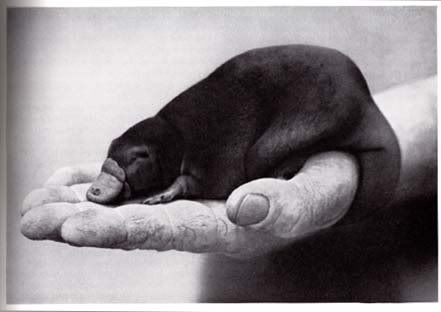
Tiny Platypus

Continuing the trend of photographs of tiny, baby animals in someone's hand: the platypus.

Friday, May 11, 2007

Leviticus Summarized

The concluding verse of Parasha Behar, Leviticus 26:2, is one of the Torah’s many instances of summarizing proper religion in a pithy sentence.

Many people are familiar with Yeshua’s summary in Matthew 22:35-40 ("The two most important commandments..."), Micah’s summary in Micah 6:8 ("He has shown thee..."), and James’s summary in James 1:27 ("True religion is..."). Other "summary verses" in scripture include Deuteronomy 10:12 and Ecclesiastes 12:13.

Hillel had a summary very similar to Yeshua's: it included the concluding phrase "...go now and study!" Finding summaries of Torah worth pondering was actually an intellectual game among first centruy Jewish scholars.

Here in Leviticus 26:2 God offers a summary focusing on spending time with him: “Keep my Shabbats and revere my sanctuary; I am Adonai.” In other words, “Rest with me and share meals with me.” The message of Leviticus, at its core, is that simple.

There are other worthy things for congregations to do: prayer, study, charity, fellowship, outreach, etc. But none of these other activities will be help God do what he wants done and extend his Kingdom unless the congregation is resting with God and sharing meals with God. Those two activities have always been how God rejuvinates and transforms people. Once we are rejuvinated and transformed by God then we can do other activities fruitfully.

Matthew Study

The congregation has started a weekly Bible study, going over Matthew's gospel. My essays about what we have discussed so far are here. More will be added weekly.

Wednesday, May 09, 2007

Tao of Yeshua: Chapter 49

49
The Saint has no prejudices.
He gives all people the benefit of the doubt.
"I am on good terms with the righteous and the wicked: thus I obtain goodness.
"I am faithful to the trustworthy and the untrustworthy: thus I obtain faithfulness."
In the midst of All-under-heaven the Saint makes no distinctions.
For the sake of All-under-heaven he allows chaos in his heart.
The people rivet their ears and eyes on him.
The Saint treats them all like innocents.

We should love others as we love ourselves.
What does this mean?
How easily we accept excuses for our failings!
Extend this same forgiveness to others.
We care for ourselves even when we sin.
Extend this same kindness to others.
We are faithful to ourselves even though we abandon goals we set.
Extend this same support to others.
At times we still see in ourselves the neediness and innocence of infancy.
Extend this same insight to others.

The 2007 Squirrel Count Begins

I had not been blogging much as Winter began to transition into Spring and squirrels came back to the back yard and garden.

Our 2007 squirrel count (how many squirrels we live trap and then release far from home) is up to 3 so far.

Last year's annual total was 15.

Tuesday, May 08, 2007

UFO Cookies

This recipe could still use a little tweaking, but I'm not sure how and it's nice enough as it is.

Preheat oven to 350 degrees.

In a large bowl (or electric mixer's bowl) combine:
  • 4 whole eggs
  • 1 cup brown sugar (not packed)
  • 1 cup yogurt, nonfat vanilla
  • 1 Tbsp vanilla
  • 3 cups gluten-free flour mix
  • 2 teaspoons xanthan gum
  • 1 1/2 teaspoons salt
  • 1 1/2 teaspoons baking soda
Give the dry ingredients a stir with the teaspoon you are holding, to distribute the xanthan gum into the flour mix before it gets wet. Then mix everything well.

Put rows of small cookies on a greased cookie sheet (or cookie sheet with a silicon mat). On each cookie put one Trader Joe's "UFO" chocolate mint. Your cookies should be small: just enough to make a little ring of dough around the mints as you press them down.

Bake on a for 15-17 minutes, until the bottoms are browned.

(The recipe also works as a bar cookie, if you melt the "UFO" mints with some heavy cream in the microwave and drizzle that on the top.)

Pizza Theology

I was reading comics this morning over breakfast, and Count Your Sheep had another gem.

One of my father's coworkers had a favorite "saying":
Pizza is a proof we existed in heaven before we were born. Why do I say this? Because everyone instinctively knows the taste of perfect pizza. We could just have finished a dinner of the best pizza we have ever eaten -- even the best pizza in all of Italy -- and we would still lean back and say, "That was amazing, but it's still missing a little something..."
The same coworker would also say, "Chocolate is one proof of a kind and benevolent God."

In a somewhat reverent manner regarding pizza and chocolate, even most athiests and agnostics I talk with seem to find it disrespectful to argue with either asserion, whether or not they agree.

Sunday, May 06, 2007

Making Flowers Last Longer

Since Springtime is here, some tips I did and didn't know before reading them...
  • Cut flower stems at an angle, under running water, before placing the flowers in a vase. This prevents air from entering the stems and clogging them up.
  • Warm water in a vase will make buds open faster. Use room-temperature water for flowers that are open and pretty. Slightly wilted blooms can often be revived by submerging the stems in hot water for ten minutes while spraying the petals with cool water.
  • Mixing into the vase's water a small amount of sugar or an asprin tablet will keep flowers fresh longer.

Tao of Yeshua: Chapter 48

48
Learning is daily accumulation.
Following the Way is daily diminishing.
Diminish, and again diminish, until you reach Non-Ado.
Abiding in Non-Ado ensures nothing is left incomplete.
Gain the world by constantly abiding in Non-Ado.
Serving your own ends you are unable to gain the world.

Following Yeshua involves dying to our desires.
The Spirit allows all things to develop naturally.
Abide in the Spirit and experience the world as it is intended to be.

A Mathematical Toolbox

For my Math 25 class I am trying to put together just what is in my metaphorical "toolbox" of math skills I use when thinking about how to approach real-life math problems.

I'm keeping track of this here.

I need to develop some lessons about this concept for the first week or two of Math 25 in future terms. One issue I have not fully processed is whose toolbox to teach about. I'm sure that my toolbox would look different than an A-level Math 25 student, and both would look different from a C-level Math 25 student. Do I try to teach "tools" at the most useful and advanced development of each concept, or the "tools" as they less useful but make more immediate sense to more students?

(For example, in my mind finding the percent of a whole number and the percent of another percent is one concept. But to most C-level Math 25 students these are two very distinct algorithms, since one involves changing every percent to decimal format and the other does not. As another example, when finding the percent change between two numbers is the final step "multiply by 100" or is that not a distinct step and merely part of how to see the decimal result of the earlier division?)

Bedtime

Why am I blogging after midnight?

Last night was a nice Erev Shabbat gathering.

This morning I got to sleep in late, since P'nei Adonai has no Shabbat services the first weekend of each month and I could not visit another congregation because of a noon appointment.

At noon I got to meet with a friend and help her plan a budget and try to get her finances in control. I normally avoid money issues on Shabbat, but no other day would work last week or next because of her work schedule and the congregational picnic tomorrow, and this was charitable activity instead of economic activity for me. She got the help she wanted, and knows to find how many hours per week to ask to work at a new job.

In the afternoon I got to relax around the house, and invented a new cookie recipe to celebrate Trade Joe's having UFO mints in stock again after a month's absense. (They had been sorely missed by my wife and some other friends; I almost expected to see UFO mints appear on the commodities exchange market.) I need to play with the dough a little more before blogging about the recipe, but image a tiny gluten-free eggy sugar cookie with a UFO mint in the middle.

Then I was tired, and took a long nap. My wife was in a cooking mood, and invented a gluten-free ravioli recipe. Needless to say, this was delicious but a lot more work than my cookies.

My wife and I have been enjoying a new computer game. Unlike our old favorite, we cannot share the same civilization. However, the games are often as short as 30 minutes (AoK is normally 60-70 minutes) and they involve a much stronger sense of map control, which is very pleasing during game play.

When I woke up from my nap it was after 9pm, and my wife had already had dinner and was playing the computer game. She paused it to make me some fresh ravioli, and also made more for herself. Then she went back to her game and I started blogging.

Unlike our multi-player games, she plays single-player at a very challenging level and the games are sometimes quick but sometimes take a few hours. This game was unusually long, so you get to read a lot of blog stuff. Everyone wins!

(I still have not touched my pile of ministry-related articles to blog about. I managed to type for a few hours just about the things I have been processing lately. No time lately for merely retrospective blogging.)

Now it's bed time.

Pleasant dreams!

The "Local Church" Movement

I found out about a month ago that several of my swing dance friends are part of the Local Church movement. One of them is likely to become the new P'nei Adonai nursery worker.

Among other things, this movement is trying to be like a first-century congregation. However, the history of the movement involves a rather elaborate example of the telephone game.

The movement's publishing house uses authors that lack an understanding of first century congregations through current scholarship and Jewish culture's preservation of its history. Instead there are the general and often innacuare ideas about the first century popular several generations ago in American seminaries, filtered through Christian culture in China, and then brought back to the United States.

It will be interesting to see what comes of the new connection between P'nei Adonai and this other local group trying to be like a first-century congregation. Having visited the other group's service one Sunday I know both groups have things they do well. The exposure to other valid and simple ways to express devotion to God could be very fruitful sharing.

Landscape Photos

Ooooh pretty.

I like how landscape photographs tell stories. I suppose the opposite, in some sense, would be a painting about telling a landscape story.

Tao of Yeshua: Chapter 47

47
Without opening the door you can know All-under-heaven.
Without looking out the window you can see the Way of heaven.
The further you seek the less you will understand.
Therefore the Saint understands without traveling,
knows about things unseen,
and achieves without acting.

A person unable to know Adonai at home, in stillness
will not benefit from searching, or going elsewhere.

Saturday, May 05, 2007

After Salvation from Slavery to Sin

This is an interesting article, in context, in part because so many old sermons have pointed this out.

Somewhat related is this other article, one of many I've seen recently about how liturgy, used in a balanced way, is making a comeback.

Biodiesel versus Bioethanol, Prius versus Hummer

Eugene is notorious for being very concerned about the environment. We have a new eco-friendly gas station whose company makes their own biodiesel, largely from used cooking oil from a few large local companies.

Biodiesel makes sense. My collegues in the science department at LCC tell me that 5% of thus U.S. gasoline usage could be replaced by biodiesel if all factory and restaurant cooking oil was recycled in that manner. (Five percent might not sound like a lot, but that would be an extremely significant change.)

Bioethanol, on the other hand, is not yet helpful. Ethanol is already used instead of MTBE by most gasoline companies during summer months, when they are legally required to have 10% additive for cleaner burning. Since that demand currently is sufficient to exhaust current U.S. ethanol production, using special bioethanol fuels does not actually reduce how much pollution the country produces overall. Until ethanol can also be efficiently produced from local waste products (instead of from crops grown to be fuel) the energy cost of growing and transporting it prevents it from producing any significant change (see "energy balance" in the previous link's page). This technology may well be developed within the next decade, but it's not yet just around the corner.

I know someone in Eugene, who upon seeing so many bioethanol bumper stickers, remarked, "It's a sign that their heart is in the right place even if their brain is not."

Changing the topic, this is entertaining.

UPDATE: Toyota announced a plan to have all their new cars by hybrids by 2020. The Futurist predicts that by 2020 such a stance will not be notable.

Star Wars posters

Sorry, but no comparison.

This one is funny. What force powers? Enlist now!

This one somewhat bugs me. The decorative design elements are exemplary of Star Wars artwork in mixing straight lines and curves in a distinctly "futuristic" manner. But the character art does not match, and so many characters and attitudes would fit in that place better than Padme in that pose.

Two Statues

One and two.

Another Skateboard Update

I still can't ollie.

But it's Springtime and getting sunnier! Maybe I will have time to practice soon.

(Monday mornings I teach an "Introduction to Messianic Judaism" class at a place in Springfield very near the county's most famous skate park. I might leave the house early...)

Firefighter

I have another friend who is getting a job as a firefighter.

Her job is actually a wilderness firefighter, not a city one, but the only funny picture I can find is this one.

Can't keep my eyes from the circling skies

I have a friend, one of whose favorite songs in high school was "Learning to Fly", who 17 years later is at a point in her career and life where she is finally taking flying lessons.

I'm very happy for her. I expect it would have happened even sooner, except that recent years have been busy with her marriage, moving, and other big changes, which have certainly been even more central to her happiness!

Since she has also retained her sense of humor from her youth, here are two pictures for her office door. ;-)

Friday, May 04, 2007

Two Open Source "Commons"

Today is "Spring In-Serivce" at LCC, when classes are canceled and employees attend meetings all day.

The best meeting so far mentioned two websites related to the "Open Educational Resources" or "Open Courseware" movement.

The first, oercommons.org, is an archive of positively reviewed free material. Besdies this resource there are few colleges such as MIT use their reputation to claim all materials are worthwhile, and other colleges that participate in cooperative consortiums with rules for quality of shared content.

The second, creativecommons.org, is a website that allows anyone to easily create personalized copyright and terms-of-use information for material they wish to share on the internet.

Another "Count Your Sheep" Gem

Do you love all your toes equally?

(For my old post about this comic, with my other favorites, go here.)

Friday, April 27, 2007

A Better Temper

In June of 2005 I got new glasses. I opted to get "transition lenses" that changed from clear into sunglasses when exposed to the UV rays of sunlight.

This was a mistake! It turns out "transition lenses" only work for a year or two before they stop changing readily. Having glasses that stopped becoming fully clear was a great bother. Since my prescription is fairly mild, I stopped wearing them most of the time when indoors.

This week I finally got around to taking the glasses to the optometrist to see what could be done. For no charge he "retempered the glass", whatever that means, which supposedly fixes them for a month or two.

So far they are working again. Hooray! In June my insurance will allow me to get new glasses once again, and I'll get a new pair without "transition lenses".

Tao of Yeshua: Chapter 46

46
When the world follows the Way, warhorses will be used as cart-horses.
When the world abandons the Way, warhorses will be raised in sacred places.
The greatest disaster is to obtain more desires.
The greatest lack is not knowing how much is enough.
The greatest sin is covetousness.
To be content with enough is to always feel rich.

We can have Yeshua!
We need seek after nothing else.

Tuesday, April 24, 2007

Superman is More Super than your Honor Student

A while ago I mentioned a Livejournal group that shares funny images from comic books.

For example, a foe Aquaman must really punch energetically Superman need merely tap with one finger.

Also, Wonder Woman might wield her greatest weapon but Superman merely laughs.

(Of course, it is no secret that Superman is often rude.)

Google Maps and Swimming

A friend shares with me that if you ask Google Maps how to go from New York to London, step #24 will be to swim across the Atlantic Ocean.

A Campus Horror and the People of God

Part of being a Messianic Jewish leader is receiving news that not everyone else receives.

Regarding the shooting at Virginia Tech, I've been shown web articles with the response by Campus Crusade for Christ (how's that for a non-Messianic name) and the response by New Life Christian Fellowship. Members of the first group include the student who discovered the dorm room shooting's aftermath, four of those killed, and one of the two who was allowed to leave a classroom unharmed. The second group had two members among those killed.

You may have also read about Liviu Librescu, a Holocaust survivor who died heroically that day.

According to a peace officer involved with the crime (no link, not a public report), Cho was not only fond of Ismael but was quoting verses from the Koran during his killing. Also, Cho apparently did not randomly pick his targets but rather chose classes that had high concentrations of Christians and Jews. This does not show Cho thought of himself as a Muslim in any sense, but he was certainly influenced to imitate a Muslim hero (as well as other things). Yet again someone overcome by evil takes out his wrath on the people of God.

Barna and Revolution

In this earlier post about Messianic Jewish culture I mention a triend among American Christians. I should give credit to George Barna for writing about this trend well in a book entitled Revoultion.

Back at the End of April

Hello again!

Life has finally calmed down enough that I can do blogging again.

The week before and after Pesach were very busy just because of congregational issues. Then I got busy because the math class I am teaching this term is one I have never taught before, and shifting from doing a mediocre job teaching to a best-possible job teaching required a lot of work. Now I just have a lot of yard work to do.

Moss Update

The moss in a blender trick works, quicker than advertised. :-)

Math 25 Changes

This term I am teaching Math 25 for the first time. This is a class about group-work activities involving practical math.

Ideally, the class gets through three activities each week. There are seven weeks of "core" activities required by the different academic majors that use Math 25 as a graduation requirement or prerequisite.
  • Week 1: Percent Review, Restaurant Tax and Tips, RCMP Licensing Percents
  • Week 2: Checking Accounts, Budgeting, Mortgages and Annuity Tables
  • Week 3: Simple and Compound Interest, Charge Options
  • Week 4: Retirement Planning (and Midterm #1)
  • Week 5: Health Formulas
  • Week 6: Payroll, Employee Taxes
  • Week 7: Floor Plans and Scale Drawings, Markup, Discount
Three subsequent class days are for assessment. There is a second midterm. There is a math "skills test" during Week 9 that looks a lot like a Math 20 midterm. A big portfolio focusing on an out-of-class project is due after once class day devote to letting students finish it up in class.

The other class sessions are for "instructor discretion" activities. In other words, past instructors have composed a collection of activities and each term whomever is teaching the class picks 3-5 of these, makes up their own, or lets students pick which to do. (The last day of class is usually set aside for review before the final exam.)

Due to the needs of the different majors making use of Math 25, some aspects of the class cannot be changed. Students are supposed to be learning how to apply mathematical problem-solving techniques to situations they have not seen before. So the class must focus on group-work about real-life activities. The instructor may not lead students by the hand through these activities by presenting similar problems to mimic or by answering so many student questions that step-by-step answers are provided. Neither may activities be grouped by which mathematical techniques apply to them.

(These requirements are understandably unpopular with many students. It would be much easier for them if we went through all of the "percent of percent" activities together, with lots of example problems to mimic and step-by-step guidance. But students would leave the class have gained little helpful experience in problem-solving.)

Four weeks into the class, it is clear that the following changes would be helpful. I am still tweaking the details of each for fine tuning, and soliciting student feedback on these ideas and other suggestions...
  • The "skills test" should happen at the end of Week 2 or the beginning of Week 3, in addition to happening at the end of the term, with students being graded on their highest score. An early version would encourage students who did not master the Math 20 material to visit office hours early in the term for help. Students who had mastered Math 20 material could do well the first time and have the option of skipping the test in Week 9 when they have a lot of work due in their other classes.
  • Probably once (but maybe twice) there should be a class day devoted to remedial review of Math 20 material. Students who did not need this would not attend this class and instead do an out-of-class activity. This activity, representing 1 of 20 class days, would be worth 5% of the overall grade, which would be a 5% that the students receiving the remedial help would be forfeiting. But those students are not aiming for an A+ anyway, and an entire class focused on their needs would help a lot more than 5% over the course of the term.
  • The next time I teach math 25 I will probably not do any of the established "instructor discretion" activities. Instead, I will push back the "core" activities two weeks, so these do not begin until Week 3. This would provide time at the start of the term to carefully develop the skills students have learned in Math 20 into a real "toolbox" of techniques with which to approach real-world math problems. For example, the concept of "percent of percent" occurs in multiple activities (RCMP Licensing, Compound Interest, Retirement Planning, Markup, Discount), but currently in a way that appears haphazard and confusing to many students; if that concept was solidifed before a bunch of activities were presented then the students would be better prepared to see these activities as using something from their "toolbox" instead of each being an isolated task needing its own procedure to solve it. Problem-solving approaches are themselves a valuable "toolbox tool" needed in this class, which could also be taught during the first two weeks.
Unrelated to the class itself, this term more students than before are having trouble with LCC's Moodle website. There is not much I can do if the web browser on their computer at home is set to not download certain file types. But over the summer I should definitely use a college computer with Camtasia to record an "introduction to Moodle for students" screen-capture movie with voice narration.

Long Hair Update

I wrote about a month ago about paying a little more attention to my long hair. Some quick updates...

I've purchased a wooden comb, which does work better with wet long hair than the brush I was using. It's also easier to keep clean. But I simply bought the first one I saw, and should probably get one with wider gaps between teeth.

Trader Joe's citrus conditioner is increasingly all my hair needs for cleaning, and shampooing less often has helped my hair become much less prone to tangles. It has a few cleansing agents which do the job unless I have been in an usually greasy environment. (It is free of "cones", for those who care to know.)

I've learned to braid my hair, but am not very good at it yet. Dividing my hair into thirds with "top, lower left, and lower right" as per this post works well even with a braid that starts at the nape of my neck. I've only worn it this way in public once.

Eat Like a Monkey

I often each lunch at LCC in the Math/Science faculty lounge. One of my colleagues often has a banana with his lunch, and always opens them from what I call the "bottom", meaning the flower side, not the stem side.

This is just as easy to do (if not easier once you have a little practice), and if you squish the banana at all then all you squish is the end you don't eat anyway.

Last Shabbat I was telling this story to another friend, who replied that he knew this trick already. He has a friend from the Philippines who routinely tells American tourists, "Monkeys know how to open bananas, why don't you?"

First Century Worship vs. Transformed Rabbinic Worship

What a Messianic Jewish congregation's culture looks like is very important, for two reasons.

It is important practically for individuals, because it provides the answer to the question, "Yeshua has given me victory over sin... now what?" Gentile churches tend to answer this question by providing people with programs. To the Jewish mindset, programs are impersonal and uncaring. It is better to have culture, which is relational and caring.

Culture explains what to do each day and what special things to do on holy days. Culture explains how to do things: ways to pause and focus on God throughout the day, ways to spend time with God alone or with other people, ways to study scripture, ways to pray, ways to use Torah obedience to express love for God, etc.

The only program P'nei Adonai has is our "Introduction to Messianic Judaism" class. I tried getting rid of it, but it turns out I can't. There's no way to have a Messianic Jewish lifestyle answer people's questions quickly enough without some forced help.

What a Messianic Jewish congregation's culture looks like is also important for group identity, because Yeshua came not only to transform the lives of individuals but also to establish a community that continues his work and represents his name and body. Our congregational culture provides the answer to the question, "What part are we in the body of Messiah?"

In one sense the Messianic Jewish answer to this second question is summarizable: we are the part of the body of Messiah that cares about being in relationship with the local and global Jewish community, and that helps Gentile Christians come to fullness in their responsibility (of Romans 11) to stir unbelieving Jews to a jealousy of relationship with Yeshua. But in another sense this question needs a cultural answer, not merely a purpose statement. What does our part of the body of Messiah look like?

For any Messianic Jewish congregation there are two obvious answers to both of these cultural questions.

One answer is to have the congregational culture based on the culture of those who worshipped Yeshua in the first century. After all, an imporant part of Messianic Judaism is understanding what that culture was like, when those following Yeshua were still a sect of Judaism, before the faith had been reworked as a new and distinctly anti-Jewish religion. There are two issues with this answer: much of that first-century culture is simply unknown to historians; of what we do know, how much is appropriate to transfer to our current time and place?

Another answer is to have congregational culture try to look like what the local, modern Jewish community would look like if revived and transformed by faith in Yeshua. This is also an appealing answer, becuase it makes sense that a Messianic Jewish congregation would look like what it hopes its surrounding Jewish culture might become. There are again issues: what would this new culture look like? how much of the diversity of Jewish culture should one congregation try and represent?

During the past three months, we at P'nei Adonai have realized that we were trying to grow in two different directions. Without realizing it, we were trying to be both like a first-century congregation and like a revived and transformed modern Jewish community. Since these to models disagree in many ways this caused problems.

We have also realized that our particular congregation must be the modern version of a first-century congregation. This is more appropriate for us and our calling for a number of reasons.

For the remainder of this essay I'll share four issues that are examples of how where disagreement was happening, and why in each case the first-century model is more appropriate for us.

None of these responses are meant to imply that a modern Jewish community revived and transformed by faith in Yeshua would not eventually do what needs to be done equally well. Rather, the first-century model provides much more guidance about where to start and what to look like.

(1) A Messianic Jewish congregation should provide a family-like community for people. It should also provide a variety of resources to help people who are not regular attenders grow spiritually.

Many American believers are looking to religious groups for resources instead family-like community. (Of these people, many already are part of another religous group with family-like community but that group is not able to offer them all the resources they desire. In days past they would simply have been frustrated, but in modern America people are used to networking and finding the resources they want.)

This dynamic is especially relevant to Messianic Jewish congregations, since part of that calling is to help Gentile Christians understand the Jewish roots of their faith to help them have a more meaningful relationship with Yeshua and also to help them stir unbelieving Jews to jealousy. We need to be offering resources to people who seldom (if ever) set foot inside our doors.

The first-century Jewish synagogue had this balance. It was in part a weekly house of prayer for its regular attenders. But it was just as much a provider of resources: Jewish families would pay dues and in exchange receive emergency aid including family burial costs, temporary food and lodging, and medical assistance. The synagogue also provided these families help resolving interpersonal disputes and tutoring in scripture study. Once followers of Yeshua began forming their own communities these same services were offered to outsiders for free.

The modern American synagogue (or local Jewish community) is not known for this balance. What resources does it provide to outsiders, especially non-Jews? (They do provide generous charitable aid to Israel, which is not local but is still within the greater Jewish community. Other ways they give may be present, but tend to be not well known and of small scale.)

(2) Spiritual growth is the responsibility of the individual.

Scripture is clear that every person is responsible for their own relationship with God.

Community can surely help. People in family-like community can support and encourage each other, and keep each other accountable. A community's leader can provide resouces, guidance, and protection.

But congregations that try to make spiritual growth the responsibility of the entire community or its leaders see most people stagnate. This happens in both Jewish synagogues and Christian churches. The scriptural model of the assembly is not a shepherd caring for passive sheep, but an overseer providing teaching and resolving disputes for a congregation of active people with a priestly and evangelistic identity.

The first-century followers of Yeshua initially participated in the established local synagogue on Shabbat mornings while meeting together at the close of Shabbat. Later, as they encountered increasing resistance from the Jewish authorities, they established their own congregations. Paul writes of only two congregational leadership roles, equivalent to the well-known roles of synagogue leader (teacher and judge) and "shamashim" (custodian and hospitality help). No other roles were invented and the community's primary purpose remained individuals supporting individuals growing increasingly holy and near to God.

The modern American synagogue (or local Jewish community) is not known for helping people with their continued growth in holiness and nearness to God. To the contrary, participating in the synagogue or community is in many placed equated with a healthy religious life, replacing that better goal. Group participation and public displays of virtue often replace an individual's responsibility for actual spiritual growth.

(3) A congregation should model transformed lives and the virtues of faith, selflessness, charity, kindness, and simplicity.

All of these things were what the early followers of Yeshua were known for among non-believers. Even their enemies admitted that believers exemplified these things as individuals and communities.

None of these things are what modern Rabbinic Jews and their communities are known for. The stereotypical American Jewish community is busy dealing with people-problems, humanist and agnostic, inward-focused, works-based, full of gossip, and not at all about a simple faith.

(4) The Messianic Movement should responsibly interact with other current moves of God.

Currently God is doing something among American Gentile Christians, stirring a desire for personal renewal, recommitment to God, and a life full of passion for God. (In contrast, earlier American moves of God were usually about evangelism, not recommitment among believers.) Messianic Judaism should be responsible and try to work with this while preserving its own identity and calling.

This is related to what was mentioned earlier about people being newly willing to move beyond the boundaries of their own "Church home" to find additional resources, and how a Messianic Jewish community should offer resources about the Jewish roots of Christianity.

Our recent congregational Passover seder was a nice example of this dynamic. About 50 people attended, and about half of those were people with a different "Church home" who left thanking myself and P'nei Adonai for hosting a worshipful, meaningful, and educational evening that had helped them better understand God's ways and plans.

Regarding this issue the first-century community model has much to offer. There are too many details to explore in this essay. A summary is simply that even if not all believers are called live in first-century ways, a Christian who is thinking, "I'm saved and now what?" is usually well advised to look for answers by considering how first-century believers lived.

The modern American synagogue (or local Jewish community) also has a lot to offer. There are numerous examples in America of synagogues and churches working together, often using guest sermons to give Jews a better understanding of their Christian neighbors and to give Christians a better understanding of the Jewish roots of their faith. However, Christians asking "I'm saved and now what?" don't look to Rabbinic Jewish groups for answers about how to have more intimacy with Yeshua.

Tao of Yeshua: Chapter 45

45
The most flawless seems cracked.
But it never wears out.
The greatest fullness seems empty.
But it never runs dry.
The most straight seems crooked.
The most skillful seems clumsy.
The most eloquent seems awkward.
Stamping overcomes cold.
Stillness overcomes heat.
Purity and stillness are normal in All-under-heaven.

The Father is present even when he appears absent.
The Spirit fills us even when we feel empty.
Yeshua is righteous, skilled at saving, and speaking truth.
In stillness we can see these things.

Three Letters from Teddy

I've read the story "Three Letters from Teddy" a couple times before. I suppose most credentialed teachers in the U.S. have done so.

Still, the new slideshow of it made my cry a little. (Since I'm at work, I had the sound off. I wonder if that matters for the emotional impact of such things.)

Friday, April 13, 2007

Absentmindedness

Happy April!

I have had a lot on my mind lately about congregational stuff, which turns into a lack of blogging until I am a bit more complete with processing these thoughts. (Some topics are conducive to use blogging to help my process thoughts, but not these).

In the meanwhile, some humor.

Yesterday I finally, for the first time in my teaching career, was spaced out about which day of the week it was and had someone stop by my office to tell me my class was waiting for me downstairs. Oops. Fortunately, my students were forgiving that I wasted some of their time.

This actually was not the most absurd instance of absentmindedness during the past few weeks. On April 2nd I had a very busy day: phone calls in the early morning, leading an "Introduction to Messianic Judaism" class in the mid-morning, preparation for and teaching of a math class at LCC in the middle of the day, getting the home ready for Pesach in the early afternoon, and leading a congregational seder for fifty people all the rest of the day. Everything went quite well, but I was kept from feeling too much like I was "on top of things" by noticing, as I got ready for bed, that all day long I had been wearing my boxer shorts backwards.

An important part of Messianic Judaism is that congregatns disciple each other to be more like Yeshua, not more like each other. May this blog post remind my congregants not to try to be like me, but to be like Yeshua! He knows what day of the week it is, and wears his underwear properly.