(Note that this essay describes what boys hear. I am not concerned with what is true. Indeed, most of these societal proclamations are clearly unscriptural.)
You Are Thanklessly Disposable
Men are disposable and women are protected, even when a society no longer faces dangers large enough to possibly require repopulating after a catastrophe. Men are drafted, women are not. Men drown, women get lifeboats. Even young boys are expected to sacrifice themselves to protect a woman.
You are less likely to graduate high school, go to college, earn a degree, find a desirable and willing spouse, and die of old age. No one is working to fix these things, even though society was willing to radically change when women suffered them.
Very few people in a man's life care what he is going through: men who cry in public are ignored or shunned, whereas women are afforded support that men will never know. The default male-male relationship is competitive (for resources or female attention) unlike how women give each other preferential treatment.
Violence against men is undervalued and not discussed.
You Are Thanklessly Servile
Masculinity is defined by how well men accommodate women. A man is a good husband if his wife is happy; a woman can be a good wife even if her husband is unhappy. In a family where both parents work, the husband is financially successful when he provides well for his family; the wife is financially successful merely by seeming strong and independent. When both spouses work at fixing a troubled marriage, society expects the wife to give the husband a grade of pass or fail.
Men are expected to serve women unconditionally and without expecting reciprocity. Women are excused from serving men they do not respect, and are not even required to express thanks for male service. A husband is expected to demonstrate respect and servility whether or not his wife has earned it ("Yes, dear"); a wife is excused from serving her husband if he has not earned her respect.
Boys are taught to sacrifice any career or lifestyle ambitions that would not lead to supporting a woman. Single men are encouraged to "settle" for a spouse; single women are fed fantasies about finding Mister Right. Single men in their thirties are discouraged (by women their age and older) from marrying women ten years younger despite some obvious advantages for both spouses. Single men over forty are expected to risk much by marrying women their age; single women over forty are allowed to ignore it when they bring nothing to the legal marriage contract and risk nothing.
Men are taught that women inherently deserve respect, compliments, aid, provision, and protection—even women who can provide for themselves, protect themselves and/or have proven themselves unrespectable. Men do not inherent deserve any of these things.
Your boyhood natural learning style that included moving, touching things, and sometimes being loud while learning is an inconvenience your female teachers do not understand or empathize with; it annoys them and so it will be suppressed. There is almost no research about how to make the classroom more appropriate for you. In contrast, feminine learning styles such as collaboration, essay questions, and prioritizing interpretation over facts are well-researched and increasingly prevalent at every grade level.
Girls get priority. They get served food first. They get seated first. They sometimes get to go first in line. When you take turns playing with a toy, your turn is shortened more by a girl's impatience than the impatience of another boy. When you are smart you may not enjoy using your learning competitively or take pride in your knowledge because that threatens girls: your teachers train you to hide your knowledge when it might hurt a girl's self-esteem.
A "Men’s Project" is something done by yourself and never fun, such as changing a tire. A "Women’s Project" is something fun to do in a room full of people, such as making jam.
A woman's expectations about a future spouse are more esteemed: a man is less masculine for complaining that has difficulty finding a "Quality Woman", but a woman is justified when she bemoans there are no "Real Men" anymore.
You Are Thanklessly Accountable
Men are accountable for their own choices and those of women around them; women can often avoid responsibility even for their own choices. If a career man and housewife have spoiled children this reflects on him, but if a career man and housewife are not earning enough money this does not reflect on her. If a man overcommits he should have known better and is blamed for each failure; if a woman overcommits she is excused as still learning to multitask well and as being too empathetic to wisely say "no" to more requests for her time and and energy.
Uniquely masculine efforts are not appreciated by society and thus cannot be empathically appreciated by women. Men are simply expected to control their tempers, be faithful to a spouse, at work emphasize teamwork and process instead of the goal, etc. Men must apologize for their male desires. Yet uniquely feminine efforts are praised by society, and female desires are praised ("you go, girl!") or excused ("women get to change their mind", "women are mysterious", "women are like that").
Men are inescapably under the motto "produce more than you personally need or perish". Women can escape that burden by having a child, whether or not they love or properly care for the child.
Your entire life the people you care most about pleasing (women) teach you a lie about what they want (being comforting is your only goal, even though being comforting stunts and hides the playfully aggressive self-confidence that both genders find attractive): when you obey their teachings they lose respect for you, shun you, give themselves to people other than you, withhold from you, and divorce you.
You Are Immoral
Feminine virtues (being softly nurturing, empathically compassionate, sweetly considerate, etc.) are extolled. Masculine virtues (stoic independence, aggressive self-confidence, rugged individualism, heroic risk taking, rational problem-solving, focused pursuit of goals, curiosity leading to innovation, thirst for knowledge, insatiable need to create things, attractive physical strength, ambition harmonizing with contentedness with what you have, etc.) are watered down sufficiently for average women to qualify and reframed as gender-neutral virtues. Masculinity is maligned as chauvinism. Suggesting that men may be more naturally capable at some virtues is offensive, even with obviously true examples such as innovation without personal application.
Men are not shown leniency for masculine vices the way women are shown leniency for feminine vices. Pretending to enjoy masculine vices is seen as immoral (playing violent sports and video games, dreaming up immense building projects, mentioning lustful desires while people-watching women). Men are even shamed for having the mere capacity to display masculine vices.
All-male spaces are now allowed; all-women spaces are valued as needed refuges. Old Boy’s Clubs are justly seen as sexist because they are so liable to view feminine behavior as "rocking the boat" even though the same is true for the much more numerous Old Girl’s Clubs.
Male leadership is inherently suspect, if not evil.
Women are "the fair sex", "your better half", "more spiritual", and sometimes even "innately good". Men are the opposite.
Male sexuality is dangerous and evil. Young men are never encouraged to explore their sexuality; young women are. While dating even mild physical intimacy with a girl is taking advantage of her. Husbands who enjoy sex more than their wives for purely biological reasons are still doing something wrong.
Male successes are unfairly won, so their property should be redistributed. Male innate immorality hinders a masculine man's betters (women and feminine men) from building a better society.
What You Produce Is Not Yours
Your money is not yours. Alimony was once a sensible solution to repay a divorced woman for giving her most energetic and physically attractive years to her husband and family, but it now applies to women who marry older.
Your marriage is not yours. It is still properly viewed as legitimate grounds for divorce if a married man has a purely physical affair with a prostitute he never sees again even when this has no impact on his children or wife; yet it is becoming socially acceptable for a married woman who finds a more attractive man to have an purely emotional affair, divorce, and after remarrying include physical intimacy.
Your children are not yours. Whether children you conceive will be born is only the mother's choice. Whether you get to see any children you have is only the mother's choice. Yet you must be prepared to financially support all children you conceive even accidentally. If you have children while married and then divorce, your wife will get the children. If she cuckolds you then you will probably pay for those kids either while married or after divorce through child support. Any enemy can file a false claim of witnessing abuse and have your children removed at least temporarily.
Your creations are not yours. We are taught that society was created by everyone, but how many things in your home were not either invented or built by a man?
Your career is not yours. Any woman can use a claim of sexual harassment to destroy your job.
Your years are not yours. Any woman can use a false claim of rape to put you in jail.
I write the above because I am raising two boys. I am responsible for teaching my boys how to deal with the burden of What Boys Hear Growing Up.
If you are the parent of a boy you are also responsible for teaching your boy how to manage this oppression. (Oppression, you ask? Yes, even though it is apples and oranges compared to discrimination.)
I have faced discrimination as the token white person teaching in an inner-city elementary school, the token male teaching at a preschool, and as a Jew expelled from the Jewish community for believing what Yeshua claimed about himself. In discriminatory situations the pain is lessened fourfold: (1) the problems are caused by individuals, so the victim knows with whom he or she was dealing; (2) the discrimination comes as a series of actions so the victim can see what to respond to; (3) the victim knows peers like himself or herself who provide understanding, encouragement, and advice as the victim struggles with the troubles and develops self-identity and self-confidence; (4) the victim has memories of how overcoming prior discrimination helped him or her grow, which provides a trust that overcoming the current problem will also make him or her stronger.
The oppression of What Boys Hear Growing Up has a very different flavor. There was no one person who puts this psychological burden on boys. It did not appear suddenly as individual actions than can bravely fought and with overcoming cause growth and strength. Instead, it is a weight of things claimed to be wrong with you that no one (even boys or men) understands or offers help managing.
I am sure a mother could compose an equivalent essay about What Girls Hear Growing Up. I would love to read that.
How do we help our boys deal with What Boys Hear Growing Up? I can think of four helps.
First, discipleship. If we are disciples of Yeshua and learn to see the world as he does then we
will have proper understandings of ourselves and other people. If boys
learn to live as Yeshua did, they will develop the proper and timeless
masculine-appropriate behaviors. Having Yeshua's worldview nullifies the
psychological burden of What Boys Hear Growing Up.
Second, training in social skills. Scripture does not teach the social skills specific to a day or culture
and we often have trouble learning these from the Holy Spirit. So
attentiveness to them helps. Parents should teach their sons how to be have enough
aggressive self-confidence to be attractive without being pushy or rude, how to be focused on a goal while leading proper teamwork among group
members, etc.
Third, exposure to appropriate masculine role models for their age.
Fourth, the kind of cooperative development and responsible wielding of aggressive self-confidence learned at places of mild ritual violence: the martial arts dojo, the military academy, the physically demanding team sport. There they learn about many dynamics of all-male groups: group members being aware of each other's strengths and weaknesses, leadership based on merit, recognition fairly awarded to all group members, repeatedly overcoming obstacles for personal growth, etc.
UPDATE: On a somewhat related note, I came across an interesting study in which researches discovered the prevalence of single women in management created a hiring bias favoring attractive men and women whose appearance is unknown during hiring, and a bias against unattractive men and attractive women. At least according to that study (which, atypically, involved real job applications instead of simulations, and did not focus on academia) the crux was not gender of job applicant but whether the woman doing the hiring saw the job applicant as a potential spouse or as competition.
Friday, March 01, 2013

Having It All
My wife and I, during a long car trip, discussed three ways for a young woman to "have it all" with a successful career and family.
The first way is simple: the househusband. Obviously, a woman can have a successful career and family if her husband takes on primary responsibility for the children. This is how my wife has it all. Of course there are details for how to make this work well. I should write about those some time.
The second way can be exhausting to do, but is theoretically simple: get married and have kids during college, when you are younger and have the most energy. A truth no one wants to mention is that a woman in her twenties can do this much more easily by marrying a man in his thirties.
(Any newlyweds in their twenties husbands the same age, please indulge me: imagine the man you married as himself ten years older. He is more responsible and mature. His career has advanced so he can pay for your college education. His looks have finally peaked and will now decline in step with yours instead of ten years later. Being single those ten years, he has had time to keep in shape so his energy level has barely diminished. Sounds nice, right?)
The third way is through careful planning. With the help of parents and other reliable older people formulate a wise plan for education and starting a career. Follow it faithfully. You will have no time for dithering at college with undecided majors, or pursuing tangential hobbies. Before college develop foundational financial habits of budgeting, expense tracking, paying off debt, and saving. Maintain sound financial habits all your life. Find consumable luxuries that are meaningful yet affordable (chocolate, tea, and games work better than cars, electronics, and Hawaiian vacations). The career you pick needs three qualities: it must earn enough to pay for child care; it must be low enough stress that it does not doom your exercise or sex life; and it must allow you to establish yourself in five to seven years so you can subsequently take years off to be home with young children and then return to the career. As soon as you can, marry a husband who wholeheartedly supports your plan. (Look for a lack of drama and grief with his in-laws, and if you two are standing together against other people's meddling and concern-trolling.) Use those five to seven childless married years to build income, become debt-free, and establish an emergency cash cushion. Once your monthly household profit would cover child care, start having kids. Once your monthly household profit would cover a mortgage and property tax, change from renting to home ownership. Because of your habits of saving money and affordable luxuries you will not suffer the regret many women do when money they once falsely saw as "disposable income" must go to child care or mortgage.
In conversation, someone suggested a fourth way: wait to start your career until after the children are school age. This certainly can lead to a happy and fulfilled life. But unlike the previous three options it does not feel like "having it all" during those early years of housewifery.
One important factor in all these ways to "have it all" is that motherhood cannot be treated as a Plan B to prepare for in the distant future. If you are devoting your life to schooling and career preparation with no visible sign of learning to manage a home and care for children then you are deceiving yourself. How can you succeed with both halves of "having it all" if you have only prepared yourself for one half?
Tuesday, February 26, 2013
LCC Teaching Survey
Seventy-five of the roughly 670 LCC instructors participated in a survey. The results are online. I have no idea what they signify, with such a low participation rate. Enjoy!
Monday, February 25, 2013
Paying Back in Beauty and Caring
This blog post is mostly a story about my grandfather: a tribute in his memory. One of many.
I have mentioned my grandfather a few times before: that he was a real "American Success Story" of hard work bringing his family from poverty to wealth, and that he was the chemist who convinced the board of Johnson and Johnson to recall all Tylenol during the Tylenol Crisis.
My grandparents met in elementary school, but she had cooties back then. They married when he was nineteen.
He went to college at the Newark College of Engineering. He worked to pay his way through college: first driving an ice cream truck, then driving a taxi.
It was difficult to support a family and pay for college. Too difficult, even for someone like my grandfather who had lived through the Great Depression and avoided debt.
At the end of one semester, the Head of the Chemistry Department asked my grandfather to step into his office. I do not know that man's name. He had a very big wooden desk.
"Your grades are slipping," he noted.
"Yes, sir," my grandfather answered.
"I hear you are a good taxi driver," he commented.
"Sir," my grandfather replied.
"You could be a brilliant chemist. The world needs brilliant chemists more than it needs taxi drivers," he said. Then he took out his checkbook and wrote my grandfather a check that would cover the next semester's tuition. "I do not want you driving a taxi next semester," he said as he handed my grandfather the check across the desk.
"Sir, I do not know when I can pay you back," my grandfather said.
"You will not pay me back," the Head of the Chemistry Department replied. "You will become a brilliant chemist. Some day you will have your own office, your own big wooden desk, and your own checkbook."
My grandfather understood. He became financially successful and generous to charities and to friends in need.
My grandfather later become instrumental in causing Johnson and Johnson to promote qualified minority employees up to positions of management decades before other large companies began to do so. When he passed away in 2003, my family discovered that sometimes he would secretly help pay for these co-workers' children's college educations with his own money.
The loss of a family member is hard. But there are universal steps for proper and healthy mourning.
Sharing stories about the virtues of the departed family member is an important part of the process from mourning the person with grief to remembering the person with a smile. These stories serve as the "knots" that tie the tapestry of their life to the tapestries of other lives by reminding and encouraging us help continue their virtues: at first because we want to commemorate their tapestry's beauty; eventually because such deeds become themes in our own tapestry.
In my family, my grandfather's generosity continues in how we help friends with interest-free loans.
How do you "pay back to the world in beauty and caring" what has been shared with you by your departed family members?
Now it was time for him to move out. She wasn't there, so he must go for both of them. It was up to him to pay back to the world in beauty and caring what Leslie had loaned him in vision and strength.
- Katherine Paterson, Bridge to Terabithia
I have mentioned my grandfather a few times before: that he was a real "American Success Story" of hard work bringing his family from poverty to wealth, and that he was the chemist who convinced the board of Johnson and Johnson to recall all Tylenol during the Tylenol Crisis.
My grandparents met in elementary school, but she had cooties back then. They married when he was nineteen.
He went to college at the Newark College of Engineering. He worked to pay his way through college: first driving an ice cream truck, then driving a taxi.
It was difficult to support a family and pay for college. Too difficult, even for someone like my grandfather who had lived through the Great Depression and avoided debt.
At the end of one semester, the Head of the Chemistry Department asked my grandfather to step into his office. I do not know that man's name. He had a very big wooden desk.
"Your grades are slipping," he noted.
"Yes, sir," my grandfather answered.
"I hear you are a good taxi driver," he commented.
"Sir," my grandfather replied.
"You could be a brilliant chemist. The world needs brilliant chemists more than it needs taxi drivers," he said. Then he took out his checkbook and wrote my grandfather a check that would cover the next semester's tuition. "I do not want you driving a taxi next semester," he said as he handed my grandfather the check across the desk.
"Sir, I do not know when I can pay you back," my grandfather said.
"You will not pay me back," the Head of the Chemistry Department replied. "You will become a brilliant chemist. Some day you will have your own office, your own big wooden desk, and your own checkbook."
My grandfather understood. He became financially successful and generous to charities and to friends in need.
My grandfather later become instrumental in causing Johnson and Johnson to promote qualified minority employees up to positions of management decades before other large companies began to do so. When he passed away in 2003, my family discovered that sometimes he would secretly help pay for these co-workers' children's college educations with his own money.
The loss of a family member is hard. But there are universal steps for proper and healthy mourning.
Sharing stories about the virtues of the departed family member is an important part of the process from mourning the person with grief to remembering the person with a smile. These stories serve as the "knots" that tie the tapestry of their life to the tapestries of other lives by reminding and encouraging us help continue their virtues: at first because we want to commemorate their tapestry's beauty; eventually because such deeds become themes in our own tapestry.
In my family, my grandfather's generosity continues in how we help friends with interest-free loans.
How do you "pay back to the world in beauty and caring" what has been shared with you by your departed family members?
Liquidity
My wife and I are long-term investors. Before deciding to invest in a stock or fund we do a lot of research to estimate its long-term potential. If that investment performs well we hold onto it, waiting until we have available cash from the next year's savings to pick a new investment.
We have been married for almost seventeen years. Most years we did what economists recommend and saved at least ten percent of our earnings.
(There were a couple years where home improvements meant we saved less, but often our house value went up. During the two years when each of our boys were born we spent a bit more than we earned due to my wife being on maternity leave.)
Einstein may have once called compound interest either "greatest invention in human history" or "the most powerful force in the universe". In any case, it should not be surprising that after seventeen years our investments had appreciated greatly.
December ended with a potential fiscal cliff and doubts about whether 2012 would be the last time to long-term capital gains without taxes if your total taxable income was less than seventy thousand dollars.
I have written before about our income: our taxable income is typically a lot less that that cutoff. However, that seventeen years of capital gains would more than double our normal income. So we decided to sell all of our investments with long-term gains, but first needed to donate a big portion of our appreciated investments to charity to stay under that cutoff to avoid paying tax on our long-term gains.
We were happy to find out about Fidelity Charitable. It is charity that holds onto the money you donate, and whenever you give an order it sends out a check to other charities. To paraphrase, it is a tax trick: my family effectively paid several years tithes "up front" for a tax benefit in 2012, and for a while will pay our tithes from our Fidelity Charity account instead of our bank account.
My wife and I are very used to a mindset in which we do not consider our investments "our money". First, because we see ourselves as stewarding a portion of God's money that in the long term is not ours. Second, because our investments have always been "sticky" instead of liquid since we could not easily sell them without worrying about tax implications.
Now it seems strange. We have reinvested, and our investments are so much more liquid. It is still God's money, but it is nearer.
There is a nice benefit. Because our investments are now liquid, the money we keep as cash at the credit union for emergencies can be very easily replaced. That means we can more readily offer our close friends interest-free loans.
We have been married for almost seventeen years. Most years we did what economists recommend and saved at least ten percent of our earnings.
(There were a couple years where home improvements meant we saved less, but often our house value went up. During the two years when each of our boys were born we spent a bit more than we earned due to my wife being on maternity leave.)
Einstein may have once called compound interest either "greatest invention in human history" or "the most powerful force in the universe". In any case, it should not be surprising that after seventeen years our investments had appreciated greatly.
December ended with a potential fiscal cliff and doubts about whether 2012 would be the last time to long-term capital gains without taxes if your total taxable income was less than seventy thousand dollars.
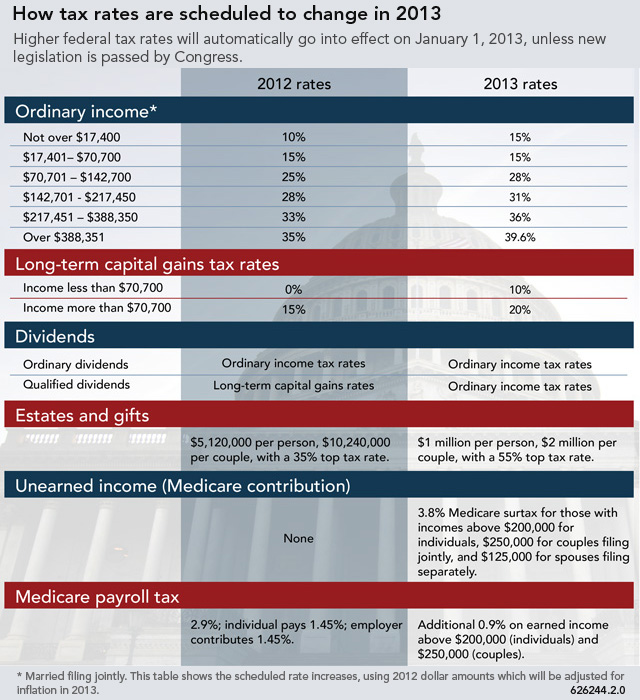
I have written before about our income: our taxable income is typically a lot less that that cutoff. However, that seventeen years of capital gains would more than double our normal income. So we decided to sell all of our investments with long-term gains, but first needed to donate a big portion of our appreciated investments to charity to stay under that cutoff to avoid paying tax on our long-term gains.
We were happy to find out about Fidelity Charitable. It is charity that holds onto the money you donate, and whenever you give an order it sends out a check to other charities. To paraphrase, it is a tax trick: my family effectively paid several years tithes "up front" for a tax benefit in 2012, and for a while will pay our tithes from our Fidelity Charity account instead of our bank account.
My wife and I are very used to a mindset in which we do not consider our investments "our money". First, because we see ourselves as stewarding a portion of God's money that in the long term is not ours. Second, because our investments have always been "sticky" instead of liquid since we could not easily sell them without worrying about tax implications.
Now it seems strange. We have reinvested, and our investments are so much more liquid. It is still God's money, but it is nearer.
There is a nice benefit. Because our investments are now liquid, the money we keep as cash at the credit union for emergencies can be very easily replaced. That means we can more readily offer our close friends interest-free loans.
Thursday, February 21, 2013
Why I Love My Wife - Reason 15
15. She is rational and responsible.
I wrote earlier about how well our plans mesh. This was huge. But it would mean little if we could not make thoughtful decisions when apart or together. It would not provide stability if we did not both feel responsible for the decisions we made.
Please allow me three examples about my wife that highlight three stereotypes about women. (The stereotypes are to provide an outline for this essay. Whether you agree with them does not matter.)
My wife is often more emotional than I am. But she can turn on her logical problem-solving mode at a moment's notice. Her decisions are rational, even when her emotions are one factor she considers when making a decision.
There are times she is at the mercy of her hormones. Yet she always feels responsible for her words and deeds. She apologizes for "acting hormonal" and never uses her gender to excuse her behavior.
She is habitually more self-focused than I am. When she hears something (anything from the weather report to economic news) she always initially meets the information by asking, "How does this affect me?" But she can move beyond this questions as quickly as she wants or needs to.
I know of a few husbands who are not so fortunate. It is difficult to live with a woman who excuses her behavior with clichés about "women get to change their mind" or "women are mysterious".
Creative Vulgarity from Children's Literature
So, what fills my mind during a grueling hike up Mount Pisgah?
In truth, not much. Pushing a jogging stroller up a steep hill for an hour while talking to a chatty four-year-old tends to quiet the inner monologue.
But later that day I thought of yet more creative vulgarities that take children's literature or television in wrong directions. Here are my current favorites. I try to make them subtle enough to fly over the heads of children. Be warned that they become more obscene as you keep reading.
Trolls under the bridge to Terabithia! - Terebithia stands for the place of imagination, so this imprecation describes writer's block or any obstacle to imagination.
George's tail! - Even though he is called a monkey, George has no tail and is actually a chimpanzee. So this malediction is used when something is proved not to exist.
Mavis's stones! - Mavis is an often unpleasant engine who shunts trucks in a quarry. Thomas and his friends do not like working with her attitude or the heavily loaded trucks she prepares them to take to construction sites. This fulmination describes something doubly unpleasant.
Donald's codpiece! - We all know what a big codpiece is supposed to represent. And Donald is a duck. Ever wonder why Daisy found that bumbler attractive?
Fraggle fewmets! - Fraggles are small. How might we track them? A vilification for something made difficult because it requires focused concentration about something unpleasant.
Pooh covered gorse-bushes! - During an expedition to find the north pole, Winnie-the-Pooh fell onto a gorse-bush. This denunciation describes something unpleasant that sounds even worse than it is.
Tinkerbell's orgy! - Peter Pan had his nose tweaked by a parade of drunk fairies. Identical meaning to the previous phrase.
Little Bear playing doctor! - In Little Bear's Friend the hero makes friends with a young girl whose doll gets broken. Little Bear fixes the doll. That's all. Again, identical meaning to the previous two phrases.
Hooper's flavored raincoats! - Luis and Maria needed to shop somewhere, at least for the first few months after their wedding until their daughter was conceived. Refers to something everyone knows is there but no one will talk about.
Jadis's frigid thighs! - Can't you picture one of the Dwarves of Narnia saying this?
Hansel's bone! - Hansel is trapped in a cage by a nearly-blind witch. She tries to fatten him up, but he holds a thin bone (in most versions of the story a chicken bone) through the bars to trick her into waiting to slaughter him. Only an obscenity because of slang.
Beren's balls! - Beren was an ancient warrior of Middle-Earth and the manliest hero ever. Remember in the Lord of the Rings Trilogy how Sauron was weakened and only an eye, and it still required every hero of that generation working together to defeat him? About 6,500 years earlier, Sauron was at his full strength and Beren's dog took him down.
Clark's kleenex! - A reference to a Larry Niven story. I do not like this obscenity: in my mind it means "an insurmountable problem!" but it could be understood as referring to Lois in a demeaning way.
Toothless Ewoks! - In prison the Wookies knock out their teeth, because gums slide better.
Wednesday, February 20, 2013
Two Summit Hikes
No blogging the past few days because I have been so tired in the evenings.
On Friday the boys and I hiked with some friends up to the summit of Spencer Butte.


This is not a difficult hike, except for a bit of scrambling over rocks at the very top. Here is a map. The distance is 1.1 miles, and the elevation gain is 722 feet (trail head is 1,340 feet, summit is 2,062 feet). So that is an average of a 12% grade.
So on Monday I thought, "Rainy days predicted for most of this week, so why not try the hike up Mount Pisgah?"

Uhg. It was grueling! Part of the reason was that I think pushing the jogging stroller was quite a bit more work that wearing Gallant in the ergo. And part of the reason was that even though the summit is lower, the trail head is much lower.
Here are two maps. The distance is 1.4 miles, and the elevation gain is 1,050 feet (trail head is 479 feet, summit is 1,529 feet). So that is an average of a 14% grade.
Now I need to catch up on blogging. Tomorrow...
On Friday the boys and I hiked with some friends up to the summit of Spencer Butte.
This is not a difficult hike, except for a bit of scrambling over rocks at the very top. Here is a map. The distance is 1.1 miles, and the elevation gain is 722 feet (trail head is 1,340 feet, summit is 2,062 feet). So that is an average of a 12% grade.

So on Monday I thought, "Rainy days predicted for most of this week, so why not try the hike up Mount Pisgah?"
Uhg. It was grueling! Part of the reason was that I think pushing the jogging stroller was quite a bit more work that wearing Gallant in the ergo. And part of the reason was that even though the summit is lower, the trail head is much lower.
Here are two maps. The distance is 1.4 miles, and the elevation gain is 1,050 feet (trail head is 479 feet, summit is 1,529 feet). So that is an average of a 14% grade.

Now I need to catch up on blogging. Tomorrow...
Sunday, February 17, 2013
Why I Love My Wife - Reason 14
14. We both believe we are sexy enough to make the other happy, and do not mind or feel threatened if the other appreciates an attractive stranger.
Modern English often inaccurately uses the word jealousy to make it synonymous with envy. Please allow me a brief example:
Now, I have already mentioned that my wife and I both think the other is sexy, that we have physical and emotional exclusivity, and that we were abstinent until married. These three factors combine to help us feel safely secure in our relationship.
But I am sure there is more that allows us to not feel threatened by the fact that the world includes other attractive people. We even enjoy trying to put our hard-wired attraction preferences under the microscope while people-watching or looking at a catalog. (From one such discussion I learned my wife is really attracted to strong hands. So I should wrap this up soon and give her another backrub to keep my hands strong and sexy.)
Here is a more detailed recent example involving this photograph from the back cover of a college alumni magazine that was lying on the dining room table one day. Not only did we disagree about which young lady was most attractive, but I could not explain why I picked the one third from the right. Some cooperative analysis revealed that it was the combination of high cheekbones and curved eyebrows: I must be wired to prioritize a Duchenne smile in which the limbic brain engages the eyes. (In the photograph all the other young women instead demonstrate a forced "social smile".) No wonder I like making my wife laugh!
It is comfortingly sexy to know my wife is enough of a sexual creature to consider other people attractive. And it is comfortingly stable to know that attraction will produce jealousy, not envy.
Modern English often inaccurately uses the word jealousy to make it synonymous with envy. Please allow me a brief example:
My wife and I are at a swing dance event. I watch her dancing with someone else.Got it? Jealousy is being stirred to an appreciation of what you have. Envy is wanting what someone else has.
If I feel jealous then I think, "My wife is attractive and a good dancer! That other guy may be dancing with her now, but I get to dance with her later and take her home."
If I feel envy then I think, "Hey, that's my wife! Get your hands off her!"
Now, I have already mentioned that my wife and I both think the other is sexy, that we have physical and emotional exclusivity, and that we were abstinent until married. These three factors combine to help us feel safely secure in our relationship.
But I am sure there is more that allows us to not feel threatened by the fact that the world includes other attractive people. We even enjoy trying to put our hard-wired attraction preferences under the microscope while people-watching or looking at a catalog. (From one such discussion I learned my wife is really attracted to strong hands. So I should wrap this up soon and give her another backrub to keep my hands strong and sexy.)
Here is a more detailed recent example involving this photograph from the back cover of a college alumni magazine that was lying on the dining room table one day. Not only did we disagree about which young lady was most attractive, but I could not explain why I picked the one third from the right. Some cooperative analysis revealed that it was the combination of high cheekbones and curved eyebrows: I must be wired to prioritize a Duchenne smile in which the limbic brain engages the eyes. (In the photograph all the other young women instead demonstrate a forced "social smile".) No wonder I like making my wife laugh!
It is comfortingly sexy to know my wife is enough of a sexual creature to consider other people attractive. And it is comfortingly stable to know that attraction will produce jealousy, not envy.
Saturday, February 16, 2013
Why I Love My Wife - Reason 13
13. She encourages my role as head of the family and leader in religious practices and teaching.
What does it mean to be head of the family?
I already wrote about how we show respect to each other. I am not respected more. But I do have some leadership roles my wife does not.
First, I provide for the household (I already wrote about providing momentum within a conversations and events). One big aspect of this role is monitoring and supporting both of our to-do lists. As each weekend approaches, my wife and I sit down and discuss what needs to be accomplished that weekend and how to fit this around our out-of-the-house plans. If we make these plans badly it is my fault. If the weekend could have been more successful if we were a little more energetic that is also my fault.
Second, I accept and am given responsibility for household. Because I am the momentum-provider even for the items on my wife's to-do list a small amount of blame or credit for how things go. Part of her career success is due to my efforts to ensure she gets enough sleep. Part of how our house needs some dusting is my fault even though this is one of the chore she does.
Third, when my wife and I must do something together but have different ways of doing things, we do it my way. This only happens for things we rarely do (such as packing for vacations) since we work out a blended way of how to do anything that happens frequently.
Lastly, in those very rare cases when we do not agree about what to do (such as I joked about here) I get to pick who gives in. I cannot remember what our second argument was about, except that it happened in our kitchen in Eugene. So I am not sure whether I always pick that I give in, or we each have had to give in once.
I did not write about being leader in religious practices and teaching for the family, since that is more commonly understood.
Thursday, February 14, 2013
Why I Love My Wife - Reason 12
12. Neither of us create or bring drama into our lives or home.
I am not sure how to write about this.
Some people are drama magnets. We are not.
(For example, tonight is the evening of Valentine's Day. Why would I pick something longer to blog about, when I could be spending time with my wife?)
I am not sure how to write about this.
Some people are drama magnets. We are not.
(For example, tonight is the evening of Valentine's Day. Why would I pick something longer to blog about, when I could be spending time with my wife?)
Wednesday, February 13, 2013
Why I Love My Wife - Reason 11
11. Our plans mesh.
This is huge. It means so many things.
When we were engaged and talking about our plans for our lives, those plans fit together. The roads which God wanted us to walk were complimentary. Our habits fit together. Our personal preferences were compatible.
Here is a surely incomplete list of examples from some quick brainstorming:
I surely could go on, but need not. The big point is that in our marriage neither my wife nor I need to make compromises. Our marriage is very relaxing because we have such similar lifestyles. (Recall that what I wrote yesterday mentioned that divorced people list different lifestyles as a reason more often than cheating!)
When my wife and I need to make plans together I never, ever worry that an argument will happen, or that one of us will end up feeling hurt and harboring bitterness because of an unhappy compromise. We can always approach those decisions fearlessly confident that we will happily agree upon the answer, whether deciding where to move, or planning a vacation, or shopping for a car, or deciding on the kindergarten in which to enroll Smiley.
Surely this adds to the stability of our marriage, even though I have never seen any statistics attempt to measure how well people's plans mesh as they build and live a life together. How could either my wife or I ever consider that we could find someone else half as good a match?
Anecdotally, we have had one argument. When we moved Rochester we could not agree about which drawer in the kitchen should be for silverware. I gave in and let my wife have her way. For all the years we lived in that apartment it seemed to me like the silverware was in the wrong drawer. So, yes, I can make a gracious compromise. :-P
Finally, I should add that a whole lot of our agreement is due to our faith. Some of this is because we have divine guidance (such as our careers). Some is simply because of scriptural morals and values. My wife and I have so much agreement because our spiritual walks have shaped us to have that agreement. And that allows us to trust that in the future we will have only increasing agreement.
This is huge. It means so many things.
When we were engaged and talking about our plans for our lives, those plans fit together. The roads which God wanted us to walk were complimentary. Our habits fit together. Our personal preferences were compatible.
Here is a surely incomplete list of examples from some quick brainstorming:
- My wife's career is of the type that might require us to move to a certain place. My career is not: I can continue my career whever we move.
- My wife's career is of the type that might require strict workday hours. (Her current job does not, but it could.) My career allows flexible workday hours.
- We both wanted to have our careers and finances stable before having kids.
- We both wanted two kids. We knew neither of us would be disappointed if those two kids were both boys or both girls and thus change our goal to more kids.
- We both wanted me to eventually be the primary caregiver of kids, and my wife to be the primary breadwinner.
- We both agreed on what raising kids well and successfully would look like.
- We both agreed on what "stuff" we wanted to own, including big things (one house, one practical car, no television, etc.) and smaller things.
- We both agreed on what we wanted in a house: a big back yard, each child having the option of his or her own bedroom, etc.
- We decided, because she likes cooking and I do not, that she would prepare most dinners. I mind washing dishes much less than she does, so I usually wash all the dinner dishes.
- We agree about how to eat healthy and what types of exercise we enjoy, and prioritize these.
- We worked out complimentary roles for household chores.
- We worked out complimentary roles for household finances.
- We want to support the same charities.
- What we enjoy as recreation on the weekends matches.
- What we enjoy as recreation on the weekday evenings matches.
- What we enjoy as recreation on vacations matches.
I surely could go on, but need not. The big point is that in our marriage neither my wife nor I need to make compromises. Our marriage is very relaxing because we have such similar lifestyles. (Recall that what I wrote yesterday mentioned that divorced people list different lifestyles as a reason more often than cheating!)

When my wife and I need to make plans together I never, ever worry that an argument will happen, or that one of us will end up feeling hurt and harboring bitterness because of an unhappy compromise. We can always approach those decisions fearlessly confident that we will happily agree upon the answer, whether deciding where to move, or planning a vacation, or shopping for a car, or deciding on the kindergarten in which to enroll Smiley.
Surely this adds to the stability of our marriage, even though I have never seen any statistics attempt to measure how well people's plans mesh as they build and live a life together. How could either my wife or I ever consider that we could find someone else half as good a match?
Anecdotally, we have had one argument. When we moved Rochester we could not agree about which drawer in the kitchen should be for silverware. I gave in and let my wife have her way. For all the years we lived in that apartment it seemed to me like the silverware was in the wrong drawer. So, yes, I can make a gracious compromise. :-P
Finally, I should add that a whole lot of our agreement is due to our faith. Some of this is because we have divine guidance (such as our careers). Some is simply because of scriptural morals and values. My wife and I have so much agreement because our spiritual walks have shaped us to have that agreement. And that allows us to trust that in the future we will have only increasing agreement.
Tuesday, February 12, 2013
Why I Love My Wife - Reason 10
10. We have only had sex with each other.
Today's reason is slightly awkward: perhaps a bit on the TMI side, and unlike what I have written before not something I actively find attractive about my wife but instead a passively helpful historical truth.
A blogger named Dalrock has a few interesting posts about divorce statistics that helped me understand how much abstinence until marriage is important. He also links to three articles by a blogger I have not other otherwise read.
I'll summarize so you do not need to follow all those links: a marriage in which the wife is abstinent until marriage apparently has a decreased risk of divorce by at least 35% and perhaps as much as 60%.
(I cannot find any data about husband abstinence. Are we unimportant?)
This is huge! Let me compare it to other factors that lower risk of divorce and apply to my marriage (I do not know how much these are statistically independent):
If you know basic statistics you can combine all of these to estimate a statistical chance, back on our wedding day, that our marriage would end in divorce. It is quite low! Do not believe folks who say that modern marriage is always dreadfully risky.
More important to my wife and I was that God gave our marriage his approval back when my wife and I were engaged, so we felt quite safe getting married. Statistics do not compare to divine guidance!
Why might abstinence be the most significant single predictor of marriage stability? Hormones!
During sex, hormones cause emotional pair-bonding, similar to the pair-bonding of lovebirds and guinea pigs. But this effect fades away with multiple sex partners. A married couple who was not abstinent has less or none of this benefit.
Furthermore, the pair-bonding remains for those prior sex partners and often causes a bit of historical revisionism. That rude college person who was so amazing in bed one time might over time be remembered as so very attractive and able to give pleasure, with all faults ignored and a youthful physique frozen in time. Even if this somehow never interferes with marital intimacy, anecdotes abound about how it hinders marital communication. When a marriage is stressed, talking through the issues with your spouse takes difficult and sometimes unpleasant work. Much more easy and feel-good to lazily reminisce about old pair-bond people. Or maybe even find them on Facebook...
So now you know the kernel of Reason #10. My wife and I are overly fond of each other because our brains have been rewired by our body chemistries--what a great deal! And we have no other competing pair-bonds to distract us from being fond (and staying fond) of each other.
(Also, do not trust anyone that says young adults need to "discover themselves" sexually before marriage. Both statistics and biology prove them wrong.)
Tangent: All of the above statistical analysis focused on predicting divorce on the wedding day. Since this is probably the only blog post I will ever write about divorce statistics, the mathematician in my wants to be more complete and comment briefly on Dalrock's chart of reasons divorces happen, which describes the other side of the issue.
The biggest cause of divorce is "abuse", which sounds simple but is not. For example, during all of my grandparent's marriage my grandfather gave my grandmother discretionary money each month and otherwise did all the finances. My grandmother liked this: she could not make a bad decision about money! But some currently prominent academics and their surveys would now label such financial unequal roles as one kind of abuse. Overall, how they widen the definition of "abuse" means this category should really be relabeled as lack of respect. (After all, few people could physically or verablly abuse a spouse they respect, and lack of respect can be fatal to marriages even without actual abuse.)
UPDATE: This website has a long list of "abuse", much of which is mere disrespect. Not good for a marriage, but not true abuse.
Apparently I was onto something when I started this new theme by describing how my wife and I respect each other.
Also, I was surprised that "different lifestyles" was perhaps more significant than "cheating". I will refer back to this tomorrow.
UPDATE: Good heavens! According to this article, "68% of men say they married the best sex of their lives, compared to 45% of women who said the same." No wonder the divorce rate is high, and so many wives slowly turn off marital sex. This article collaborates.
UPDATE: How many men are abstinent until married? I find conflicting statistics, compounded by the usual problems with survey reliability. Try these two links as places to start if you are doing your own research.
UPDATE: More data on partner count and marriage stability, from the Heritage Foundation (so a bias alert).
Today's reason is slightly awkward: perhaps a bit on the TMI side, and unlike what I have written before not something I actively find attractive about my wife but instead a passively helpful historical truth.
A blogger named Dalrock has a few interesting posts about divorce statistics that helped me understand how much abstinence until marriage is important. He also links to three articles by a blogger I have not other otherwise read.
I'll summarize so you do not need to follow all those links: a marriage in which the wife is abstinent until marriage apparently has a decreased risk of divorce by at least 35% and perhaps as much as 60%.
(I cannot find any data about husband abstinence. Are we unimportant?)
This is huge! Let me compare it to other factors that lower risk of divorce and apply to my marriage (I do not know how much these are statistically independent):
- college-educated women have a well-established decreased risk of divorce by about 25%
- high-IQ women in the U. S. have an additional decreased risk of divorce by about 30% independent from educational level
- couples who wait at least seven months before having kids have a decreased risk of divorce by about 25%
- our income level correlates to a decreased risk of divorce by about 30%
- neither of us have been married before, which decreases risk of divorce by about 35%
- only one of us has divorced parents, which decreases risk of divorce by about 15%
If you know basic statistics you can combine all of these to estimate a statistical chance, back on our wedding day, that our marriage would end in divorce. It is quite low! Do not believe folks who say that modern marriage is always dreadfully risky.
More important to my wife and I was that God gave our marriage his approval back when my wife and I were engaged, so we felt quite safe getting married. Statistics do not compare to divine guidance!
Why might abstinence be the most significant single predictor of marriage stability? Hormones!
During sex, hormones cause emotional pair-bonding, similar to the pair-bonding of lovebirds and guinea pigs. But this effect fades away with multiple sex partners. A married couple who was not abstinent has less or none of this benefit.
Furthermore, the pair-bonding remains for those prior sex partners and often causes a bit of historical revisionism. That rude college person who was so amazing in bed one time might over time be remembered as so very attractive and able to give pleasure, with all faults ignored and a youthful physique frozen in time. Even if this somehow never interferes with marital intimacy, anecdotes abound about how it hinders marital communication. When a marriage is stressed, talking through the issues with your spouse takes difficult and sometimes unpleasant work. Much more easy and feel-good to lazily reminisce about old pair-bond people. Or maybe even find them on Facebook...
So now you know the kernel of Reason #10. My wife and I are overly fond of each other because our brains have been rewired by our body chemistries--what a great deal! And we have no other competing pair-bonds to distract us from being fond (and staying fond) of each other.
(Also, do not trust anyone that says young adults need to "discover themselves" sexually before marriage. Both statistics and biology prove them wrong.)
Tangent: All of the above statistical analysis focused on predicting divorce on the wedding day. Since this is probably the only blog post I will ever write about divorce statistics, the mathematician in my wants to be more complete and comment briefly on Dalrock's chart of reasons divorces happen, which describes the other side of the issue.
The biggest cause of divorce is "abuse", which sounds simple but is not. For example, during all of my grandparent's marriage my grandfather gave my grandmother discretionary money each month and otherwise did all the finances. My grandmother liked this: she could not make a bad decision about money! But some currently prominent academics and their surveys would now label such financial unequal roles as one kind of abuse. Overall, how they widen the definition of "abuse" means this category should really be relabeled as lack of respect. (After all, few people could physically or verablly abuse a spouse they respect, and lack of respect can be fatal to marriages even without actual abuse.)
UPDATE: This website has a long list of "abuse", much of which is mere disrespect. Not good for a marriage, but not true abuse.
Apparently I was onto something when I started this new theme by describing how my wife and I respect each other.
Also, I was surprised that "different lifestyles" was perhaps more significant than "cheating". I will refer back to this tomorrow.
UPDATE: Good heavens! According to this article, "68% of men say they married the best sex of their lives, compared to 45% of women who said the same." No wonder the divorce rate is high, and so many wives slowly turn off marital sex. This article collaborates.
UPDATE: How many men are abstinent until married? I find conflicting statistics, compounded by the usual problems with survey reliability. Try these two links as places to start if you are doing your own research.
UPDATE: More data on partner count and marriage stability, from the Heritage Foundation (so a bias alert).
Women with 0 non-marital sexual partners had a 80.47% chance of being in a stable marriage.UPDATE: Two more posts by Dalrock about divorce, showing statistically (for what that is worth) divorce is contagious and does not make people happy.
Women with 1 non-marital sexual partners had a 53.63% chance of being in a stable marriage.
Women with 2 non-marital sexual partners had a 43.65% chance of being in a stable marriage.
The trend continues but I won't keep typing...
Monday, February 11, 2013
Why I Love My Wife - Reason 09
9. We are faithful both physically and emotionally.
Faithfulness includes having things we make sure we do together physically and emotionally. The things in this category we might do with other people also, but not with purposeful regularity. For example, I might sometimes give a friend a neck massage, but I treat it as a duty to give my wife as much massage as she asks for--and to frequently ask if she needs a massage so that I am not relying on her initiative.
Faithfulness includes having things we make sure we only do with each other physically and emotionally. The things in this category we might not do very often, but when they happen we know it is a special thing reserved for each other. For example, the fireplace can add a romantic ambiance to various stuff, and we know we only treat fireplaces as romantic with each other--even though we might not do this at all during the warm summer months when we do not heat the house.
(I have written before about how terrible it is when spouses are not each other's best friends and closest confidants.)
To paraphrase, physically and emotionally we have reliability, intimacy, and exclusivity.
Sunday, February 10, 2013
Why I Love My Wife - Reason 08
8. We both enjoy date nights and see the importance of practicing dating.
Now that little Gallant is twenty months old, my wife I can enjoy more date nights. Finding a babysitter is easier.
Oddly, we best like going to a theatre: to see a musical if possible, or a movie otherwise.
Back when we had not been married so long, we wanted date nights to involve a lot of talking. We had dreams to discuss, long-term plans to make, and events to plan. Now that we are old fogies we just want to relax together and get something new to talk about. Most of what used to be long-term conversation topics have happened: we have kids and know how to raise them, we have a house and know how to maintain it, etc. The time we spend cuddling in bed is plenty for making short-term plans because life with little kids means each weekend we get to do about one interesting thing instead of several.
We also realize that, because we have little kids, we are not as skilled at date nights as we once were. We have gotten rusty. So we value "practicing" them, meaning both "doing that often" and "getting even better at that".
Saturday, February 09, 2013
Slightly Deeply Funky
For the last few months I have really been enjoying my new boots.
Long ago I heard the advice, "A very comfortable pair of shoes you wear often is worth spending a bit on. You posture and back are worth it."
For the past few years I thought I had found a "very comfortable" pair of shoes. But after I tried on the Fleuvog Burgundy Kaden boot while visiting Portland I knew my old concept of comfort was way out of whack. They are truly amazing, and my posture and back appreciate them greatly.

The Fleuvog company has many mottos, of which one is "Be deeply funky." I certainly am not a very funky person. But I think with my long hair, burgandy boots, and goatee without a moustache that I am beginning to qualify as slightly deeply funky.
Why I Love My Wife - Reason 07
7. We collect romantic traditions as togetherness rituals.
I think I am a day behind, so two of these today!
This reason needs explaining because the phrase "togetherness rituals" is meaningless personal jargon. But after a few examples you will recognize what I refer to, and hopefully relate the idea to ways you interact with your own close friends and family.
Many of our rituals are occasions for kissing: on a bridge, in an elevator, when the car odometer is a palindrome.
(Of course there are hello and good-bye kisses too. Those rituals are so common I am not sure they count as "collected" by us.)
We also have codes for what different types of touches mean. When we do five fingertip touches, one with each finger of one hand, that is a code for the five words "I love you very much." Two squeezes when holding hands means "Glad you are here." We pet the back of the other person's hand to mean "It is nice to relax with you." When we go on a walk we link elbows arm in arm to emphasize being together (when on walks with our kids this translates as "Ha! We have both momentarily escaped from having to hold a little boy's hand"). Or on walks we will hold hands and swing those arms like a pendulum: a small swing means "What is next?" whereas a big swing means "Onward!"
I sometimes ponder what advice about dating I will give to our boys when they are older. I am pretty sure one nugget will be:
"Do not hold her hand until you can say six different things just by how you touch her hair.UPDATE: Changed the "nugget" to be longer and funnier.
Do not touch her tushy until you can say six different things just by how you hold her hand.
Do not kiss her until you can say six different things just by how you touch her tushy.
Do not nap beside her in a hammock until you can say six different things just by how you kiss her.
And you better not be doing more than napping beside her in a hammock!"
Why I Love My Wife - Reason 06
6. We both think the other person is sexy and treat them that way.
This reason should not be notable. But I suppose it must be, after I compared how my wife and I behave with the statistics about how often married people do Married People Stuff ™ in bed.
Throughout the day, whenever we are together, we pay attention to each other in ways that communicate "you are sexy". This happens with eye contact and little touches when we walk past one another. We like to sit close to each other. We sneak hugs and kisses when the kids are not looking (and often when they are). We purposefully keeping up our appearance at home and compliment each other on how we appreciate seeing our spouse in nicer clothes than sweatpants and a formless tee shirt. There is also the trick of paying attention to the other person when they are not expecting it: this is the time a comment on how we are attracted to the other person's body seems most genuine. And of course there is lots of cuddling and Married People Stuff ™.
Friday, February 08, 2013
Why I Love My Wife - Reason 05
5. She swing dances with me.
I could write much about this if I had more time and better words. For now I will merely note that real swing dancing, focusing on connection and lead-and-follow (instead of the kind often taught at colleges that pushes the follow through scripted moves with jerky arm motions) is all about enjoying being with someone while communicating with movements of body weight and sharing of momentum.
I could write much about this if I had more time and better words. For now I will merely note that real swing dancing, focusing on connection and lead-and-follow (instead of the kind often taught at colleges that pushes the follow through scripted moves with jerky arm motions) is all about enjoying being with someone while communicating with movements of body weight and sharing of momentum.
Wednesday, February 06, 2013
Why I Love My Wife - Reason 04
4. She laughs when we cuddle in bed and say silly things.
You don't really need me to explain this one, do you?
You don't really need me to explain this one, do you?
Tuesday, February 05, 2013
Why I Love My Wife - Reason 03
3. She laughs when I tease her in all three types of teasing
Smiley often asks if what he says is "silly" or "teasing". Therefore I have had to pay attention to what teasing really is. I have identified three ways I tease my wife.
- my lame attempts at playful innuendo
- my silly obvious lies told just to make her laugh
- my responding to nagging with agree-and-exaggerate
The first I will not elaborate on. My improvised innuendo really is terrible. But she still laughs and usually teases me back.
The second is the type of teasing Smiley does: saying obvious untruths just to make someone laugh. ("Have you checked the weather report for tomorrow?" "Yes, heavy volcanic activity.") I do not do this nearly as often as I should, since my wife does enjoy it.
The third is a great trick. Lately I have learned about how wives sometimes use a "fitness test" question to check their husband's confidence and reliability. These are deliberately (although often unconsciously) awkward questions: either both people already know the answer or there is no right answer. (As examples: "Did you miss me?", "Do you still want to go out for Thai food on Sunday?", or "Do you worry about our relationship?" Of course, the classic is "Do these pants make me look fat?") The best responses are usually playful agreement followed by either witty exaggeration or absurd embellishment. (Possible answers to the four questions above are "Yes, but it's complicated," "Of course! I'm still working on perfecting post-Thai-food farts," "Yes, but don't start taking that for granted," and "Maybe, let's compare without the pants.") The same style of playful agree-and-exaggerate works to defuse most nagging. ("Have you washed the car yet?" "Yes, but I did a terrible job. Now it’s your turn.")
Anyway, the point was that my wife finds my teasing funny, and I love that she does.
UPDATE: Did some minor re-wording for clarity. I also thought of other good answers to the pants questions. First, "Let me see them," followed by making the pant legs into a circle and looking through it. Second, "I'll try them on so you can see what they do." Either way you are being playfully confident and inviting your wife to give you an opportunity to compliment her tushy.
Monday, February 04, 2013
Why I Love My Wife - Reason 02
Continuing the new theme...
2. She appreciates my role as momentum-provider during conversations and events.
It takes energy to keep activities and conversations from stalling, especially at the end of the day when both spouses are tired.
Somebody needs to suggest what to do when nothing is happening, have ideas or preferences prepared, and maintain a storehouse of interesting topics of conversation for during walks or soaks in the spa.
Somebody needs to enliven conversations with silly jokes and defuse tense situations with witty agree-and-exaggerate statements.
Somebody needs to push for setting aside time to exercise together, especially if one spouse only goes for walks or does strength training if the other is with them.
Somebody needs to be the first to set aside the laptop when we both crash after the boys are asleep.
It is a lot of mental work to be lively yet relaxing, playful yet clear, and prepared yet flexible.
My work day with the boys is much more physically exhausting than my wife's work day behind a computer and at meetings. Yet she is the one who gets more mentally fatigued each work day she has to make difficult choices and carefully word things to avoid offending people.
So it becomes my job at the end of the day to do that mental work at home and be the provider of momentum. My wife realizes and appreciates this. I suspect that if she took it for granted I would quickly find that the responsibility felt like a burden rather than a happy act of agape.
Again I ask for brainstorming help: in what other ways does someone need to be the momentum-provider?
Sunday, February 03, 2013
Why I Love My Wife - Reason 01
Today is an engagement anniversary for my wife and me.
I have been doing a lot of computer writing that has edged out blogging. But time to remedy that with a new theme!
I mentioned in November that I had started reading Manosphere blogs. Let me say now that there is nothing like reading comments from a bunch of men who have or had unhappy marriages to make me appreciate my great marriage. One of the first things I did after encountering these blogs was to write down lots of reasons why I love my wife.
And what better day than now to finally get around to processing those as blog posts?
Here is the first.
(Tangent #1: With nearly all of these I originally wrote them as "she does..." but later changed them to "we do..." to emphasize the healthy marriage and avoid giving the false impression that she is a saint married to an old goat.)
(Tangent #2: For anyone new to my blog, know that I purposefully avoid using my wife's first name. We want those searching the internet for her name to find her professional work, not this blog.)
1. We know how to show respect to each other.
This one is a bit difficult to write about, simply because modern American culture does a terribly job at teaching people how to show respect. So I need to be specific, which will sound overly clinical about a dynamic that is quite natural to us. Here it goes...
We are polite with our words. We say "please" and "thank you" to each other, and usually "you're welcome." We ask requests instead of making demands.
We are polite with our body language. We do not stand in a way that boxes in the other, we start conversations a bit angled (rather than parallel), we give each other enough space, we do not move too quickly.
We appreciate each other's ideas. We ask each other for advice.
We compliment each other's good habits.
We forgive each other's mistakes and never bring those up again.
We seldom have disagreements. On those rare times when we do, we avoid disagreeing in front of the children or in public.
We give each other priority. Over the years we have established little ritual acts of kind subservience towards each other (how we get each other tea, etc.).
What are other ways to show respect? If I have not listed something it is probably due to insufficient brainstorming, not that the something is lacking in our marriage relationship.
UPDATE: I did think of one way to show respect we neglect. When in face-to-face conversation and holding an object, it is most proper to hold it by your hip rather than in front of your chest. (See any James Bond film with Sean Connery, how Connery holds a glass or pen.) Holding an object high can send the minor body language signals "I want something between us" or "I am holding this high and aggressively." But my generation was never taught this, and my wife and I know neither of those signals would be truthful between us.
Thursday, January 03, 2013
More Than A Thousand!
One day last month, when we were using our oven, Smiley was talking with us about numbers and temperature. He asked how hot was a candle, and the stove downstairs burning firewood?
The numbers were a lot bigger than I expected. Candle flames are about 1,800 °F and the flames in a wood stove get to be 2,700 °F. The catch is that these are flame temperatures. The air around the fire is much cooler.
The numbers were a lot bigger than I expected. Candle flames are about 1,800 °F and the flames in a wood stove get to be 2,700 °F. The catch is that these are flame temperatures. The air around the fire is much cooler.
Wednesday, January 02, 2013
Online Illumination
The British Library now has an online catalogue of illuminated manuscripts. Fun!
Tuesday, January 01, 2013
All I Want for New Years is to Finally Stop Teething
More teething news for Gallant. (The last update was at the very end of October.)
On December 18th, after two months of acting like more teeth were imminent, Gallant finally had his next twelfth tooth break through: his upper right canine.
He kept teething. On December 29th his lower right lateral incisor broke through. The next night his upper left canine broke through.
Hooray! As soon as these new teeth finish arriving he will have a balanced smile: six teeth on top and four on bottom (plus four balanced molars a smile would not show).
But he is still teething! He gnaws on his fingers and toys way in the back of his mouth. He must be working on his two-year molars.
Thursday, December 20, 2012
Gallant's 18 Month Checkup
Gallant had his eighteen month checkup a month ago. It was a bit early, but that was the day an appointment was available.
Now he is 31.2 inches tall (25th percentile), he weighs 23 pounds 2 ounces (20th percentile), and his head size is 47.1 cm (30th percentile).
(Comparing him to his big brother's eighteen month checkup again shows how inaccurately those percentiles are read from the chart.)
Tuesday his right upper eye tooth finally broke through. He is still working on at least three more teeth. Fortunately, he is sleeping through the night again.
Tuesday, November 20, 2012
Smiley at Preschool
Smiley goes to preschool three days a week, from 9 am until noon.
My wife and I were not planning on enrolling him in any preschool. All of the local preschools we knew about were very expensive because they catered to families in which every parent works. They provide breakfast and lunch, last more than three hours per day, and some even provide busing.
Then, a year ago, we heard about the preschool run by the city Parks and Recreation District at the Amazon Community Center. It was a great fit for our family. The cost is great ($5 per hour) and we admire Smiley's teacher for the wonderful job she does.

There M/W/F class is still accepting students for this school year.

My wife and I were not planning on enrolling him in any preschool. All of the local preschools we knew about were very expensive because they catered to families in which every parent works. They provide breakfast and lunch, last more than three hours per day, and some even provide busing.
Then, a year ago, we heard about the preschool run by the city Parks and Recreation District at the Amazon Community Center. It was a great fit for our family. The cost is great ($5 per hour) and we admire Smiley's teacher for the wonderful job she does.
There M/W/F class is still accepting students for this school year.
Monday, November 19, 2012
Manosphere Theology
A couple months ago I started reading a few Manosphere blogs. Four of them are intriguing.
As far as I know, none of these authors are religious. But they readily ascribe to some basic scriptural theology.
First, we are more broken than we realize. In our natural state we do things we do not want to do, often without realizing it. We often think we want things we do not really want, or we not realize the deep desires at the root of our superficial wants. Although we like to consider our behavior as rational our actions are often better explained by natural inclinations and desires.
(Scripture would add that this broken "old self" can be replaced by a fixed "new self" infused with God's own spirit.)
Second, we focus too much about what others think of us. We put on acts to impress people. We monitor ourselves in an attempt to see ourselves as others do. We say things we do not mean to smooth things over with people. We dwell on trying to figure out what others want, even though this is often doomed because (as mentioned above) people often do not really know what they want.
(Scripture would add that we should instead focus on what pleases God. This is more important because God is eternal and in charge. It is easier because God really does know what he wants, and for the important issues had told us.)
Third, we think about ourselves more that we like to admit. We assume events near us are about us. We attribute meaning to impersonal things. We hear about acts far from us and assume they will effect us. Even when we are generous and sacrificing we still often think about how our deeds cost us and change us.
(Scripture would add that we can escape thinking about ourselves by keeping our focus on God as we channel his goodness and generosity. Then our actions are about what God is doing, other people's reactions say something about God instead of about us, and we have no worries about running out of resources, time, or energy.)
Therefore, despite my disagreement with many things these authors write, we have some deep foundational agreement.
Some of their posts prompt a response in me, "Thank goodness I have a 'new self' and need not worry about that any more." A few posts even help me notice areas in my life where I am neglecting my new self and letting the old self emerge again.
Some of their posts prompt me to consider issues of fatherhood or marriage that are worth thinking about. What will I teach my sons about masculinity and being a gentleman? Can I do a little about my physical fitness and dress to be more pleasing to my wife? Etc.
Some of the posts are just interesting psychology, even if irrelevant to my life. A few might be relevant to my math teaching, but I am not sure about that.
And a lot of posts I just read and forget. But even those posts were usually interesting due to seeing that largely scriptural understanding of people filtered through a very secular combination of world-view and application.
- Athol and his mission to extract marriage advice from pick-up artist psychology.
- Vox and his mission to help save Western civilization.
- Ian and his mission to help stifled children become freely silly adults.
- Susan and her mission to teach your people something better than the hook-up culture.
As far as I know, none of these authors are religious. But they readily ascribe to some basic scriptural theology.
First, we are more broken than we realize. In our natural state we do things we do not want to do, often without realizing it. We often think we want things we do not really want, or we not realize the deep desires at the root of our superficial wants. Although we like to consider our behavior as rational our actions are often better explained by natural inclinations and desires.
(Scripture would add that this broken "old self" can be replaced by a fixed "new self" infused with God's own spirit.)
Second, we focus too much about what others think of us. We put on acts to impress people. We monitor ourselves in an attempt to see ourselves as others do. We say things we do not mean to smooth things over with people. We dwell on trying to figure out what others want, even though this is often doomed because (as mentioned above) people often do not really know what they want.
(Scripture would add that we should instead focus on what pleases God. This is more important because God is eternal and in charge. It is easier because God really does know what he wants, and for the important issues had told us.)
Third, we think about ourselves more that we like to admit. We assume events near us are about us. We attribute meaning to impersonal things. We hear about acts far from us and assume they will effect us. Even when we are generous and sacrificing we still often think about how our deeds cost us and change us.
(Scripture would add that we can escape thinking about ourselves by keeping our focus on God as we channel his goodness and generosity. Then our actions are about what God is doing, other people's reactions say something about God instead of about us, and we have no worries about running out of resources, time, or energy.)
Therefore, despite my disagreement with many things these authors write, we have some deep foundational agreement.
Some of their posts prompt a response in me, "Thank goodness I have a 'new self' and need not worry about that any more." A few posts even help me notice areas in my life where I am neglecting my new self and letting the old self emerge again.
Some of their posts prompt me to consider issues of fatherhood or marriage that are worth thinking about. What will I teach my sons about masculinity and being a gentleman? Can I do a little about my physical fitness and dress to be more pleasing to my wife? Etc.
Some of the posts are just interesting psychology, even if irrelevant to my life. A few might be relevant to my math teaching, but I am not sure about that.
And a lot of posts I just read and forget. But even those posts were usually interesting due to seeing that largely scriptural understanding of people filtered through a very secular combination of world-view and application.
Sunday, November 18, 2012
The Samsara of Laundry
Although I am not a Buddhist, I can appreciate some of that faith's truths.
Laundry is a great example of "escaping the wheel of illusion".
In my family, I am the person who does nearly all of the laundry. I used to feel happy or anxious because of this responsibility. Being caught up with laundry gave me a warm, fuzzy feeling. Having a lot of laundry to do caused discontent.
Neither feeling had any solid foundation. We own enough clothes that an empty laundry basket offers no real benefit compared to a half-empty laundry basket. Days when I really had to laundry were never miserable because of that chore.
The situation was also an overall negative. The warm, fuzzy feeling from finishing laundry was never as intense as the anxiety from urgent laundry.
All this exemplifies "illusion". It was all in my head, and an overall source of unhappiness (albeit a very minor one).
Moreover, the only choices were to stay within the illusion or completely depart. I needed to let go of the warm, fuzzy feeling of completed laundry if I wanted to cast away feeling anxious on urgent laundry days. Trying to hold onto the former would keep me from being able to cast away the latter. Overall my life would be less happy if I tried to retain one particular happiness.
Having left behind that particular "illusion" it seems a very silly thing when I view it from outside. There are many issues that a far worthier sources of contentment or stress in my role as househusband.
Saturday, November 17, 2012
Berry Comparison
We buy a lot of bulk food at Azure Standard. Back in 2010 I wrote about our normal purchases: gluten-free grains, flours, and pastas. (The prices from that old blog post of 2010 are more-or-less unchanged.)
During our most recent order we also wanted to buy organic berries for our two boys to eat. This prompted us to do some price comparisons among Azure Standard, Trader Joe's, and Market of Choice.
(This analysis ignores some bulk pricing for berries at Azure Standard. We do not have room in our garage freezer for ten pounds of a single type of berry.)
The results were surprising. Market of Choice was never the least expensive choice. Trader Joe's won for the two most commonly bought kinds of berries.
Trader Joe's had the least expensive organic berries. Strawberries were $2.79 per pound and blueberries were $3.99 per pound.
Azure Standard had the other least expensive options: cherries at $4.94 per pound, Marion berries at $5.55 per pound, blackberries at $5.79 per pound, and raspberries at $5.79 per pound.
(Earlier in the year Trader Joe's was selling organic raspberries, but they had sold out by the time we did our pricing. Perhaps they are the best buy for organic raspberries when still in stock?)
None of these sources sell organic cranberries or mango. The least expensive conventional cranberries were at Azure Standard at $1.10 per pound. The least expensive conventional frozen mango was at Trader Joe's for $1.79 per pound.
Trader Joe's also had the least expensive pesticide-free or organic spinach, at $1.49 or $1.99 per pound, respectively.
Friday, November 16, 2012
Round Beard at Sixteen Days
I mentioned that I was growing a beard for Movember. This morning Smiley took a picture that shows sixteen days of beard growth. I am growing a "round beard", also known as a Van Dyke.

The ultimate goatee with mustache might be the Batman goatee. Yet I do not think that style really suits me.
I am curious how a round beard would look if really long. Ever since I was old enough to read The Hobbit I have wanted a long beard. But I do not want a full beard, and as far as long round beards go I do not anticipate having the eyebrow length to do this look.

The ultimate goatee with mustache might be the Batman goatee. Yet I do not think that style really suits me.

I am curious how a round beard would look if really long. Ever since I was old enough to read The Hobbit I have wanted a long beard. But I do not want a full beard, and as far as long round beards go I do not anticipate having the eyebrow length to do this look.
Thursday, November 15, 2012
Pathfinder Play-by-Posts
I have started playing in two Pathfinder games online, using the Paizo forum for Play-by-Post games.
 In Gravel to Granite I play Shayne Anigon the gnome bard illusionist. This is an interesting campaign because we are asked to start at "zero level" which means my character is temporarily relying on theatrics and cantrips instead of more potent weapons and spells.
 In GM Odea's Short Adventure Playtest I play the fourth-level variant of the Paizo pregenerated wizard Ezren (PDF file). This adventure has stalled for two days; I am not sure why.
Like many people I have an itch to check my inbox. This is a nice way to feed that itch in a very limited way, without the danger of becoming sucked into reading online news or comics for too long.
Visiting Far Away Land
More than a year ago I wrote about how Smiley invented Far Away Land as the place where characters in stories live.
Back then "Eugene" was the real world and Far Away Land was inside Eugene, surrounded by a tall wooden wall so the wicked bad guys could not get out.
During the past year Smiley's internal sense of geography has developed. He now understands that the real world contains many places other than Eugene, included places like South America that are bigger than Eugene.
Today Smiley finally comprehended that Far Away Land is not in the real world. It is only pretend. It is not "on the same map" and we cannot get there by walking or by car, train, or airplane.
For a few minutes he was terribly disappointed. I could almost see his dreams of visiting Little Bear, Magalene, and Robin Hood crashing down. Then he brightened up and said, "All my dreams are in Far Away Land. When I dream I am there."
Tuesday, November 13, 2012
Arborist Comparisons
During that April snowstorm a tall wild-looking apple tree in our back yard fell on our house. It fell slowly and caused no damage. (My wife did not even wake up.)
But we needed it removed and its stump ground so it would not regrow. We also needed to remove a big Ponderosa Pine on our uphill property line that was threatening to fall on our neighbor's house. Finally, we had a tall, skinny, and sick White Oak near that might as well get removed while the other work was being done.
I contacted three arborists. How did the bids compare?
The first was Gene Burks of Second to None Tree Service (541-517-3736). He is a one-man operation, and the arborist we use to prune dead branches from our back yard's wonderful White Oak tree. He does not do stump grinding.
His bid for the Apple was $400, the Ponderosa Pine was $1,650, and the sick White Oak was $100.
(We eventually hired Gene to remove all three trees. His method for removing the Ponderosa Pine was fascinating to watch. He removed half of the branches and hauled them away, then removed the rest and built a "bird's nest" under the Pine. Then he started at the top and dropped ten-inch to twelve-inch rounds down into that nest cushion.)
The second bid was from Bakke Tree Care, another one-man operation that was recommended by a friend. Jonathan Bakke was friendly and prompt. I cannot say more since we did not hire him.
His bid for the Apple was $280, the Ponderosa Pine was $3,900, and the sick White Oak was $100.
(I have no idea why his bid for the Ponderosa Pine was so high. I also wonder if he would use the same "bird's nest" method or if he had some other technique? His bid for the Apple was quite low: I'll never know if he had some trick to make that job simpler.)
Finally, we called Sperry Tree Care, which might be the biggest tree care business in Eugene. Since they were the only arborist I called who was able to do stump grinding we hired the for that job ($80).
Their bid for the Apple was $380, the Ponderosa Pine was $1,950, and the sick White Oak was $250.
(Talking to the fellow who removed the stump, I found out that Sperry Tree Care prides itself in "beautification" jobs. They often have customers who say "make the yard as nice as you can for such-and-such amount of money". A crew of four to six workers arrives, makes plans, checks the plans with the client, starts the clock, and then divides and conquers.)
Gas Pump Ineptitude
Oregon has a law prohibiting motorists from pumping their own gas at gas stations. One of the multitude of original reasons was to help employ teenagers, although now most gas station attendants are adults.
Because of that law there is a stereotype that Oregonians are inept at pumping their own gas. Saturday I fulfilled that stereotype in an humorously exemplary manner.
Last weekend my family visited relatives in Auburn, Washinton. After the five hour drive from our home we thought it prudent to refill the tank. I forgot how much I had been spoiled by Costco gas pumps and ran into trouble. (The gas station at which I most often pump my own gas is at the Costco near my grandmother's home.)
First, I mistyped my zip code when using my credit card. I am used a gas pump that makes a beep with each key press and has a decently readable display. This pump was silent and nearly illegible from age and glare. Pressing "Enter" after only typing four digits caused an error. I am forced to go to the building and have an employee clear the pump so I can try again.
For my second attempt I slow down and double check my keypad use. But when I remove the nozzle I discover the hose does not reach. I am used to the super-long hoses at Costco gas stations, and parked with my car's gas cap facing away from the pump. I turn the car around, but the gas pump has given up on waiting for me. Again I go into the building and ask the employee to clear the pump.
On my third try the pump will not accept my credit card. It apparently has a "two strikes, you're out" policy. Again I go into the building. I cannot use the credit card inside without specifying a dollar amount. I pay with cash, and finally pump my gas. Of course, getting my change means I have to enter the building a fourth time.
Thursday, November 08, 2012
Two Fun Fairy Tale Picture Books
Smiley has two new "favorite" fairy tales in our current round of library books.
The Well at the End of the World is a delightful fusion and adaptation of a few much too traditional tales. The author, Rober D. San Souci, is quite a wordsmith. The illustrations are active and cute.
The Hinkey-Pink seems to be a more modern fairy tale. It does not have as interesting a plot and is not as carefully written. But has more physical humor, which Smiley enjoys.
Wednesday, November 07, 2012
Half Price Hult Tickets
Today only, until 5pm, you can buy half price tickets for two Hult Center holiday events: an evening Christmas music performance and an afternoon performance of Swan Lake.
Tuesday, November 06, 2012
Worn In
On Sunday I took the boys for a walk. Smiley wanted to visit the playground on the way home.
Me: You just said you were worn out. You asked if you could ride in the stroller and Gallant could walk. How can you enjoy the playground if you are too tired to want to walk?
Smiley: I am not tired. I am just worn out, and it takes a little while for a person to get worn in again.
After the Election
The election results are nearly complete. As usual, Intrade was a most accurate election predictor.
President Obama has been re-elected. Congress is probably divided with a liberal Senate and conservative House. (Moreover, as xkcd illustrates, Congress is at its most ideologically extreme divide since 1820.)
Perhaps the presidential election is less significant than whether Congress is divided: any president's potential to effect legislation is small compared to whether Congress is churning out new laws or suffering stalemate.
But the presidential race is better blogging material, so here I go.
I've written before about how living in Oregon prevents me from caring too much about the presidential race. My state's electoral college votes are very predictable.
Yet I can still talk about the big issues. (It will be interested to re-read this blog post years from now, when time will tell whether these are the big issues.)
Normally the most important long-term implication of any presidential election is the potential Supreme Court nominations. For this issue a Mitt Romney win would have been nice. The next president will probably appoint two or three new justices. President Obama has already appointed one or two justices who believe axiomatically that impartial laws do not exist. If four years from now the majority of the court holds this view it will change our county incredibly.
The other huge issue for this election is the Affordable Care Act, and for this issue I am happy President Obama was re-elected. The PPACA It is an ungainly and horrendous bulk of legislation. But it is the lesser of two evils. Our country is hurt more by having health insurance tied to employment (as opposed to being part of the market like automobile insurance or home owner's insurance). Because half of employed people are, by definition, getting a better than average deal on insurance through their employment, and many retired people still benefit after ending employment, Americans will never vote away the current system unless our country passes through a time of national health coverage. (I just pray the Affordable Care Act allows removing the link between employment and insurance before the economy is really hit by the Entitlement Crisis and the Federal government runs out of money.)
Regarding the other, smaller issues President Obama's re-election provides many unknowns because so many of his first term accomplishments have delayed implementation.
Personally, I will enjoy a break from reading Instapundit, a blog that has succumbed to frustration. Today Glenn Reynolds wrote, "If Romney loses this thing, it’ll only be because of fraud," and later he wrote "They [the mainstream media] must be neutralized in coming years." I normally enjoy Glenn's hobby of pointing out media bias, but I do not enjoy reading someone who feels bitter and combative.
The most interest response to the election I have read so far was from Sarah Hoyt, who wrote, "We’re not a country of land or blood. We’re a country of beliefs. If we’ve lost that, who are we? Who am I? And where do I go?" My reply was that we are a country of stories, not a country of beliefs. Contrary to what pundits proclaim, I do not believe that today's election could save or doom the country or its economy. The next four years will provide plenty of stories, and from these we will draw our identities, values, hopes, fears, and dreams.
Sunday, November 04, 2012
Newspaper Political Endoresements
Today I learned about two interesting "predictors" for the presidential election. Both are just entertainment for mathematicians: neither has any experimental evidence supporting its predictive power.
The first is the types of books being sold in each state: the Election Heat Map as tracked by Amazon.
The other only applies when there is an incumbent running for re-election. How many newspapers endorsed the incumbent during his first campaign but have now switched to the opponent? Mitt Romney is doing well by this measure.
I already knew about Intrade and a few of the many sports related coincidences.
Which other "predictors" do you know about?
Saturday, November 03, 2012
To the Pain
As the election approaches I am each day reading from both Google News and Instapundit. Together these provide a pretty good balance of bias.
At Instapundit a few guest bloggers were invited to participate until the election. I was amused a few days ago when one of them, Sarah Hoyt, offered a public challenge of a duel to the pain.
At Instapundit a few guest bloggers were invited to participate until the election. I was amused a few days ago when one of them, Sarah Hoyt, offered a public challenge of a duel to the pain.
Friday, November 02, 2012
A Househusband Muses about Modern Motherhood
Allow me to paraphrase a pair of humorous conversations I had one day earlier this year.
Moms in urban American are exposed to an interesting phenomenon I'll now nickname Modern Motherhood. (I'm sure that phrase has been coined a gazillion times already. But I'm stealing it for just one blog post. With italics. Then you can have it back.)
There are lots of magazines offering to teach the basics of Modern Motherhood, which seems to primarily involve which books about child psychology to read, where to go to talk about those books, how to decorate your home and bake cute treats for each holiday, and new ways to relax.
Keeping the house clean is also a part of Modern Motherhood although these magazines would never, ever use the word "housewife". Even the word "housework" is avoided. Instead it is "chores" or "cleaning" and these always are assumed to be as enjoyable and mood-friendly as an equivalent time spent doing long division.
Actual parenting is secretly optional. The magazines avoid saying this explicitly but grandparents can also fully participate in Modern Motherhood with those books, those places to talk about those books, all the cute decorating of home and baked goods, and deliberate destressing.
I do not care about Modern Motherhood and clearly give off a vibe that proclaims I am much more interested in boffer swords than Fourth of July cupcakes.
Those moms who do participate in Modern Motherhood correctly surmise that despite any similarities of offspring ages or genders our parenting interests are divergent and so they do their best to ignore me. Mentioning a dedication to housework offers a bit of commonality, but only briefly because another couple sentences of conversation will still reveal that I barbarically have never spent a moment (let alone the proper number of days) worrying about whether to purchase or sew a Halloween costume.
Smiley has many friends he sees fairly often at play dates at parks or homes. Would it surprise you to hear that none of his close friends' moms subscribe to Modern Motherhood? They look for toy/clothing deals on Craigslist instead of reading parenting books, discuss kid-friendly U-pick farms and library/museum events instead of new fads in child psychology, collect beauty by memorizing the funny things their kids say instead of making carefully iced cookies, and unwind not intensely at spas or on a solo hike in the mountains but just a bit during play dates because there is someone older than five to talk to.
(Postscript: I should mention that the small and local Mom Magazine is much more sensible. It is also at all the pediatrician waiting rooms but is not part of the parenting subculture this blog post pokes fun at.)
Me: We both have two kids of the same ages, who we spend all day parenting.and
Mom at a park: Go away. We have nothing in common.
Me: I got a vacuum as my father's day present.For a couple months the difference puzzled me but I eventually figured it out thanks to some magazines in the pediatrician's waiting room.
Mom at the grocery store: You are my soul mate.
Moms in urban American are exposed to an interesting phenomenon I'll now nickname Modern Motherhood. (I'm sure that phrase has been coined a gazillion times already. But I'm stealing it for just one blog post. With italics. Then you can have it back.)
There are lots of magazines offering to teach the basics of Modern Motherhood, which seems to primarily involve which books about child psychology to read, where to go to talk about those books, how to decorate your home and bake cute treats for each holiday, and new ways to relax.
Keeping the house clean is also a part of Modern Motherhood although these magazines would never, ever use the word "housewife". Even the word "housework" is avoided. Instead it is "chores" or "cleaning" and these always are assumed to be as enjoyable and mood-friendly as an equivalent time spent doing long division.
Actual parenting is secretly optional. The magazines avoid saying this explicitly but grandparents can also fully participate in Modern Motherhood with those books, those places to talk about those books, all the cute decorating of home and baked goods, and deliberate destressing.
I do not care about Modern Motherhood and clearly give off a vibe that proclaims I am much more interested in boffer swords than Fourth of July cupcakes.
Those moms who do participate in Modern Motherhood correctly surmise that despite any similarities of offspring ages or genders our parenting interests are divergent and so they do their best to ignore me. Mentioning a dedication to housework offers a bit of commonality, but only briefly because another couple sentences of conversation will still reveal that I barbarically have never spent a moment (let alone the proper number of days) worrying about whether to purchase or sew a Halloween costume.
Smiley has many friends he sees fairly often at play dates at parks or homes. Would it surprise you to hear that none of his close friends' moms subscribe to Modern Motherhood? They look for toy/clothing deals on Craigslist instead of reading parenting books, discuss kid-friendly U-pick farms and library/museum events instead of new fads in child psychology, collect beauty by memorizing the funny things their kids say instead of making carefully iced cookies, and unwind not intensely at spas or on a solo hike in the mountains but just a bit during play dates because there is someone older than five to talk to.
(Postscript: I should mention that the small and local Mom Magazine is much more sensible. It is also at all the pediatrician waiting rooms but is not part of the parenting subculture this blog post pokes fun at.)
Thursday, November 01, 2012
Starting Movember
Two years ago Nathen introduced me to Movember.
I keep my hair the way my wife likes it best: long hair and clean-shaven. This year my wife granted permission to grow facial hair for Movember. (No plans yet to ask for sponsors and raise money for a men's health cause as Nathen did.)
This morning I shaved my face as usual. Tomorrow I start shaving more carefully.
Wednesday, October 31, 2012
Smiley Learns About Riddles
Smiley has been introduced to riddles by the delightful library book Clever Rachel by Debby Waldman.
One of the book's riddles is: "Impossible to touch but easy to feel, it's sweet as honey and hard to conceal. What is it?" The answer is love.
Smiley wanted to answer the riddles as soon as they were stated in the book.
One of the book's riddles is: "Impossible to touch but easy to feel, it's sweet as honey and hard to conceal. What is it?" The answer is love.
Smiley wanted to answer the riddles as soon as they were stated in the book.
Me: What do we call things you feel?So he does not fully have the word love in his vocabulary, but I think he solved the riddle.
Smiley: Feelings.
Me: Are feelings something you can touch?
Smiley: No.
Me: What is a feeling?
Smiley: Being scared.
Me: Is being scared sweet like honey?
Smiley: No.
Me: What is a nice feeling that is sweet like honey?
Smiley: The kissing feeling.
Tuesday, October 30, 2012
Gallant Teething Again
Saturday morning Gallant got his eleventh tooth.
For many months he had four top incisors, two bottom incisors, and four molars: nicely balanced.
Now he has his lower left lateral incisor. He let me play with his gums. No sign of anything other imminent developments.
For many months he had four top incisors, two bottom incisors, and four molars: nicely balanced.
Now he has his lower left lateral incisor. He let me play with his gums. No sign of anything other imminent developments.
Election Telephone Silliness
I have received three amusing phone calls about the upcoming elections.
Two were simply routine phone calls from Democratic supporters. These were amusing because they focused on re-electing President Obama instead of other Democratic candidates or issues. I find it almost unfathomable that Oregon's electoral college votes will not go to the Democratic presidential candidate. But apparently the polls show that outcome is no longer certain: currently President Obama leads Mitt Romney at 47% to 41%, but eight percent of the voters are undecided and the poll margin of error is five percent.
The other was a call from Kate Brown herself, who after some small talk asked for a campaign contribution of ten thousand dollars. I told her thank you for the compliment, but I certainly do not have that kind of money floating around. From what list did she get my name? She did not know. Since most political donations are public record and I have never made any donations more than twenty-five dollars it seems that someone earned a few bucks selling our incumbent Secretary of State a bogus list of likely donors to call.
Sugar
Someone asked me to share this infographic about sugar on my blog. I might as well as an excuse to archive some statistics, which can always be useful on future Math 25 tests.
(Be careful trusting statistics. That infographic claims Americans get most of their sugar from soft drinks, but a recent Wellness Letter stated it was from grains. Americans simply eat so much cereal, bread, baked goods, and so forth that the total sugar from that category exceeds soft drinks.)
Talking about sugar also provides an excuse to link to Nathen's blog post about chocolate bars and sugar content, and the Wellness Letter writeup. My preferred low-sugar chocolate bar is the Dagoba Eclipse with 87% cocoa.
Subscribe to:
Posts (Atom)